
VR Industrial Tour · Civil · Engineering
Water Treatment Plant - VR industrial tour.
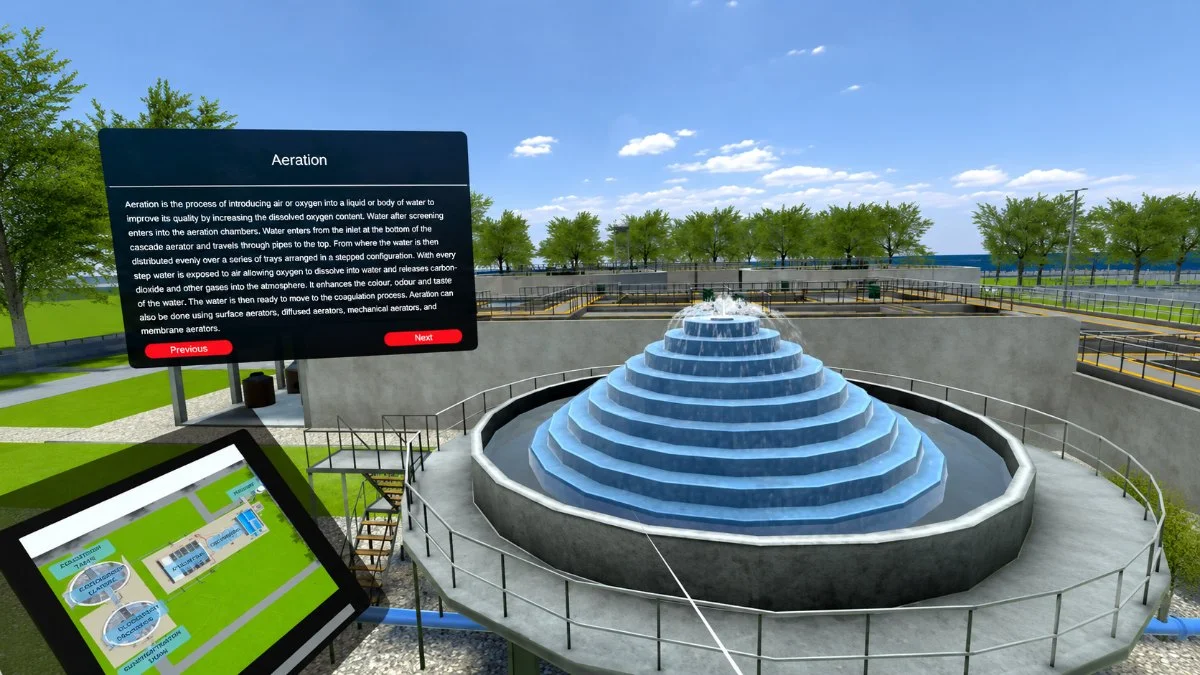
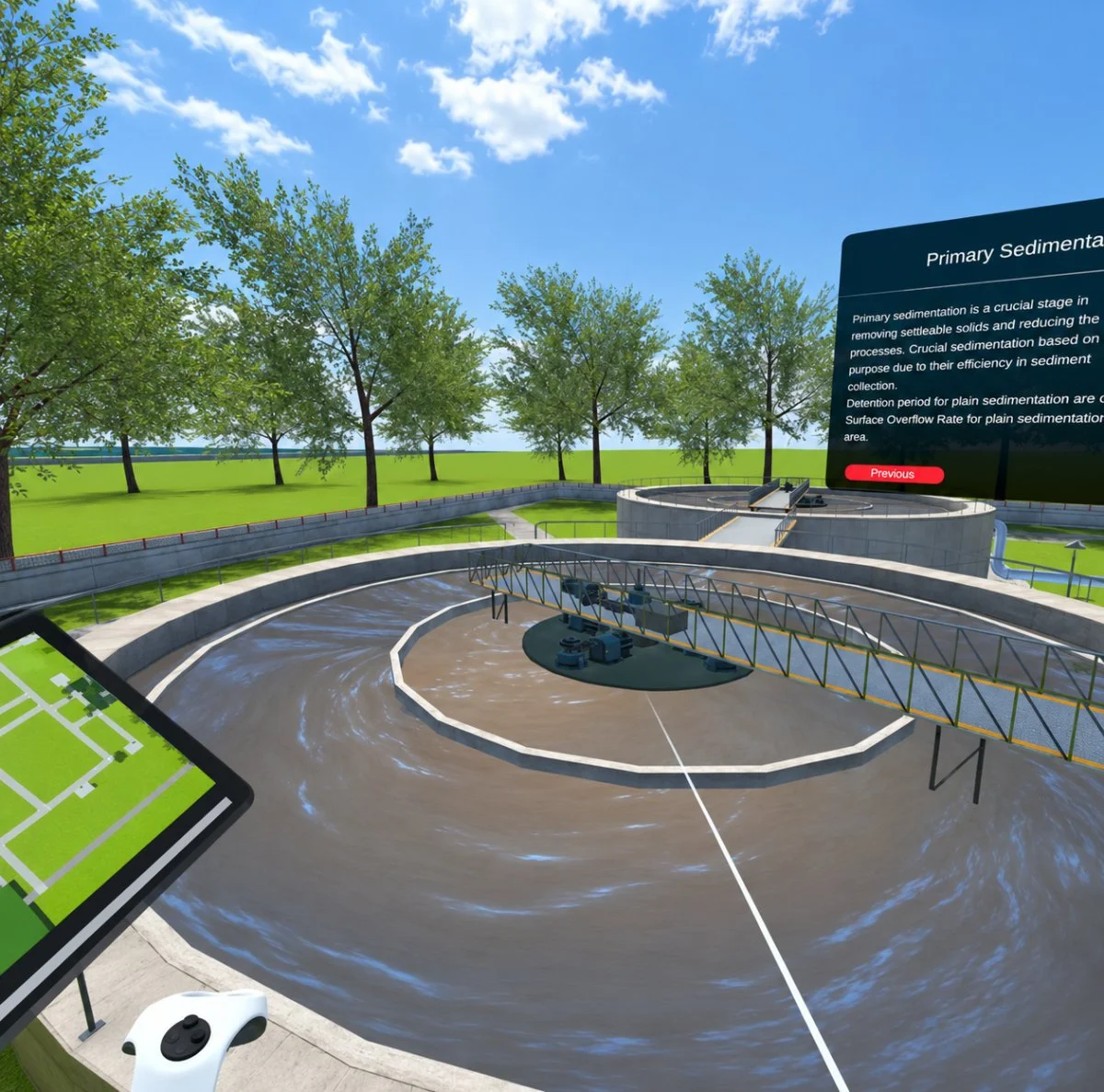
Follow raw water becoming safe drinking water in VR - through intake, cascade aeration, clarification and sedimentation, chemical purification, and UV disinfection. Guided and Self-Explore modes.
See it
Inside the module.
Learning objectives
By the end of this module, students will be able to:
Understand the overall process of drinking-water treatment
Identify the key units - intake structures, aerators, clarifiers, sedimentation tanks, chemical dosing, and UV units
Explain how raw water is treated by aeration, chemical purification, settling, clarification, and disinfection
Understand how cascade aerators raise dissolved oxygen and remove undesirable gases
Visualise how suspended particles settle in sedimentation and clarification tanks
Understand how UV disinfection reduces microbial contamination in treated water
About the module
From raw water to safe supply.
A drinking-water treatment plant removes suspended solids, impurities, harmful microorganisms, and undesirable chemistry from raw water before it reaches the public. The process typically runs through intake, aeration, chemical treatment, clarification, sedimentation, disinfection, and treated-water handling.
This module is a structured virtual industrial visit rather than a simulation experiment. In Guided Tour Mode, learners are taken stage by stage with explanations of each treatment step. In Self-Explore Mode, they move through the plant at their own pace, observing the equipment, process flow, water movement, and layout.
The tour covers the intake where raw water enters, cascade aerators where water meets air, clarification and sedimentation tanks where heavier particles settle, chemical dosing and treatment, and UV disinfection in the final purification stage - connecting classroom theory to real municipal water infrastructure. The 7thi AI tutor and built-in assessment support the visit.
AICTE / NEP 2020
Aligns with Civil, Environmental, Water Supply, and Public Health Engineering outcomes, supporting experiential, visualization-led, and infrastructure-focused learning.
ABET (United States)
Supports Student Outcome 1 through engineering knowledge of water-treatment systems and public infrastructure, and Student Outcome 7 through applied learning via immersive industrial exposure.
NBA (India)
Maps to Course Outcomes in Environmental and Water Supply Engineering, supporting POs around engineering knowledge, environment and sustainability, society, and modern tool usage.
University syllabi
Maps to unit topics, industrial-visit requirements, course outcomes, and assessment rubrics. Request a custom mapping.
Get this module
Included in these iXRLabs packages.
Civil Engineering
CoreCivil VR modules - structures, construction, surveying, geotechnics, and materials.
Complete Engineering
All disciplinesThe full engineering library - 240+ modules across mechanical, civil, and electrical, including Water Treatment Plant.
Custom rollout
QuotePick specific modules, devices, and seat counts. We'll scope a deployment for your department.
7thi and assessment in this module
7thi in this module
Students can ask 7thi questions at any point - about the treatment stages and equipment or anything they see in the tour. 7thi answers in context, without breaking the flow.
Assessment
Session data - concepts mastered, time per scene, assessment scores - appears on the faculty dashboard. Export to your LMS via xAPI.
Keep exploring
Related engineering modules.
Is this a simulation or a tour?
It is a virtual industrial visit - a structured, explorable tour of a realistic plant rather than a calculation-based experiment. It lets students see infrastructure that is often difficult to access in person.
Which treatment stages are covered?
Intake, cascade aeration, clarification and sedimentation, chemical purification, and UV disinfection, ending with treated-water handling.
What's the difference between Guided and Self-Explore modes?
Guided Tour Mode walks learners through each stage with structured explanations. Self-Explore Mode lets them move through the plant freely and observe the equipment and process flow at their own pace.
What prior knowledge do students need?
Foundation-level civil or environmental engineering. Suitable for undergraduate Year 2 and above, and for diploma/polytechnic programmes.
Which headsets is this module optimised for?
HTC, Meta Quest 2 / 3 / Pro, ClassVR, and any WebXR-compatible browser. It also runs in desktop browsers without a headset.
Tour a water treatment plant in a demo.
Thirty minutes, the full module, your curriculum questions answered.