iXRLabs

Grants for VR labs

Fund your VR lab with grants your college can use.

Colleges and universities pay for VR labs with education, workforce and research grants. Here are 56 programmes across 9 regions, with who can apply, typical amounts, timing and how a VR lab fits each one. Our team helps with quotes, proposal sections and partnership letters.

Reviewed 56 programmes9 regions

A researcher in a VR headset and lab coat working through an immersive botany experiment in a university plant-science lab
28programmes with
funds flowing now

All grants, by region

Grants for VR labs, by region.

Each programme lists who can apply, typical amounts and timing, and how a VR lab fits what the funder pays for. Links go to the official programme page or the best public source.

Grants for VR labs in the USA.

Lead with money colleges already hold (Perkins V, Title III, state workforce funds), then plan competitive federal bids for 2027.

11 programmesAll regions

Funds flowing now: Annual allocation

Perkins V career and technical education funds

U.S. Department of Education, through your state CTE agency

Who can apply
Community and technical colleges with CTE programmes
Size and timing
About $1.4B a year nationally; colleges typically receive $100K–$2M a year. 2027–28 local plans are usually written March–June 2027

How a VR lab fits

Equipment, software and simulated work environments are allowable when tied to your local needs assessment (CLNA).

Next round coming: Next round around mid-2027

Strengthening Institutions Program (Title III)

U.S. Department of Education

Who can apply
Under-resourced two- and four-year institutions, including HBCUs and tribal colleges
Size and timing
Up to $3M (individual) or $5M (cooperative) over 5 years; about 330 new grants made in 2026

How a VR lab fits

Allowable uses explicitly include laboratory equipment and educational materials.

Funds flowing now: 2026 grantees spending now

HRSA Nurse Education, Practice, Quality and Retention – Transition to Practice (NEPQR-TPP)

Health Resources and Services Administration

Who can apply
Schools of nursing and healthcare facilities serving rural and medically underserved communities
Size and timing
Up to $750K a year for 4 years; 2026 awards run Sep 2026–Aug 2030

How a VR lab fits

One programme objective is buying simulation-based technology to expand experiential learning; anatomy, physiology and nursing-skills modules fit directly.

Next round coming: Next deadline 7 Oct 2027

NSF Advanced Technological Education (ATE)

National Science Foundation

Who can apply
Two-year colleges lead; technology partners can be named collaborators
Size and timing
Up to $475K for colleges new to ATE, up to $1M otherwise

How a VR lab fits

Technician education in engineering, manufacturing, energy and biotech; VR labs fit curriculum and lab-access projects.

Next round coming: FY2026 closed; watch for 2027

USDA Distance Learning and Telemedicine (DLT)

U.S. Department of Agriculture, Rural Utilities Service

Who can apply
Colleges and other organisations delivering distance learning to rural sites
Size and timing
$50K–$750K per grant with a 15% minimum match; about $27M in the FY2026 round

How a VR lab fits

Eligible costs include computer hardware, software licences and instructional programming for distance learning.

Funds flowing now: 2026–27 plans due 30 Oct 2026

California Strong Workforce Program

California Community Colleges Chancellor’s Office

Who can apply
California community colleges
Size and timing
$218.9M statewide for 2026–27, with a 24-month spending window

How a VR lab fits

CTE equipment; bundling licences with headsets helps them count as equipment.

Next round coming: Next windows mid-2027

Rural and regional programmes: FIPSE RPED, ARC POWER, Delta Regional Authority

U.S. Department of Education, Appalachian Regional Commission, Delta Regional Authority

Who can apply
Rural, Appalachian and Delta-region colleges
Size and timing
$50K–$2.5M depending on programme

How a VR lab fits

Browser and headset labs suit rural and distance learners with limited physical lab access.

Check with the funder: Annual cycle; check the current window

Meta Data Center Community Action Grants

Meta

Who can apply
Public schools and registered nonprofits (including college foundations) in communities with a Meta data centre, in the US and Europe
Size and timing
Varies by site; funds are used within a year of award

How a VR lab fits

Funds STEAM education and technology projects; recent grantees include university AI and immersive-learning programmes.

Grants for VR labs in Canada.

Canadian colleges, CEGEPs and polytechnics can fund lab equipment through the tri-agency College and Community Innovation programme.

2 programmesAll regions

Check with the funder: Check NSERC for the next competition

Applied Research Tools and Instruments (ARTI) grants

NSERC, with CIHR and SSHRC

Who can apply
Eligible Canadian colleges, CEGEPs and polytechnics
Size and timing
One-year equipment grants; 34 awards worth $6.32M were announced in 2025

How a VR lab fits

Equipment that strengthens applied research with local industry and gives students hands-on training.

Check with the funder: Periodic competitions

Technology Access Centre (TAC) grants

NSERC College and Community Innovation programme

Who can apply
Colleges establishing specialised applied research centres
Size and timing
17 awards worth $23.5M over five years in the 2025 round

How a VR lab fits

Centres in manufacturing, health or energy can include VR training and visualisation for partners and students.

Grants for VR labs in the UK and Ireland.

Capital funds for teaching equipment are live in England, Wales and Ireland. Many have just been awarded, so winners are buying now.

6 programmesAll regions

Funds flowing now: Winners published Dec 2026

OfS capital funding competition 2026–27 (England)

Office for Students

Who can apply
OfS-registered higher and further education providers
Size and timing
£76.75M competition; bids of £150K–£2M. Funding from Nov 2026

How a VR lab fits

Capital covers teaching equipment including IT; priority sectors include advanced manufacturing, digital and health.

Check with the funder: Check DfE for the next round

Local Skills Improvement Fund (England)

Department for Education

Who can apply
Collaborations of FE providers responding to their Local Skills Improvement Plan; individual colleges cannot apply alone
Size and timing
Capital and revenue funding per area

How a VR lab fits

Equipment and facilities for priority skills such as automation, digital and net zero.

Next round coming: Contracts from May 2027

NHS Supply Chain simulation framework

NHS Supply Chain

Who can apply
NHS trusts and universities buying through the framework
Size and timing
£210M framework with an immersive technology lot; contracts from May 2027

How a VR lab fits

A procurement route for health and nursing simulation content.

Open for applications: Plans due 10 Feb 2027

Medr digital capital for FE (Wales)

Medr

Who can apply
Directly funded Welsh FE colleges
Size and timing
£3M ringfenced for 2026–27; first half paid around Dec 2026

How a VR lab fits

Colleges must submit a three-year digital investment plan; VR labs belong in those plans.

Funds flowing now: 2026 allocations

SOLAS / ETB devolved capital (Ireland)

Department of Further and Higher Education, Research, Innovation and Science

Who can apply
Ireland’s 16 Education and Training Boards
Size and timing
€39M+, including €12M devolved capital for ICT equipment and €7M for specialist equipment

How a VR lab fits

ETB equipment budgets can cover VR labs for MedTech, engineering and apprenticeship programmes.

Grants for VR labs in Europe.

EU programmes favour consortia. iXRLabs can join as the XR content and technology partner in bids being drafted now.

7 programmesAll regions

Next round coming: 2027 call expected

Erasmus+ KA2: Cooperation Partnerships, Centres of Vocational Excellence, Alliances for Innovation

European Commission (EACEA and National Agencies)

Who can apply
Consortia of universities, VET providers and companies. The UK rejoins Erasmus+ from 2027
Size and timing
2026 deadlines have passed; the 2027 call and Programme Guide are expected shortly

How a VR lab fits

Name iXR Labs as the XR content and technology partner in KA220-VET/HED and CoVE bids.

Open for applications: Open: due 13 Jan 2027

EIT Higher Education Initiative

European Institute of Innovation and Technology

Who can apply
Consortia of 3+ HEIs in 3 countries plus 2+ industry partners
Size and timing
€40M call; up to €1.25M per project over 18 months

How a VR lab fits

Join as an industry partner on teaching-innovation and deep-tech skills projects.

Funds flowing now: National calls to 2027

European Social Fund Plus (ESF+)

European Commission and national managing authorities

Who can apply
VET and higher education providers through national and regional calls
Size and timing
€142.7B for 2021–27; calls run until the end of the budget period

How a VR lab fits

Regional upskilling and XR adoption projects, such as Finland’s ESF-funded XR work at Savonia.

Funds flowing now: Started Sep 2026

DigitalPakt Schule 2.0 (Germany)

Federal ministry, delivered by the Länder

Who can apply
General and vocational schools (Berufsschulen); not universities
Size and timing
€5B over 5 years from 1 Sep 2026

How a VR lab fits

Covers digital learning platforms and equipment for vocational schools.

Check with the funder: Phase 2 pending

Npuls (Netherlands)

Nationaal Groeifonds

Who can apply
All 113 MBO, HBO and WO institutions
Size and timing
€560M programme; phase 2 recommended at €244.7M

How a VR lab fits

Partner with Npuls teaching and learning centres on digital learning.

Grants for VR labs in India.

Most central schemes are already sanctioned. 2026–27 is the spend-down year, so add VR labs as a line item in approved project plans.

6 programmesAll regions

Funds flowing now: 2026–27 spend-down

PM-USHA (Pradhan Mantri Uchchatar Shiksha Abhiyan)

Ministry of Education

Who can apply
State public universities and colleges
Size and timing
MERU ₹100 cr per university, GSU ₹20 cr, GSC about ₹5 cr per college; 60:40 Centre–State share (90:10 in NE and hill states)

How a VR lab fits

Grants include equipment and soft components, and colleges were asked to focus GSC funds on labs and equipment.

Funds flowing now: Institutions selected Aug 2026

MERITE (Multidisciplinary Education and Research Improvement in Technical Education)

Ministry of Education with the World Bank

Who can apply
275 government and aided technical institutions (175 engineering colleges and 100 polytechnics)
Size and timing
₹4,200 cr for 2025–26 to 2029–30; up to about ₹18 cr per institution, performance-linked

How a VR lab fits

Named components include skill and maker labs, digitalisation and blended courses.

Check with the funder: Check AICTE for the annual call

AICTE MODROBS (Modernisation and Removal of Obsolescence)

AICTE

Who can apply
AICTE-approved institutions and polytechnics meeting age, admission and NBA criteria
Size and timing
Reported up to ₹30 lakh per proposal, up to 3 proposals per institution; complete within 2 years

How a VR lab fits

Department-level lab modernisation for mechanical, electrical, civil and other labs.

Check with the funder: Check AICTE for the annual call

AICTE IDEA Lab

AICTE

Who can apply
AICTE-approved institutions
Size and timing
Set by AICTE per call

How a VR lab fits

Hands-on STEM and product visualisation labs where 3D and VR content fits naturally.

Funds flowing now: Cluster approvals ongoing

PM-SETU (ITI upgradation)

Ministry of Skill Development and Entrepreneurship

Who can apply
1,000 government ITIs in hub-and-spoke clusters, run through industry-led SPVs
Size and timing
₹60,000 cr over 5 years; ₹6,140.5 cr allocated for 2026–27

How a VR lab fits

Trade simulations for mechanical and electrical trades, bought through the cluster’s anchor industry partner.

Check with the funder: Check DST for the current call

DST-FIST

Department of Science and Technology

Who can apply
University departments and colleges with PG science and technology departments
Size and timing
Covers lab renovation, equipment and networking

How a VR lab fits

Science department labs where VR complements research instruments.

Grants for VR labs in the Middle East.

In the Gulf, most money flows through national budgets, training subsidies and research councils rather than open grant calls.

6 programmesAll regions

Funds flowing now: Ongoing

HRDF (Hadaf) training support, Saudi Arabia

Human Resources Development Fund

Who can apply
Private employers training Saudi nationals at listed partner institutes, plus Doroob e-training
Size and timing
HRDF pays 75% of training cost (up to SAR 3,000 per trainee per month, for up to 24 months)

How a VR lab fits

Employers can claim support for training delivered with VR labs at partner institutes.

Next round coming: 2027 budget due ~Dec 2026

Saudi university and TVTC budgets

Ministry of Finance and Ministry of Education

Who can apply
Public universities, TVTC technical colleges and Strategic Partnership Institutes
Size and timing
SAR 202bn for education in 2026; the 2027 budget is expected around early Dec 2026

How a VR lab fits

Add VR labs to university and college line items for engineering, health and technician programmes.

Funds flowing now: 2026 budget

Oman higher education budget

Ministry of Higher Education, Research and Innovation

Who can apply
Sultan Qaboos University, UTAS and private HEIs
Size and timing
Education receives 40% of the OMR 5.2bn social allocation in 2026; SQU and UTAS named for upgrades

How a VR lab fits

Engineering and health lab upgrades.

Check with the funder: Check QRDI for the current cycle

QRDI Council programmes, Qatar

Qatar Research, Development and Innovation Council

Who can apply
Qatari research institutions and universities
Size and timing
Set per programme

How a VR lab fits

Research collaborations on VR learning efficacy.

Grants for VR labs in Africa.

National infrastructure grants and development-bank projects are the main routes. Several name digital learning and lab equipment explicitly.

8 programmesAll regions

Funds flowing now: 2026 cycle

TETFund interventions (Nigeria)

Tertiary Education Trust Fund

Who can apply
Public universities, polytechnics and colleges of education
Size and timing
2026 cycle: ₦2.53bn per university, ₦1.87bn per polytechnic, ₦2.06bn per college of education, with a new ICT line

How a VR lab fits

ICT and equipment lines, and engineering workshop upgrades.

Funds flowing now: Tenders expected

Kenya TVET digitisation (Team Europe)

KfW, AFD and the European Union

Who can apply
Kenyan TVET institutions, including 10 digital centres of excellence
Size and timing
€46.85M, signed Dec 2025

How a VR lab fits

Explicitly funds modern digital tools and digital learning services; expect international tenders.

Funds flowing now: 2026 formula approved

GETFund (Ghana)

Ghana Education Trust Fund

Who can apply
Public tertiary institutions
Size and timing
GH¢9.8bn total in 2026, of which GH¢1.5bn for tertiary

How a VR lab fits

Include VR labs as a lab-capacity line inside your institution’s GETFund request.

Grants for VR labs in the Philippines.

CHED innovation grants and SUC capital budgets are the most direct routes; new TESDA innovation centres need fit-out in 2026–27.

6 programmesAll regions

Check with the funder: Calls run ~2 years ahead

DOST-PCIEERD Grants-in-Aid

Department of Science and Technology

Who can apply
Public and private HEIs and research institutes
Size and timing
Equipment allowed when integral to an R&D project

How a VR lab fits

XR in engineering education or digital-twin research.

Check with the funder: Long-lead

DOST-PCHRD health R&D

Department of Science and Technology

Who can apply
HEIs and research hospitals
Size and timing
Concepts submitted in 2026 for 2028 funding

How a VR lab fits

Nursing simulation efficacy studies with a partner college.

Funds flowing now: Rolling out 2026

TESDA scholarships, including TWSP

TESDA

Who can apply
TESDA-accredited TVET providers
Size and timing
About ₱19B in scholarships rolling out in 2026

How a VR lab fits

Scholarship fees pay training costs, so providers can license browser labs per trainee.

Grants for VR labs in Australia.

TAFE Centres of Excellence and state TAFE equipment budgets are the clearest buying routes; several budget explicitly for virtual training.

4 programmesAll regions

Funds flowing now: Centres launching 2026

TAFE Centres of Excellence

Department of Employment and Workplace Relations, with the states

Who can apply
Public TAFEs and dual-sector universities named as hosts
Size and timing
Up to $324M Commonwealth over five years, matched by the states; centres still being announced in 2026

How a VR lab fits

Some centres budget explicitly for virtual reality and simulated training.

Funds flowing now: Projects in planning

TAFE Technology Fund

Department of Employment and Workplace Relations

Who can apply
Public TAFEs, through state governments
Size and timing
$50M in total; newer projects in planning

How a VR lab fits

Eligible uses include specialist training equipment and technological infrastructure.

Funds flowing now: 2026–27 budgets

State TAFE capital and equipment budgets

NSW, Queensland and WA governments

Who can apply
TAFE NSW, TAFE Queensland and WA TAFE colleges
Size and timing
NSW 2026–27: $233.2M for classroom technology and devices; QLD: $68.9M for four new TAFE centres; WA: $33.9M modern equipment programme

How a VR lab fits

Classroom technology and equipment lines are the most direct budgets; time proposals to budget cycles.

Funds flowing now: Ongoing

Clean energy workforce: New Energy Apprenticeships and the WA Clean Energy Skills CoE

DEWR and the WA Government

Who can apply
Apprentices and employers; TAFE WA
Size and timing
Up to $10,000 per apprentice; the WA centre has $70.5M over five years

How a VR lab fits

More apprentices means more electrical and renewables training; sell simulations to the TAFEs delivering it.

Amounts, eligibility and deadlines change every year. We reviewed these programmes in ; always confirm details on the funder’s official page before you apply. iXRLabs does not award grants.

56

grant programmes

9

regions covered

28

with funds flowing now

3

open for applications

How we help

How iXRLabs helps you win funding.

Your institution stays the applicant. We handle the parts of the proposal that relate to the VR lab, so your grants office can focus on the rest.

  1. Find the right grant.

    Tell us your programmes, location and timeline. We shortlist grants you qualify for and flag deadlines, match requirements and spending windows.

  2. Build a grant-ready budget.

    Get an itemised quote for headsets, curriculum-mapped modules, multi-year licences and faculty training, split into the cost categories your funder uses.

  3. Strengthen the proposal.

    We map modules to your syllabus and accreditation framework, draft technical and outcome sections, and provide letters of support or partnership.

  4. Deliver and report.

    Once funded, we deploy the lab, train faculty and provide usage and learning analytics you can use in grant reports.

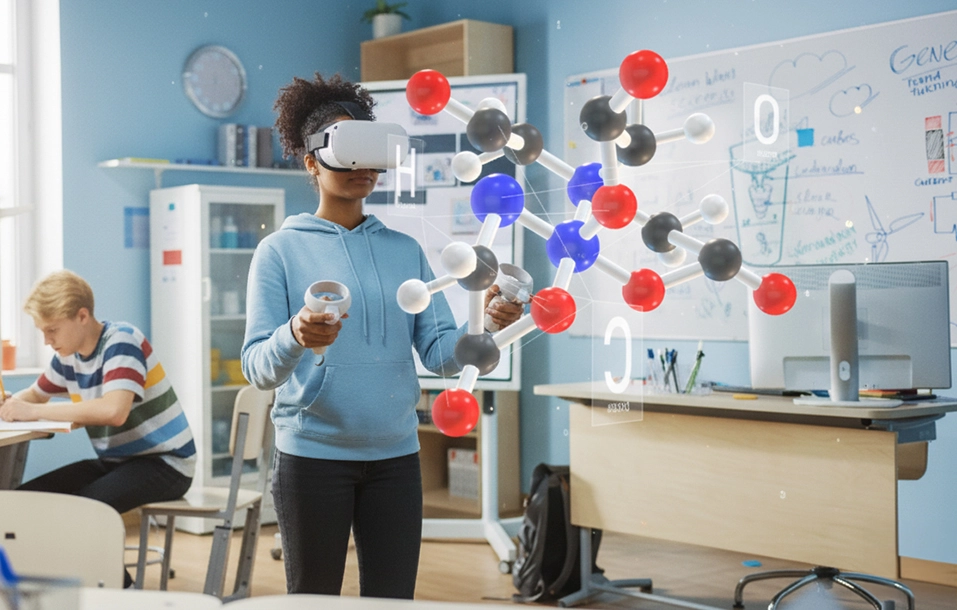
A student in a VR headset handling a 3D molecular model during a virtual chemistry experiment in a classroom

Allowable costs

What grants can pay for.

  • Virtual lab setup

    VR headsets, charging and storage, and a complete lab for a full class or department.

  • Curriculum-mapped modules

    500+ VR and AI modules across engineering, medical, sciences and nursing, mapped to your syllabus.

  • AI tutor and analytics

    The 7thi AI tutor guides students through experiments, with analytics that show engagement and outcomes.

  • Multi-year licences

    Licences that cover the full grant period, so the lab keeps running after the first year.

  • Faculty training

    Onboarding and training so instructors can build VR sessions into their courses from day one.

  • Browser and desktop access

    Hybrid access for distance and rural learners, where a grant targets remote or blended delivery.

Application guide

How to apply for a VR lab grant.

Every funder has its own forms, but strong applications for lab technology follow the same path.

  1. Confirm eligibility and timing.

    Read the funder’s guidance for who can apply, allowable costs, match requirements, submission limits and the spending window. Talk to your grants or research office early.

  2. Start from a documented need.

    Describe the gap the lab closes: limited lab seats, costly or hazardous equipment, clinical placement pressure, or outdated workshops. Link it to your institutional plan, needs assessment or accreditation requirements.

  3. Define measurable outcomes.

    Set targets funders can track, such as students served, lab hours added, pass rates, skills assessments or certifications earned.

  4. Budget the whole programme.

    Include hardware, multi-year licences, content, setup and faculty training, backed by an itemised quote. Follow the funder’s rules on equipment versus software costs.

  5. Plan procurement and partners.

    Check whether the funder requires competitive quotes or a sole-source justification. Collect letters of support from technology, industry or academic partners.

  6. Show sustainability and submit.

    Explain how the lab keeps running after the grant ends, then submit through the funder’s portal and plan for progress reporting.

Common questions

What grants offices ask first.

Answers for colleges and universities funding a VR lab. For procurement and budget questions, our team is one call away.

Talk to us

Can colleges use grant funding to set up a VR lab?

Yes. Many education, workforce and research grants allow spending on lab equipment, instructional software, simulation and training. Examples include Perkins V in the US, PM-USHA and MERITE in India, the OfS capital competition in England and TAFE Centres of Excellence in Australia. What matters is that the VR lab clearly serves the grant’s stated purpose, such as workforce training, lab access or digital learning.

Which countries and regions does this grants list cover?

The list covers 56 grant programmes in 9 regions: the USA, Canada, the UK and Ireland, Europe, India, the Middle East, Africa, the Philippines and Australia. Each entry shows who can apply, typical amounts and timing, how a VR lab fits the funder’s rules, and a link to the official programme page.

Which grants are the best fit for a VR lab?

The strongest fits are programmes that name equipment, simulation or digital learning as allowable costs and that you can draw on soon: formula funds your institution already receives (Perkins V, PM-USHA, TETFund), capital and equipment funds (OfS, Medr, TAFE budgets, TVET CIEG) and nursing simulation programmes (HRSA NEPQR). Competitive research grants such as NSF ATE or Erasmus+ take longer but can fund larger, multi-year projects.

Does VR software count as equipment in a grant budget?

It depends on the funder. Many grants treat an item as equipment only above a unit-cost threshold (in the US, often $5,000–$10,000 per unit), so annual licences usually sit under supplies, software or contractual costs. A perpetual licence bundled with headsets can sometimes be booked as equipment. Check your funder’s cost rules, and we will split the quote to match them.

Can we name iXRLabs in our application, or do we need competitive quotes?

Most public grants require you to follow your institution’s and the funder’s procurement rules. Some, like USDA DLT, do not allow a predetermined vendor without a sole-source justification. We can supply detailed specifications, comparison information and, where it applies, documentation to support a sole-source or single-source justification.

Can iXRLabs be a partner on a consortium bid?

Yes. For programmes such as Erasmus+, the EIT HEI Initiative, NSF ATE and Digital Europe, iXRLabs can join as the XR content and technology partner, provide a letter of support or commitment, and describe our role in the work plan.

What does iXRLabs provide to support an application?

We help you shortlist suitable grants, provide an itemised, grant-ready quote, map our modules to your syllabus and accreditation framework (for example AICTE, NBA, ABET or nursing standards), draft technical and outcome sections, supply letters of support, and plan the deployment and faculty training timeline that funders ask to see.

Does iXRLabs write or submit the grant for us?

Your institution remains the applicant and submits the proposal. We work alongside your grants office or project lead and supply the sections and documents that relate to the VR lab, so your team can focus on the institutional parts of the bid.

How early should we start?

Start at least 8–12 weeks before a deadline for most national or state grants, and 3–6 months ahead for federal, EU or development-bank programmes that need partners, letters and match funding. For formula funds and capital budgets, start before your annual plan or budget is finalised.

We already have grant funding. Can we still use it for iXRLabs?

Often, yes. If your current grant allows equipment, software or curriculum materials and the VR lab fits the approved project, you may be able to add it as a budget line or a revision. Check with your programme officer; we can provide the quote and a short justification.

Does iXRLabs provide grant funding?

No. iXRLabs does not award grants. We help institutions find funding and prepare the parts of an application that relate to their VR lab.

How current is this list?

We reviewed these programmes in October 2026. Amounts, eligibility and deadlines change every year, so always confirm details on the funder’s official page before you apply.


Planning a grant application for a VR lab?

We’ll help you pick the right grant and prepare a quote and proposal sections that fit it. Tell us your programmes and timeline.