
VR Module · Chemistry · Sciences
Thin Layer Chromatography - VR experiment module.
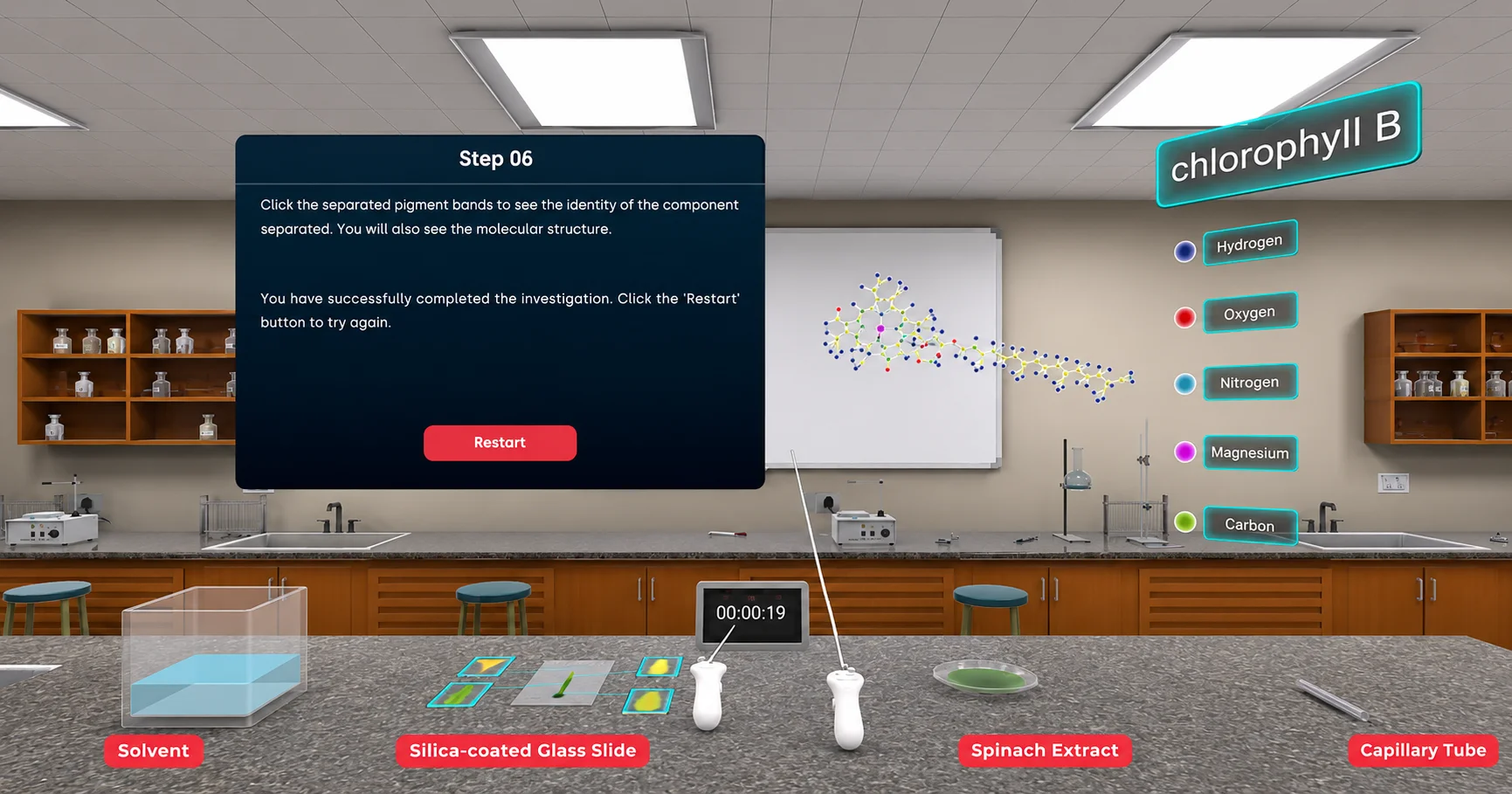
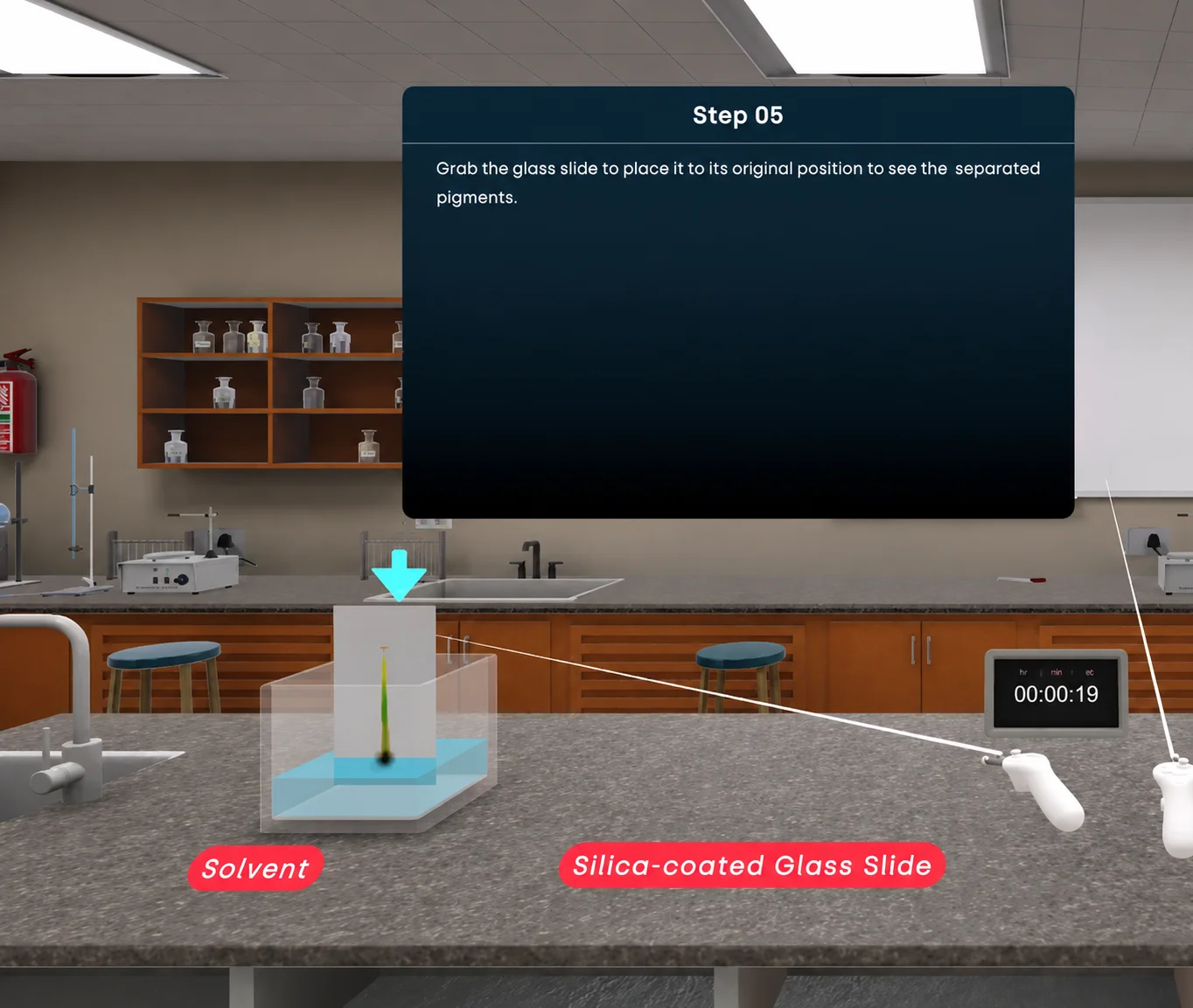
Separate and identify organic compounds with TLC in a virtual lab - prepare the plate, spot the sample, develop it in the solvent chamber, watch the components separate, and calculate the Rf value.
See it
Inside the module.
Learning objectives
By the end of this module, students will be able to:
Understand the principle of thin layer chromatography
Identify the role of the stationary phase, mobile phase, TLC plate, solvent chamber, capillary tube, and sample spot
Perform sample spotting and solvent development in a virtual lab setup
Observe separation of components based on polarity, adsorption, and solubility
Understand the solvent front, baseline, compound spots, and visualisation methods
Calculate and interpret the Rf value for organic compounds
Relate TLC to compound identification, reaction monitoring, and purity testing
About the module
A complete TLC workflow, in a virtual chemistry lab.
Thin layer chromatography is a widely used analytical technique for separating and identifying compounds in a mixture. It works on the differential movement of compounds between a stationary phase - usually silica gel or alumina - and a mobile phase, usually an organic solvent or solvent mixture.
In this iXRLabs VR experiment module, students perform the TLC workflow step by step. They prepare the TLC plate, mark the baseline, apply the sample with a capillary tube, place the plate inside the developing chamber, observe solvent movement, and identify the separated compound spots after development.
The module explains core organic chemistry concepts such as adsorption, polarity, solvent front, retention factor, mobile phase selection, and stationary phase interaction, and helps learners avoid common errors - overspotting, incorrect solvent level, a disturbed baseline, improper chamber saturation, and inaccurate Rf measurement. It works well as a pre-lab activity, a virtual lab, or an assessment. The 7thi AI tutor and built-in assessment run throughout.
UGC / NEP 2020 (India)
Supports experiential, digital, skill-based, and practical chemistry learning across science and laboratory education.
NAAC / OBE
Supports ICT-enabled teaching, virtual lab exposure, practical learning outcomes, and student engagement in laboratory-based courses.
University syllabi
Maps to B.Sc. Chemistry, Organic Chemistry, Analytical Chemistry, Pharmaceutical Chemistry, and Life Sciences practical syllabi. Request a custom mapping.
TVET / Lab technician training
Supports chromatography familiarisation, lab procedure awareness, sample preparation, observation skills, and analytical testing workflows.
Get this module
Included in these iXRLabs packages.
Sciences
CoreChemistry, physics, and biology VR modules - titration, chromatography, separation techniques, and analytical methods.
Complete Sciences
All streamsThe full sciences library across chemistry, physics, biology, and zoology, including Thin Layer Chromatography.
Custom rollout
QuotePick specific modules, devices, and seat counts. We'll scope a deployment for your department.
7thi and assessment in this module
7thi in this module
Students can ask 7thi about polarity, Rf value, solvent selection, or anything they see in the experiment. 7thi answers in context, without breaking the flow.
Assessment
Session data - concepts mastered, time per scene, assessment scores - appears on the faculty dashboard. Export to your LMS via xAPI.
Keep exploring
Related science modules.
Does the module calculate the Rf value?
Yes. Students measure the distance travelled by each component and the solvent front, and the module helps them compute and interpret the retention factor (Rf) for each separated compound.
What prior knowledge do students need?
Foundation-level organic chemistry. Suitable for undergraduate Year 1 and above, and for diploma / polytechnic chemical science courses.
How long is a typical session?
About 15 minutes for a full run including assessment. Students can pause, resume, and repeat the development as often as they like.
Which common errors does it cover?
Overspotting, incorrect solvent level, a disturbed baseline, improper chamber saturation, and inaccurate Rf measurement - so students learn good technique safely.
Which headsets is this module optimised for?
HTC, Meta Quest 2 / 3 / Pro, ClassVR, and any WebXR-compatible browser. It also runs in desktop browsers without a headset.
See Thin Layer Chromatography in a demo.
Thirty minutes, the full module, your curriculum questions answered.