
VR Module · Electrical · Engineering
Swinburne's Test on DC Shunt Motor - VR module.
Run Swinburne's no-load test on a DC shunt motor in VR - connect the setup, record voltage and current, separate constant from variable losses, and estimate efficiency at any load without loading the machine.
See it
Inside the module.
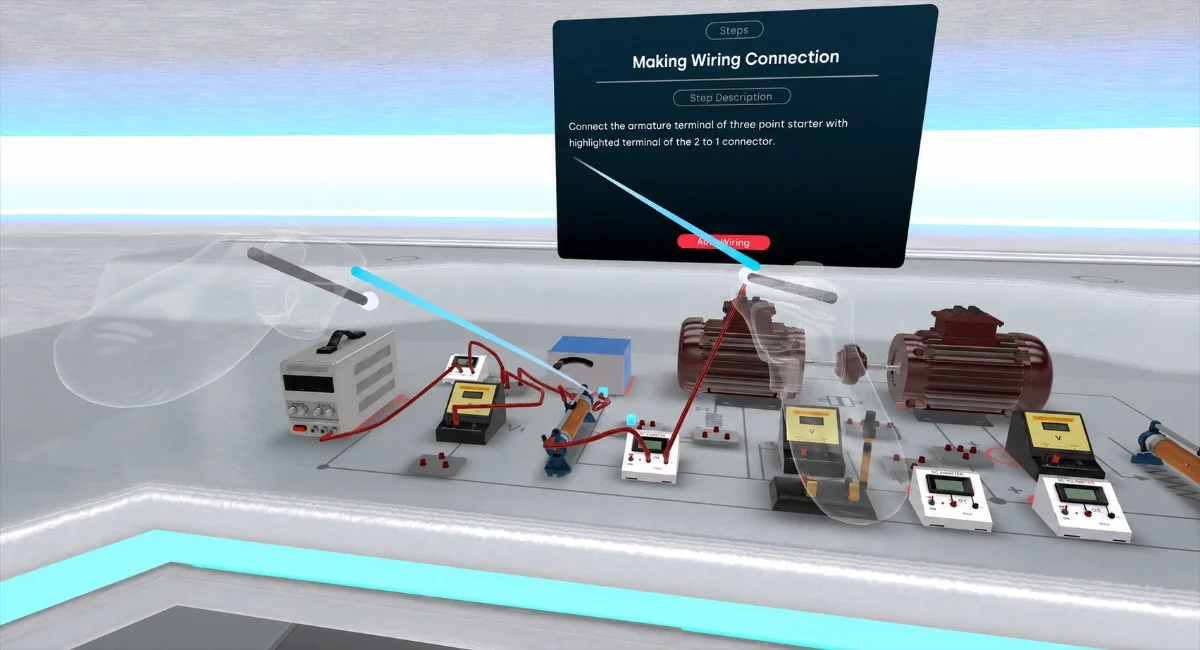
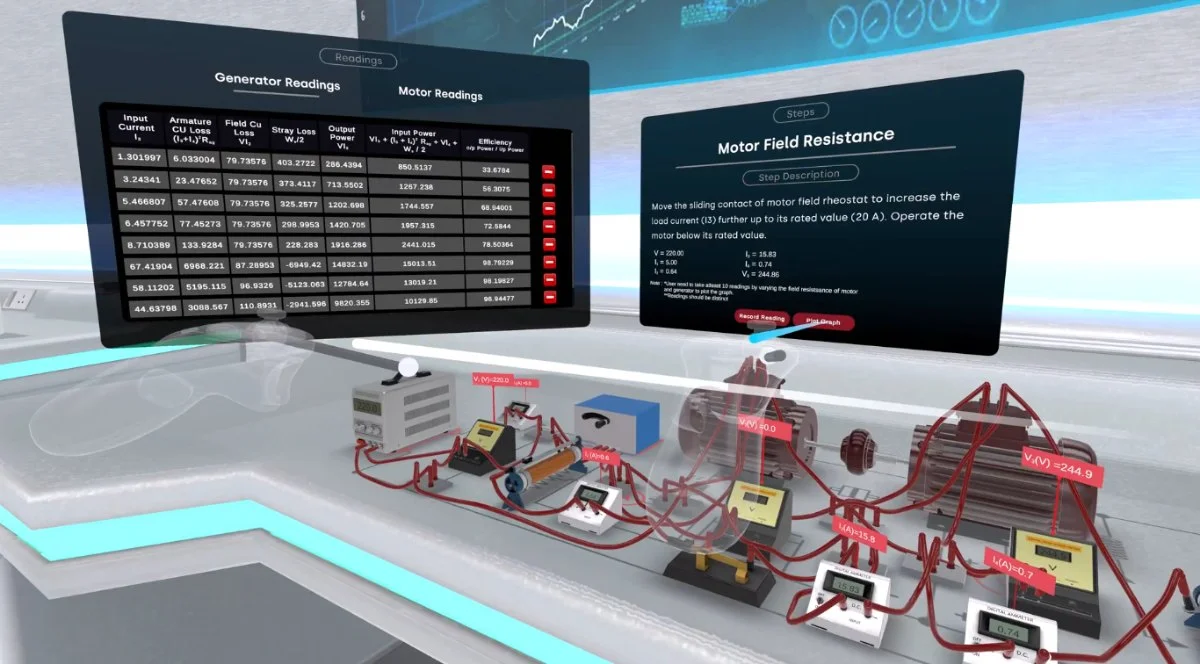
Learning objectives
By the end of this module, students will be able to:
Understand the purpose of Swinburne's Test on a DC shunt motor
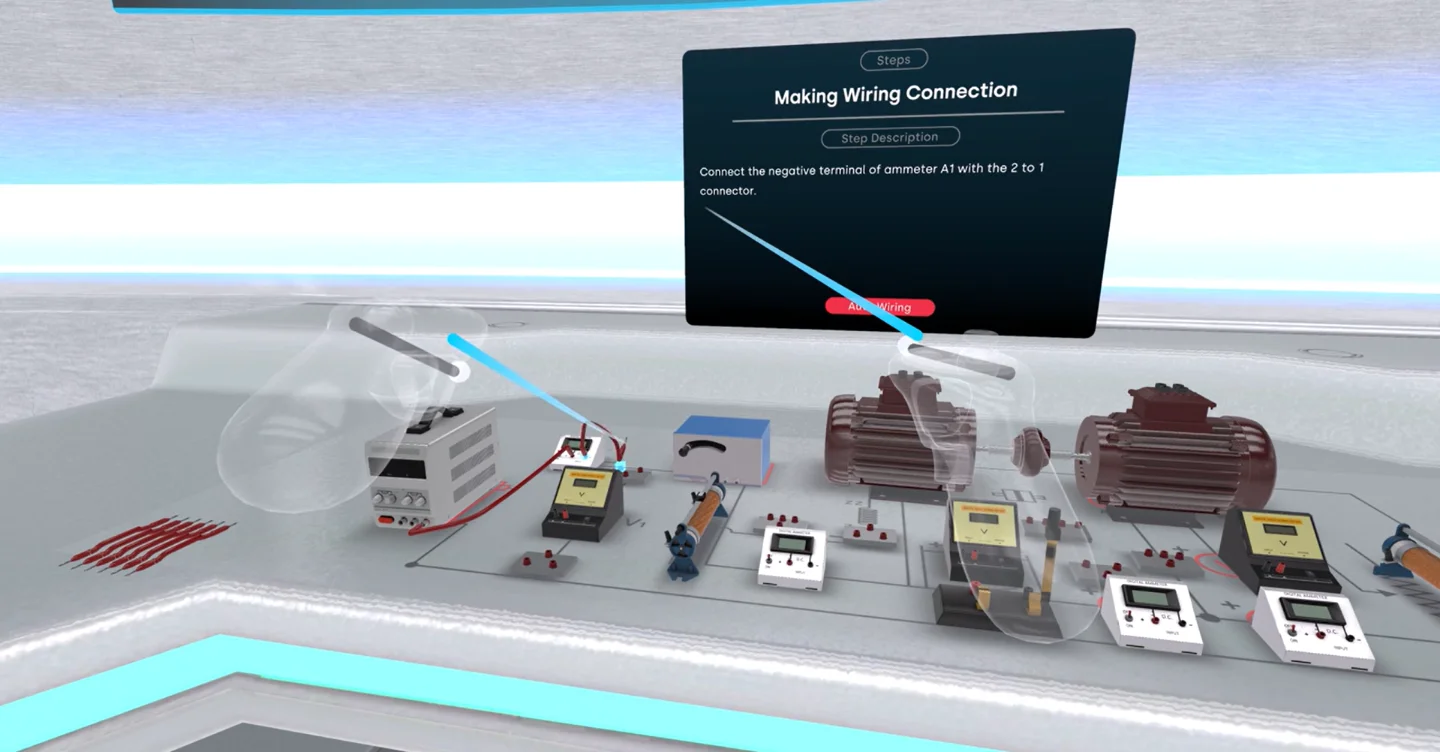
Identify the test setup - motor, starter, ammeter, voltmeter, field rheostat, and armature and shunt-field circuits
Perform the no-load test procedure in a virtual electrical machines lab
Measure no-load input power and separate constant losses from variable losses
Calculate armature copper loss, stray losses, output power, and efficiency
Estimate efficiency at different load currents without physically loading the motor
About the module
Estimate efficiency without loading the machine.
Swinburne's Test is the standard no-load method for estimating the efficiency of a DC shunt motor. Rather than loading the machine mechanically, it is run at rated voltage under no load; the input power, armature current, field current, and armature resistance are then used to separate losses and estimate efficiency across the load range.
In this module, students enter a virtual electrical machines lab and perform the test step by step - understanding the circuit, connecting the motor set, observing the starting sequence, reading the instruments, and recording the electrical parameters. The roles of the field winding, armature winding, starter, field rheostat, supply, and meters are made visible throughout.
The experiment links theory to practice: armature and field current, back EMF, iron and friction-and-windage losses, copper loss, constant and variable losses, input and output power, and efficiency. It lets students rehearse safely before working with real high-current machines. The 7thi AI tutor and built-in assessment support the whole experience.
ABET (United States)
Supports Student Outcome 1 through engineering knowledge of DC machines, losses, and efficiency, and Student Outcome 6 through experimentation, measurement, and data interpretation.
NBA (India)
Maps to Course Outcomes in Electrical Machines and Electrical Machines Laboratory, supporting POs around engineering knowledge, problem analysis, investigation, and modern tool usage (notably PO4 and PO5).
University syllabi
Maps to institutional Swinburne's Test lab experiments, DC motor theory, course outcomes, lab records, viva questions, and assessment rubrics. Request a custom mapping.
AICTE / NEP 2020
Aligns with Electrical Engineering, Electrical Machines, and Electrical Measurements laboratory outcomes, supporting experiential, competency-based, and virtual-lab learning.
Get this module
Included in these iXRLabs packages.
Electrical Engineering
CoreElectrical VR modules - machines, power systems, transformers, drives, and control.
Complete Engineering
All disciplinesThe full engineering library - 240+ modules across mechanical, civil, and electrical, including Swinburne's Test on DC Shunt Motor.
Custom rollout
QuotePick specific modules, devices, and seat counts. We'll scope a deployment for your department.
7thi and assessment in this module
7thi in this module
Students can ask 7thi questions at any point - about DC machines, losses, and efficiency or anything they see in the experiment. 7thi answers in context, without breaking the flow.
Assessment
Session data - concepts mastered, time per scene, assessment scores - appears on the faculty dashboard. Export to your LMS via xAPI.
Keep exploring
Related engineering modules.
Does the motor get loaded during the test?
No - that's the point of Swinburne's Test. The machine runs at no load, and efficiency at any load is calculated from the measured losses, which is safer and avoids the need for a loading arrangement.
What prior knowledge do students need?
Foundation-level understanding of DC machines. Suitable for undergraduate Year 2 and above, and for diploma/polytechnic electrical programmes.
How long is a typical session?
About 45 minutes for a full run including assessment. Students can pause and resume, and faculty can assign specific steps.
Does it show the calculations?
Yes. Learners record readings and the module works through constant losses, armature copper loss, stray losses, output power, and efficiency, so students can connect the formulas to the procedure.
Which headsets is this module optimised for?
HTC, Meta Quest 2 / 3 / Pro, ClassVR, and any WebXR-compatible browser. It also runs in desktop browsers without a headset.
See Swinburne's Test live in a demo.
Thirty minutes, the full module, your curriculum questions answered.