
VR Module · Civil · Engineering
Water Treatment Plant
Environmental Engineering
See it
Inside the module.
Learning objectives
By the end of this module, students will be able to:
Understand the overall process of drinking-water treatment
Identify the key units - intake structures, aerators, clarifiers, sedimentation tanks, chemical dosing, and UV units
Explain how raw water is treated by aeration, chemical purification, settling, clarification, and disinfection
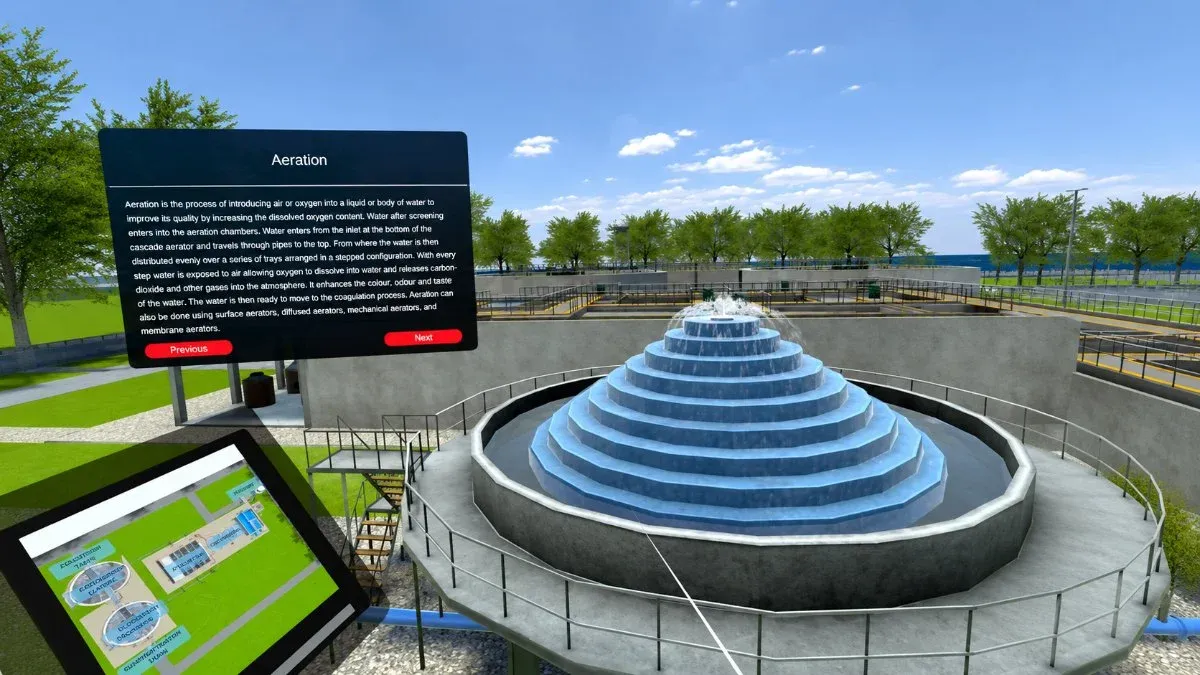
Understand how cascade aerators raise dissolved oxygen and remove undesirable gases
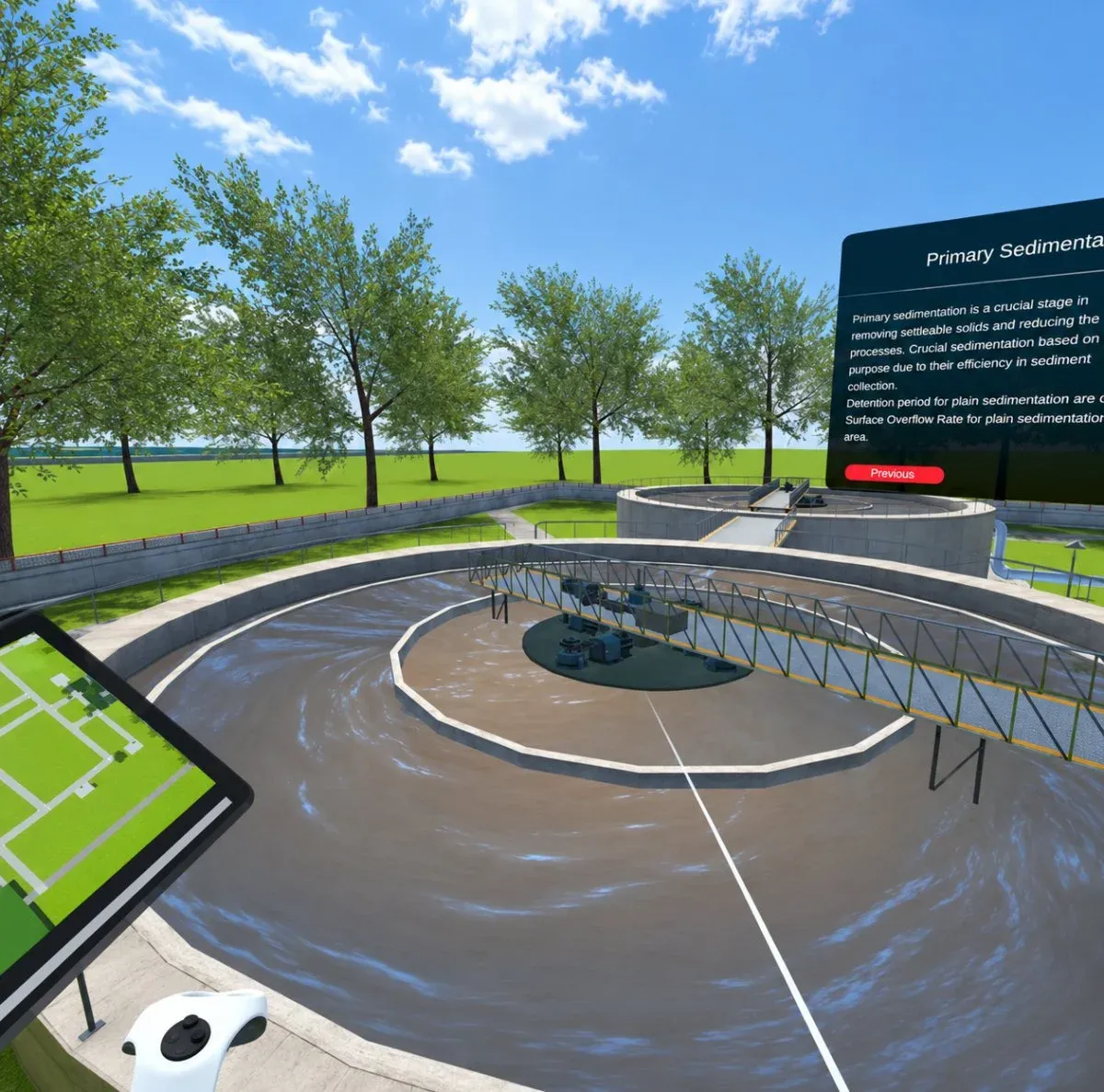
Visualise how suspended particles settle in sedimentation and clarification tanks
Understand how UV disinfection reduces microbial contamination in treated water
From raw water to safe supply.
A drinking-water treatment plant removes suspended solids, impurities, harmful microorganisms, and undesirable chemistry from raw water before it reaches the public. The process typically runs through intake, aeration, chemical treatment, clarification, sedimentation, disinfection, and treated-water handling.
This module is a structured virtual industrial visit rather than a simulation experiment. In Guided Tour Mode, learners are taken stage by stage with explanations of each treatment step. In Self-Explore Mode, they move through the plant at their own pace, observing the equipment, process flow, water movement, and layout.
Why a virtual plant visit?
- Municipal treatment plants restrict visitor numbers, and a full cohort rarely gets past the gate.
- The process areas that matter most - dosing, clarifier walkways, UV chambers - are exactly the areas visitors are kept away from.
- Stages are physically separated across a large site, so the process order is hard to perceive on foot.
- The tour can be paused at any unit and repeated before an exam.
Units on the tour
- Intake structure and raw-water inlet
- Cascade aerator with stepped trays
- Coagulation and chemical dosing
- Clarifier and sedimentation tanks
- UV disinfection unit
- Treated-water outlet
Concepts it makes tangible
- How raw water becomes safe drinking water
- Aeration - raising dissolved oxygen and stripping gases
- Coagulation, flocculation, and settling of suspended solids
- Clarification and sedimentation detention
- UV disinfection and microbial reduction
- The order and purpose of each treatment stage
On the tour
- Guided Mode walks each stage in treatment order
- Self-Explore lets students move between units freely
- Each unit is explained where it sits in the process
How faculty use it
- Virtual industrial visit when a plant trip is not possible
- Pre-visit briefing before a real treatment-plant tour
- Safe access to operating process areas
- Guided walkthrough for large classes
The tour covers the intake where raw water enters, cascade aerators where water meets air, clarification and sedimentation tanks where heavier particles settle, chemical dosing and treatment, and UV disinfection in the final purification stage - connecting classroom theory to real municipal water infrastructure. The 7thi AI tutor and built-in assessment support the visit.
How the module works
The module is a structured walk through a working drinking-water plant, following raw water in the order it is actually treated. Students move from the intake through the cascade aerator, into coagulation and chemical dosing, on to the clarifier and sedimentation tanks, through UV disinfection and finally to the treated-water outlet. Each unit is explained where the student stands in front of it, so the purpose of a stage and its position in the sequence are learned together. Guided Tour follows the treatment train from end to end; Self-Explore lets students move between units freely and return to any stage before an exam.
What students take away
Students finish able to describe every major stage of conventional drinking-water treatment, explain what each unit process removes or achieves, and reason about why the stages are ordered as they are - for instance, why aeration precedes chemical treatment, and why disinfection comes last. They understand the plant as an integrated system rather than a set of isolated tanks, which is exactly the understanding a design project or a real plant visit demands.
In the classroom
Environmental and public-health engineering courses use the tour to give a whole cohort the plant experience that access restrictions usually reserve for a lucky few. It works as a briefing before a real works visit, making that visit far more productive, and as a full substitute where a visit cannot be arranged. Because students can return to any unit and step through the treatment train as often as they like, it also serves as revision before examinations and as a shared reference point for design coursework.
Interactive features and modes
A Guided Tour follows the treatment train in the exact order water is processed, while Self-Explore lets students move between units freely and return to any stage. Each unit process is explained where the student stands in front of it, so purpose and position in the sequence are learned together. The whole tour can be paused, replayed and revisited, which makes it as useful for exam revision as for a first encounter.
Why it matters
Municipal treatment plants are essential infrastructure and tightly access-controlled, so a full cohort rarely gets past the gate, and the areas that matter most for teaching - dosing, clarifier walkways, UV chambers - are the very areas visitors are kept away from. The stages are also spread across a large site, so even a successful visit gives little sense of the process order. A virtual tour puts every student inside the plant, at every stage, in the correct sequence, and lets them return as often as they need.
The bigger picture
The value of walking a treatment plant in the correct sequence is that water treatment is a chain of interdependent processes, not a collection of independent tanks. Aeration prepares water for the chemistry that follows; coagulation and clarification remove the load that would otherwise overwhelm disinfection; disinfection comes last because it guards the treated water on its way out. A student who understands the plant as an integrated system - each stage sized and placed for a reason - designs and operates far better than one who has memorised the units in isolation. The tour builds exactly that systems view.
Devices, deployment and assessment
Deploying the module is straightforward. It runs on Meta Quest, ClassVR and Pico headsets, on WebXR-compatible browsers, and on the desktop without any headset at all, so a department can start with the hardware it already has and scale as it grows. Faculty can assign the whole module or specific scenes, set it as pre-lab preparation or post-lab revision, and track progress on a dashboard that records concepts mastered, time per scene and assessment scores, with export to the LMS via xAPI. The 7thi AI tutor answers student questions in context throughout, so learners are never left stuck and faculty are not fielding the same question forty times.
Who this module is for
- Civil and environmental engineering undergraduates from Year 2
- Public health engineering and water resources programmes
- Departments unable to arrange plant visits for large cohorts
- Faculty briefing students before a real treatment-works tour
Syllabus alignment
Where this module fits.
AICTE / NEP 2020
Aligns with Civil, Environmental, Water Supply, and Public Health Engineering outcomes, supporting experiential, visualization-led, and infrastructure-focused learning.
ABET (United States)
Supports Student Outcome 1 through engineering knowledge of water-treatment systems and public infrastructure, and Student Outcome 7 through applied learning via immersive industrial exposure.
NBA (India)
Maps to Course Outcomes in Environmental and Water Supply Engineering, supporting POs around engineering knowledge, environment and sustainability, society, and modern tool usage.
University syllabi
Maps to unit topics, industrial-visit requirements, course outcomes, and assessment rubrics. Request a custom mapping.
Keep exploring
Related modules.
See Water Treatment Plant live in a demo.
Thirty minutes, the full module, your curriculum questions answered.
Which treatment stages does the tour cover?
Raw-water intake, cascade aeration, coagulation and chemical dosing, clarification and sedimentation, UV disinfection and the treated-water outlet - in the order water actually passes through them.
Is this a simulation or a tour?
A structured industrial tour rather than an operating simulation. The goal is that students understand what each unit does and why it sits where it does in the sequence, not that they run the plant.
What does the aeration stage teach?
How a cascade aerator raises dissolved oxygen and strips dissolved gases by exposing thin films of water to air, and why that matters before the chemical treatment stages begin.
Can it replace a real treatment plant visit?
It is designed to precede or substitute for one. Where a visit is possible it makes it far more productive; where it is not, which is common for large cohorts, it provides the process understanding a visit would have given.
Is this mapped to our curriculum?
It is mapped to ABET, NBA and equivalent frameworks, and we map it to your own environmental engineering syllabus before deployment. Request a custom mapping.
Can this be used in a flipped classroom?
Yes. Students complete Water Treatment Plant before the lecture, so class time goes on analysis and discussion rather than first exposure to the topic.
Does it integrate with our LMS?
Yes. Moodle, Canvas and Blackboard are supported, with SSO and xAPI export of session data and assessment results.
What prior knowledge do students need?
Foundation-level environmental engineering. The module suits UG Year 2+ and above, including diploma and polytechnic cohorts.
Which treatment stages does the tour cover?
Raw-water intake, cascade aeration, coagulation and chemical dosing, clarification and sedimentation, UV disinfection and the treated-water outlet - in the order water actually passes through them.
Is this a simulation or a tour?
A structured industrial tour rather than an operating simulation. The goal is that students understand what each unit does and why it sits where it does in the sequence, not that they run the plant.
What does the aeration stage teach?
How a cascade aerator raises dissolved oxygen and strips dissolved gases by exposing thin films of water to air, and why that matters before the chemical treatment stages begin.
Can it replace a real treatment plant visit?
It is designed to precede or substitute for one. Where a visit is possible it makes it far more productive; where it is not, which is common for large cohorts, it provides the process understanding a visit would have given.
Is this mapped to our curriculum?
It is mapped to ABET, NBA and equivalent frameworks, and we map it to your own environmental engineering syllabus before deployment. Request a custom mapping.
Can this be used in a flipped classroom?
Yes. Students complete Water Treatment Plant before the lecture, so class time goes on analysis and discussion rather than first exposure to the topic.
Does it integrate with our LMS?
Yes. Moodle, Canvas and Blackboard are supported, with SSO and xAPI export of session data and assessment results.
What prior knowledge do students need?
Foundation-level environmental engineering. The module suits UG Year 2+ and above, including diploma and polytechnic cohorts.