
VR Module · Electrical · Engineering
Three Phase Transformer
Transformers - Electrical Machines
See it
Inside the module.
Learning objectives
By the end of this module, students will be able to:
Identify the main parts of a three-phase step-down transformer
Understand the primary winding, secondary winding, laminated core, terminals, bushings, tank, insulation, and cooling system
Explain how voltage transformation happens through electromagnetic induction
Relate the turns ratio to step-down voltage operation
Understand three-phase connections such as star and delta, where relevant
Visualise the magnetic flux path, energy transfer, losses, heating, and cooling
Connect transformer operation with substations, distribution networks, and industrial power systems
The full machine, part by part and in action.
A three-phase step-down transformer reduces high-voltage three-phase electrical power to a lower voltage suitable for distribution, industrial loads, and end-use systems. It is a key machine in substations, distribution networks, factories, commercial buildings, and utility infrastructure.
In this iXRLabs 3D machine module, students observe the transformer as a complete system and understand the function of each part. The working explanation shows how alternating current in the primary winding produces a changing magnetic flux in the core, which induces voltage in the secondary winding. The module explains voltage reduction using the turns ratio and shows how three-phase power is handled across the winding system.
Why a 3D three-phase transformer?
- Three-phase construction is genuinely three-dimensional, and single-line diagrams hide how the limbs and windings sit.
- The oil, tank and radiators are the whole thermal story and are never opened in service.
- Star and delta connections are far clearer when the physical terminals and links are visible.
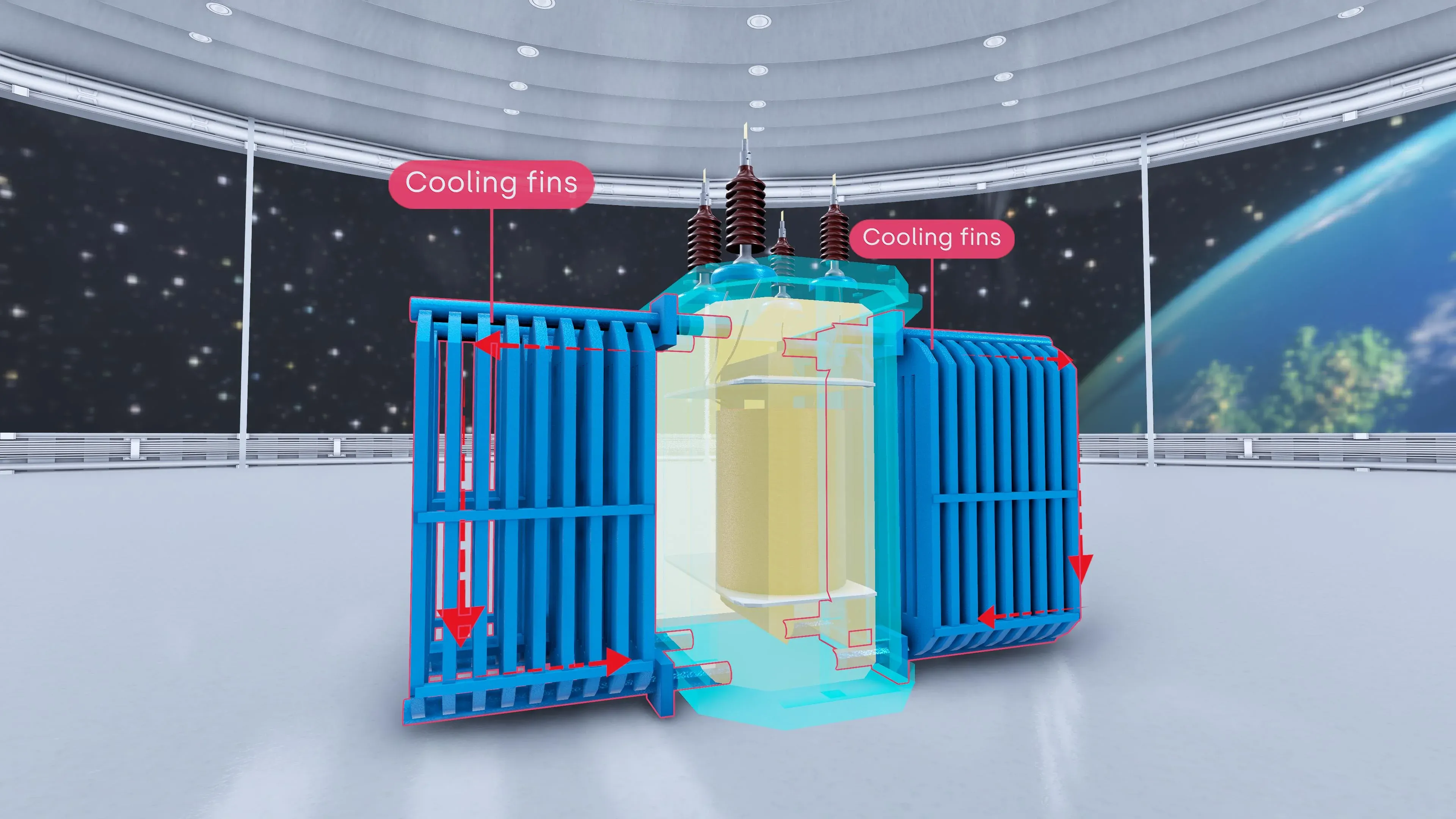
- Cutaway views show oil circulation, which no drawing conveys well.
Parts you can inspect
- Primary and secondary windings
- Laminated core and limbs
- Tank and insulating oil
- Bushings and terminals
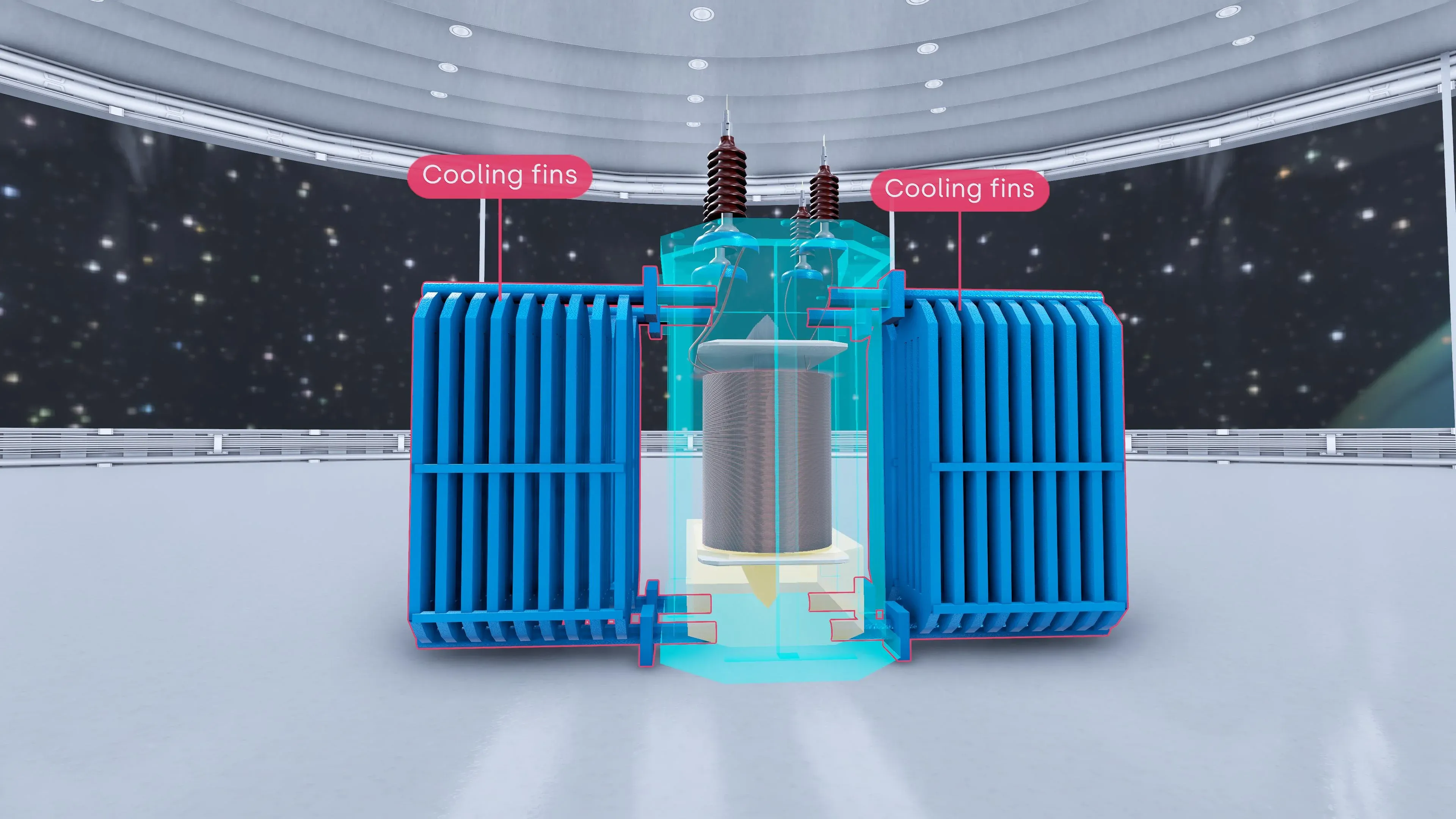
- Cooling fins / radiators and conservator
- Insulation system
Concepts it makes tangible
- Voltage transformation by electromagnetic induction
- Turns ratio and step-down operation
- Star and delta three-phase connections
- The magnetic flux path and energy transfer
- Losses, heating, and oil cooling
- Links to substations, distribution, and industrial supply
Modes of interaction
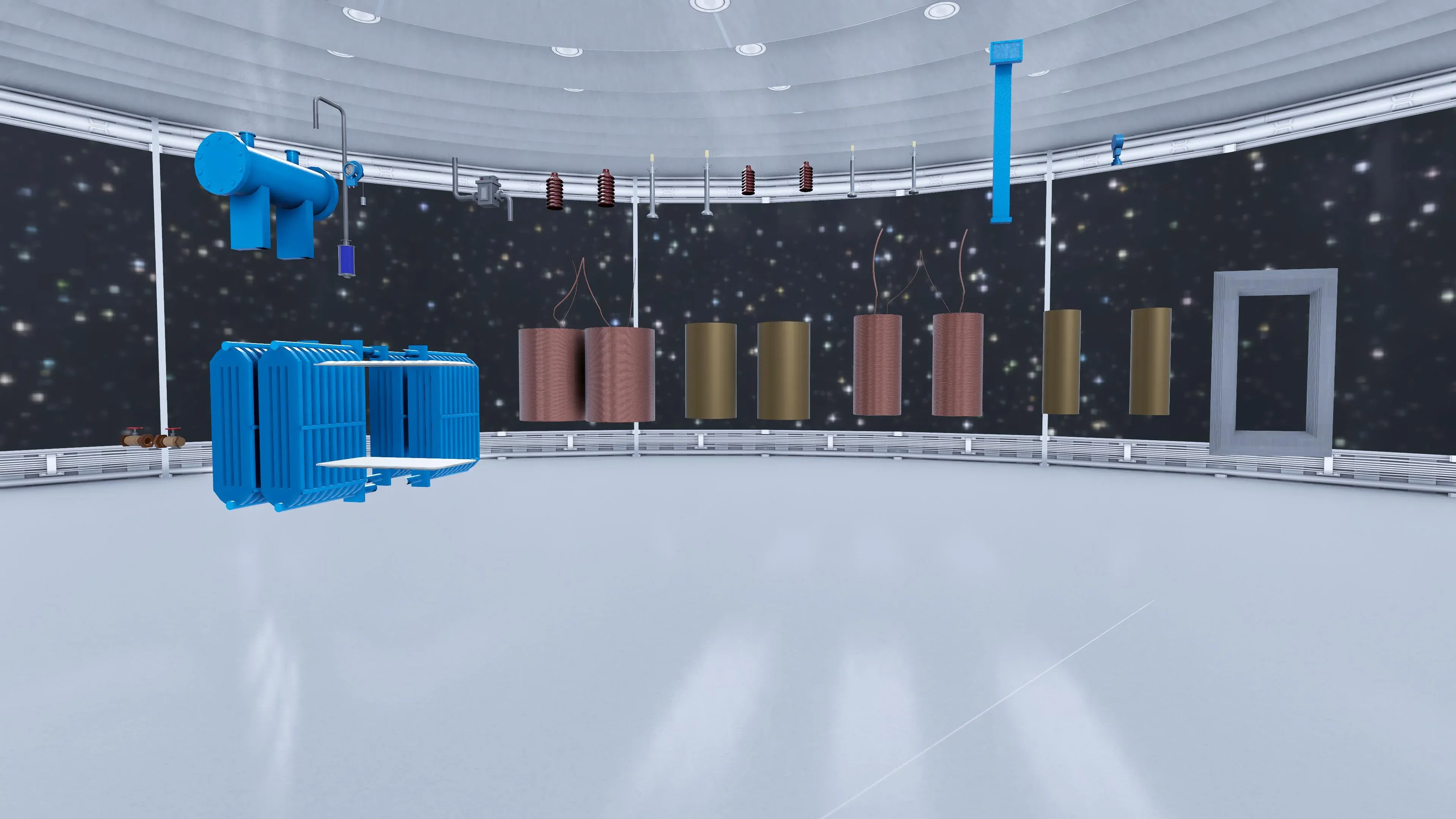
- Assembly / Disassembly to study each part
- Cutaway views reveal the core, windings, and oil flow
- Working Mode traces flux and energy transfer
How faculty use it
- Pre-lab / pre-lecture primer on transformers
- Flipped classroom and exam revision
- Safe alternative to opening a live transformer
- Assessment of construction and working
It also introduces practical engineering concepts - core losses, copper losses, insulation, cooling, terminal connections, bushings, vector groups, load behaviour, voltage regulation, and transformer safety. It works well for machine familiarisation, classroom demonstration, virtual lab support, and power systems learning, with the 7thi AI tutor and built-in assessment throughout.
How the module works
Students inspect a three-phase step-down transformer inside and out. They start with the external machine - tank, high-voltage bushings and the cooling fins - then cut away the tank to follow the core limbs, the windings arranged around them, and the oil circulation path out to the radiators and back. The star and delta connections are shown as physical terminals and links rather than as symbols on a single-line diagram, so the effect on line and phase voltages and on the availability of a neutral becomes clear. A working mode traces the flux and the step-down action through the turns ratio.
What students take away
A student can explain star and delta connections and how the choice affects voltages, the neutral and the vector group; describe how the transformer steps voltage down through mutual induction; and account for core and copper losses, heating and oil cooling. They understand the machine as a three-dimensional physical object rather than a single-line symbol, which is the understanding real distribution engineering requires.
In the classroom
Transformer and power-systems courses use the module as a short, focused familiarisation with the three-phase machine students will meet throughout distribution engineering. It works as flipped-classroom preparation, as a primer before lab work, and as revision, with the star and delta connections and the vector group being frequent examination topics. Its brevity makes it easy to slot into a single teaching session.
Interactive features and modes
Students can inspect the external machine, cut away the tank to follow the core, windings and oil circulation, and separate the transformer into its component parts and rebuild it. The star and delta connections are shown as physical terminals and links, and a working mode traces the flux and the step-down action through the turns ratio. Its compact length makes it easy to deliver in a single teaching session.
Why it matters
Three-phase transformers move power through substations, distribution networks and industrial supplies, and their construction is genuinely three-dimensional in a way that flat diagrams hide. The oil, tank and radiators are the entire thermal story and are never opened in service; star and delta connections are far clearer as physical links than as symbols; and oil circulation is almost impossible to convey on paper. A 3D model with cutaway and working modes shows all of it in a few minutes.
The bigger picture
Three-phase power is inherently three-dimensional, and much of what confuses students about three-phase transformers comes from trying to understand a genuinely spatial machine through flat single-line symbols. Seeing the three windings physically connected in star or delta, following the oil that carries heat from the windings to the radiators, and watching the flux link primary to secondary makes the machine legible in a way symbols never can. Since three-phase transformers sit at every step of the distribution network, that concrete understanding pays off across the whole of power engineering.
Devices, deployment and assessment
Deploying the module is straightforward. It runs on Meta Quest, ClassVR and Pico headsets, on WebXR-compatible browsers, and on the desktop without any headset at all, so a department can start with the hardware it already has and scale as it grows. Faculty can assign the whole module or specific scenes, set it as pre-lab preparation or post-lab revision, and track progress on a dashboard that records concepts mastered, time per scene and assessment scores, with export to the LMS via xAPI. The 7thi AI tutor answers student questions in context throughout, so learners are never left stuck and faculty are not fielding the same question forty times.
Who this module is for
- Electrical engineering undergraduates from Year 2 studying transformers and power systems
- Diploma and polytechnic electrical students
- Power distribution and utility training programmes
- Faculty needing a short, focused machine-familiarisation session
Syllabus alignment
Where this module fits.
ABET (United States)
Supports engineering knowledge of electrical machines, electromagnetic systems, power distribution, and transformer operation.
NBA (India)
Supports POs related to engineering knowledge, problem analysis, investigation, and modern tool usage - especially PO5.
University syllabi
Maps to Electrical Machines, Power Systems, Transmission and Distribution, and Substation Equipment course outcomes. Request a custom mapping.
AICTE / NEP 2020
Maps to Electrical Engineering, Electrical Machines, Power Systems, and lab-based learning outcomes; supports experiential and competency-based learning.
Keep exploring
Related modules.
See Three Phase Transformer live in a demo.
Thirty minutes, the full module, your curriculum questions answered.
Does the module cover star and delta connections?
Yes. Students see how the three windings are physically connected in star or delta on each side, and how that choice affects line and phase voltages, the availability of a neutral, and the vector group.
Can students see inside the tank?
Cutaway views expose the laminated core and limbs, the winding arrangement around them, and the oil circulation path from the windings out to the radiators and back.
How is the step-down action explained?
Working mode shows alternating current in the primary producing changing flux in the core, that flux inducing voltage in the secondary, and the turns ratio setting the reduced output voltage.
Which practical concepts does it introduce?
Core and copper losses, heating and oil cooling, insulation systems, bushings and terminal connections, vector groups, load behaviour, voltage regulation and transformer safety.
Is the assessment graded automatically?
Yes. Scores reach the faculty dashboard immediately, pass thresholds are adjustable, and results export to your LMS via xAPI.
Is this mapped to our curriculum?
It is mapped to ABET, NBA and equivalent frameworks, and we map it to your own transformers syllabus before deployment. Request a custom mapping.
Can this be used in a flipped classroom?
Yes. Students complete Three Phase Transformer before the lecture, so class time goes on analysis and discussion rather than first exposure to the topic.
Does it integrate with our LMS?
Yes. Moodle, Canvas and Blackboard are supported, with SSO and xAPI export of session data and assessment results.