
VR Module · Electrical · Engineering
Swinburne's Test on DC Shunt Motor
DC Machines
See it
Inside the module.
Learning objectives
By the end of this module, students will be able to:
Understand the purpose of Swinburne's Test on a DC shunt motor
Identify the test setup - motor, starter, ammeter, voltmeter, field rheostat, and armature and shunt-field circuits
Perform the no-load test procedure in a virtual electrical machines lab
Measure no-load input power and separate constant losses from variable losses
Calculate armature copper loss, stray losses, output power, and efficiency
Estimate efficiency at different load currents without physically loading the motor
Estimate efficiency without loading the machine.
Swinburne's Test is the standard no-load method for estimating the efficiency of a DC shunt motor. Rather than loading the machine mechanically, it is run at rated voltage under no load; the input power, armature current, field current, and armature resistance are then used to separate losses and estimate efficiency across the load range.
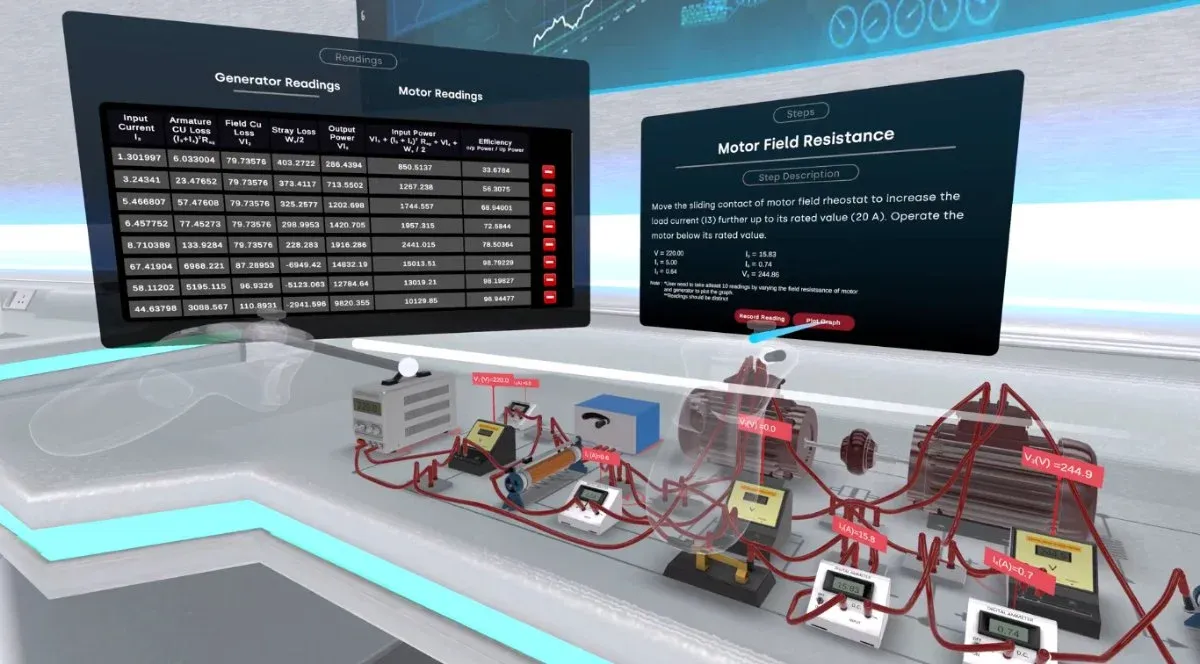
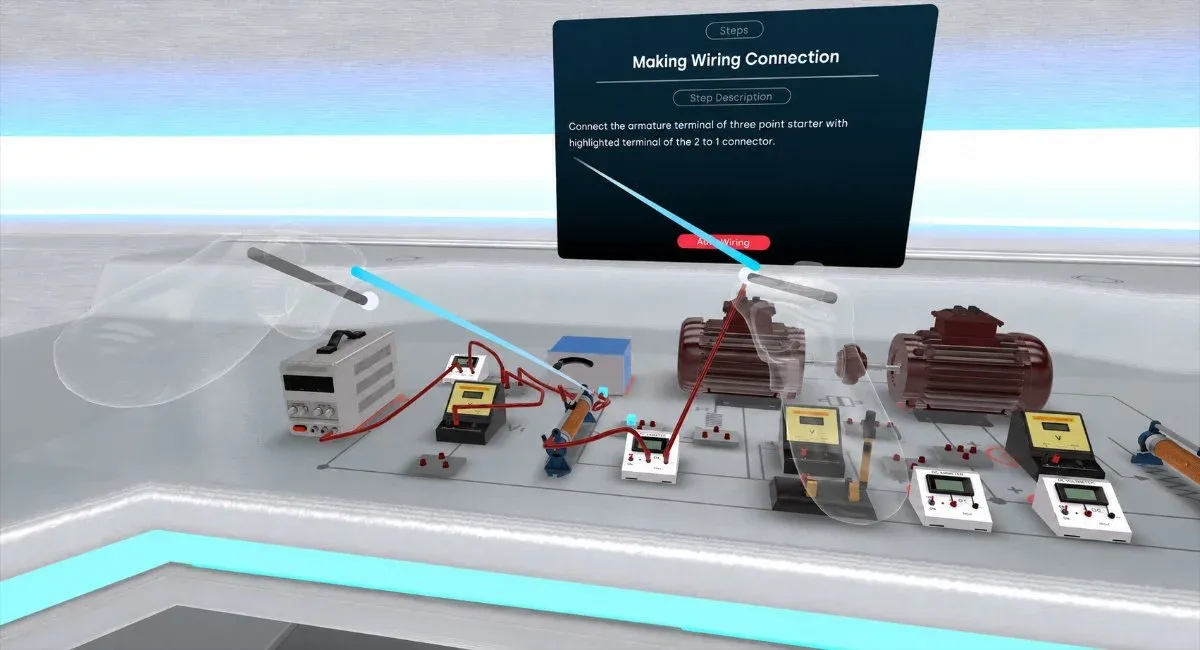
In this module, students enter a virtual electrical machines lab and perform the test step by step - understanding the circuit, connecting the motor set, observing the starting sequence, reading the instruments, and recording the electrical parameters. The roles of the field winding, armature winding, starter, field rheostat, supply, and meters are made visible throughout.
Why run Swinburne's test in VR?
- DC machine benches are high-current, and a miswired starter can damage equipment or injure a student.
- Machines lab time is scarce, and one bench typically serves a whole batch by rotation.
- Students can repeat the wiring until the circuit is understood rather than copied off the board.
- Loss separation is an arithmetic exercise that only becomes meaningful when tied to a live reading.
The test setup
- DC shunt motor and coupled machine
- Three-point starter
- Ammeter and voltmeter
- Field rheostat
- Armature and shunt-field circuits
Concepts it makes tangible
- The principle of Swinburne's no-load test
- Constant losses versus variable losses
- No-load input power measurement
- Armature copper loss and stray losses
- Efficiency estimation at any load without loading the machine
The experiment workflow
- Wire the setup with guided connections
- Run the no-load test and record readings
- Separate constant from variable losses
- Calculate output power and efficiency
- Estimate efficiency across load currents and plot the curve
How faculty use it
- Pre-lab preparation for the electrical-machines lab
- Unlimited repeats with no risk of overloading a real motor
- Remote or overflow lab option
- Assessment of procedure, calculation, and interpretation
The experiment links theory to practice: armature and field current, back EMF, iron and friction-and-windage losses, copper loss, constant and variable losses, input and output power, and efficiency. It lets students rehearse safely before working with real high-current machines. The 7thi AI tutor and built-in assessment support the whole experience.
How the module works
Students carry out the classic no-load method for finding the efficiency of a DC shunt motor. They wire the circuit through guided connections, work the three-point starter through its correct sequence, and run the machine at rated voltage on no load while reading the ammeters and voltmeters. From the no-load input they extract the constant losses - iron loss plus friction and windage - and they calculate the variable armature copper loss for any assumed load current, then plot efficiency across the whole load range. Because the whole rig is virtual, students can build the circuit wrong, see what happens, and repeat until the wiring is understood rather than copied.
What students take away
A student can explain why Swinburne's test is done at no load, separate constant losses from variable losses and describe where each comes from, and estimate efficiency across the load range from a single cheap test. Importantly, they can also state the method's limits - that stray load losses and the effects of temperature rise and armature reaction at full load are not captured - so they treat the result as the estimate it is.
In the classroom
DC-machines courses use the module to let every student wire, start and measure the test safely and repeatedly before touching the real high-current bench. Because the wiring can be built wrong and simply reset, students come to understand the circuit rather than copy it from the board, which makes the subsequent physical lab both safer and more valuable. It also supports remote and overflow machines labs where bench access is limited.
Interactive features and modes
The module provides guided wiring so students build the circuit connection by connection, a correctly sequenced three-point starter, live ammeter and voltmeter readings, and an adjustable field rheostat. From the no-load measurements it separates constant from variable losses and plots efficiency across the load range. The whole rig can be reset and re-run, so a miswired circuit is a learning opportunity rather than a damaged machine.
Why it matters
Finding a large DC machine's efficiency by actually loading it needs a dynamometer or brake and dissipates full-rated power, which is why Swinburne's elegant no-load method has been a staple of machines labs for over a century. But DC benches run at high current, a miswired three-point starter can damage equipment or injure a student, and one bench usually serves a whole batch by rotation. Running the test in VR lets every student wire, start and measure safely and repeatedly before they ever touch the real high-current rig.
The bigger picture
Swinburne's test is a small masterpiece of experimental economy: by running a machine at no load and separating the losses, it estimates efficiency across the whole load range without ever loading the machine or dissipating full-rated power. Understanding why that works - and, just as importantly, understanding its limits, since stray load losses and full-load heating are not captured - teaches students to reason about what an experiment does and does not measure. That critical awareness, treating a result as an estimate with known assumptions rather than an exact truth, is a habit that matters far beyond this one test.
Devices, deployment and assessment
Deploying the module is straightforward. It runs on Meta Quest, ClassVR and Pico headsets, on WebXR-compatible browsers, and on the desktop without any headset at all, so a department can start with the hardware it already has and scale as it grows. Faculty can assign the whole module or specific scenes, set it as pre-lab preparation or post-lab revision, and track progress on a dashboard that records concepts mastered, time per scene and assessment scores, with export to the LMS via xAPI. The 7thi AI tutor answers student questions in context throughout, so learners are never left stuck and faculty are not fielding the same question forty times.
Who this module is for
- Electrical engineering undergraduates from Year 2 studying DC machines
- Diploma and polytechnic electrical programmes
- Departments running remote or overflow machines labs
- Faculty preparing students before high-current bench work
Syllabus alignment
Where this module fits.
ABET (United States)
Supports Student Outcome 1 through engineering knowledge of DC machines, losses, and efficiency, and Student Outcome 6 through experimentation, measurement, and data interpretation.
NBA (India)
Maps to Course Outcomes in Electrical Machines and Electrical Machines Laboratory, supporting POs around engineering knowledge, problem analysis, investigation, and modern tool usage (notably PO4 and PO5).
University syllabi
Maps to institutional Swinburne's Test lab experiments, DC motor theory, course outcomes, lab records, viva questions, and assessment rubrics. Request a custom mapping.
AICTE / NEP 2020
Aligns with Electrical Engineering, Electrical Machines, and Electrical Measurements laboratory outcomes, supporting experiential, competency-based, and virtual-lab learning.
Keep exploring
Related modules.
See Swinburne's Test on DC Shunt Motor live in a demo.
Thirty minutes, the full module, your curriculum questions answered.
Why is Swinburne's test done at no load?
Loading a large DC machine needs a dynamometer or brake and dissipates full rated power. Running at rated voltage on no load gives the constant losses directly, and copper loss is then calculated for any load current.
What do students actually do in the module?
Wire the setup with guided connections, work the three-point starter through its correct sequence, take ammeter and voltmeter readings, adjust the field rheostat, separate the losses and plot the efficiency curve.
Which losses are separated?
Constant losses - iron loss plus friction and windage - come from the no-load input power. Variable loss is armature copper loss, calculated from armature current and resistance at each assumed load.
What are the limits of the method?
Because the machine is never loaded, stray load losses and the effects of temperature rise and armature reaction at full load are not captured. The module states this rather than presenting the figure as exact.
Which headsets does this module run on?
HTC, Meta Quest, ClassVR, WebXR, plus any WebXR-compatible browser. It also runs on desktop without a headset, which covers faculty preview and remote cohorts. OpenXR and 6DOF headsets are supported.
Is the assessment graded automatically?
Yes. Scores reach the faculty dashboard immediately, pass thresholds are adjustable, and results export to your LMS via xAPI.
Is this mapped to our curriculum?
It is mapped to ABET, NBA and equivalent frameworks, and we map it to your own dc machines syllabus before deployment. Request a custom mapping.
Can this be used in a flipped classroom?
Yes. Students complete Swinburne's Test on DC Shunt Motor before the lecture, so class time goes on analysis and discussion rather than first exposure to the topic.
Why is Swinburne's test done at no load?
Loading a large DC machine needs a dynamometer or brake and dissipates full rated power. Running at rated voltage on no load gives the constant losses directly, and copper loss is then calculated for any load current.
What do students actually do in the module?
Wire the setup with guided connections, work the three-point starter through its correct sequence, take ammeter and voltmeter readings, adjust the field rheostat, separate the losses and plot the efficiency curve.
Which losses are separated?
Constant losses - iron loss plus friction and windage - come from the no-load input power. Variable loss is armature copper loss, calculated from armature current and resistance at each assumed load.
What are the limits of the method?
Because the machine is never loaded, stray load losses and the effects of temperature rise and armature reaction at full load are not captured. The module states this rather than presenting the figure as exact.
Which headsets does this module run on?
HTC, Meta Quest, ClassVR, WebXR, plus any WebXR-compatible browser. It also runs on desktop without a headset, which covers faculty preview and remote cohorts. OpenXR and 6DOF headsets are supported.
Is the assessment graded automatically?
Yes. Scores reach the faculty dashboard immediately, pass thresholds are adjustable, and results export to your LMS via xAPI.
Is this mapped to our curriculum?
It is mapped to ABET, NBA and equivalent frameworks, and we map it to your own dc machines syllabus before deployment. Request a custom mapping.
Can this be used in a flipped classroom?
Yes. Students complete Swinburne's Test on DC Shunt Motor before the lecture, so class time goes on analysis and discussion rather than first exposure to the topic.