
VR Module · Mechanical - Thermal - Energy · Engineering
Steam Turbine
Rankine Cycle - Steam Turbine - Turbomachinery
See it
Inside the module.
Learning objectives
By the end of this module, students will be able to:
Identify the major components - casing, rotor, shaft, nozzles, moving and fixed blades, bearings, seals, inlet, and exhaust
Explain how each component converts steam energy into mechanical shaft power
Describe the working of a two-stage / double-flow turbine - admission, expansion, blade interaction, and exhaust
Correlate turbine operation with the Rankine cycle - boiler, expansion, condenser, and pump
Interpret pressure, temperature, and velocity changes across stages from CFD-style steam-flow diagrams
Explain why double-flow configurations balance axial thrust in large steam turbines
A steam turbine you can open up and run.
A steam turbine converts the energy of high-pressure steam into mechanical shaft power - steam expands through nozzles and blades, spinning the rotor. Steam turbines drive thermal and nuclear power plants, marine propulsion, and industrial and combined-cycle systems.
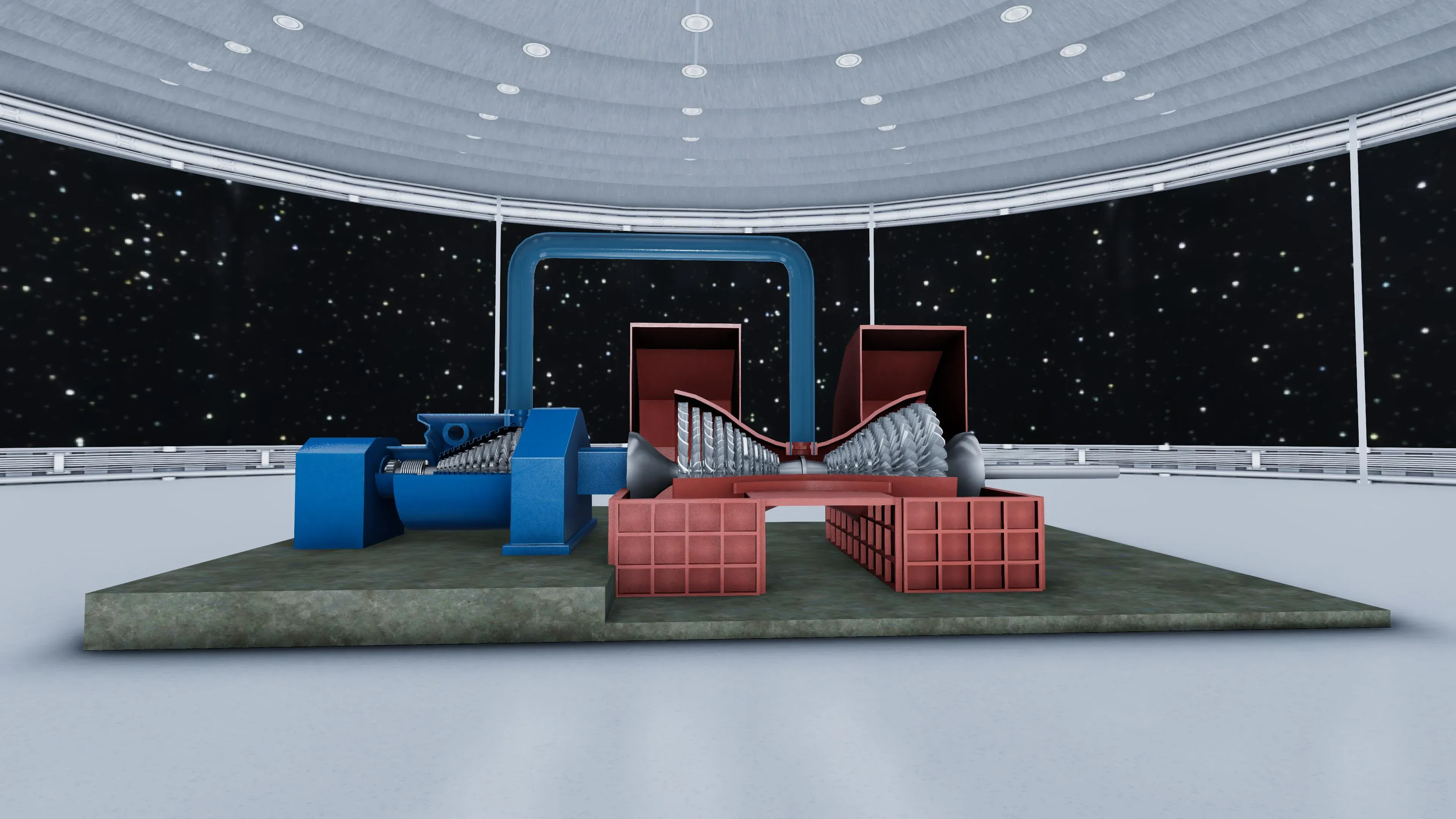
Students explore a two-stage / double-flow turbine as a complete machine. In Assembly / Disassembly Mode they inspect the casing, rotor, blade rows, nozzles, shaft, bearings, seals, inlet, and exhaust; in X-Ray View the internal flow path, blade arrangement, rotor-stator interaction, and double-flow configuration become visible.
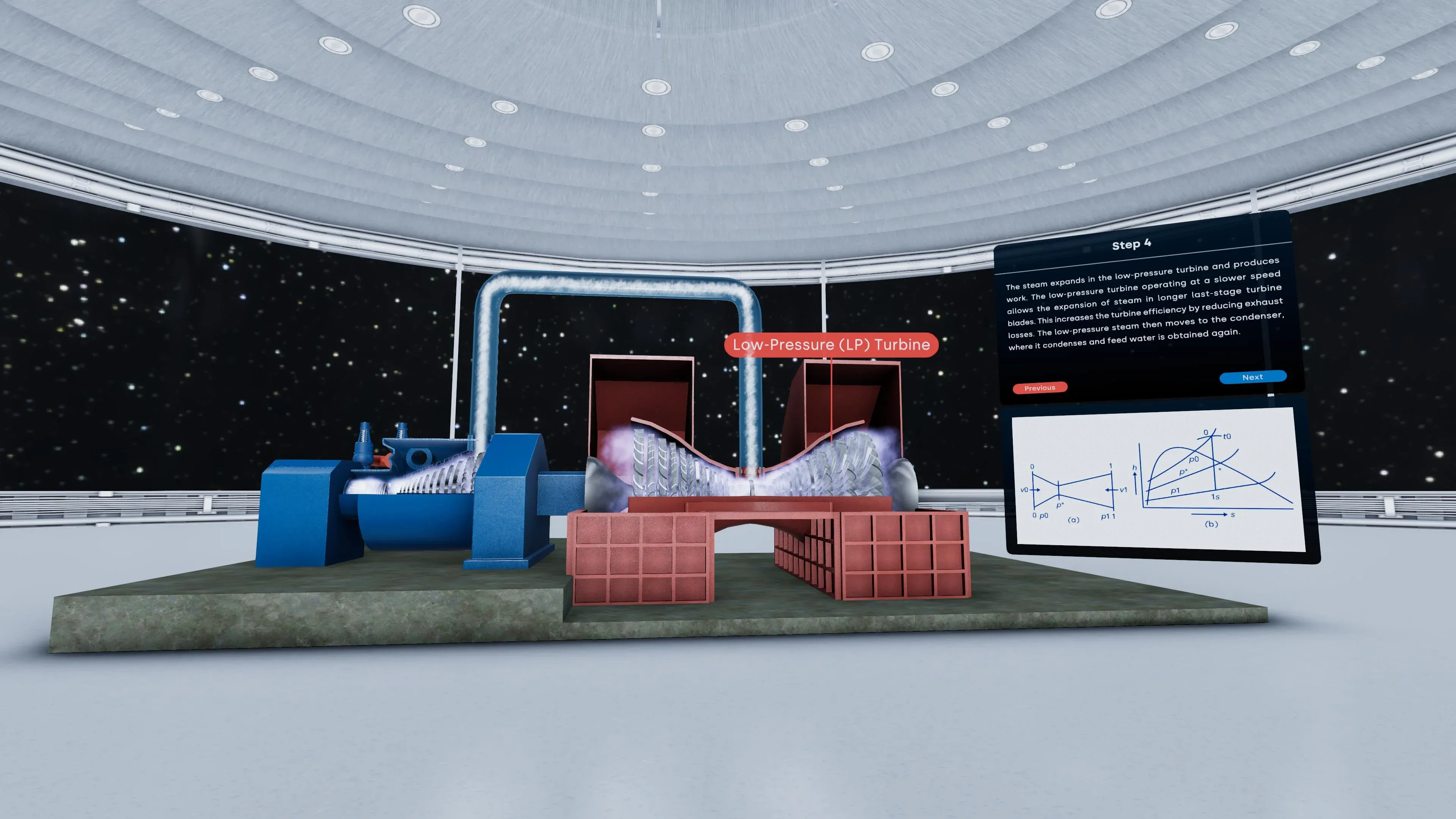
In Working Mode the operation is animated - high-pressure steam entering, expanding across stages, rotating the shaft, and producing power - with a CFD-style steam-flow layer showing flow direction, velocity change, pressure drop, and energy transfer, all mapped to the Rankine cycle so students connect the turbine to the wider power-generation loop of boiler, turbine, condenser, and pump.
Why a virtual steam turbine?
- A steam turbine is opened only during major overhaul, so almost no student ever sees inside one.
- Pressure, temperature and velocity change across every stage, and all three changes are invisible.
- The double-flow arrangement exists to balance axial thrust, which is far easier to see than to describe.
- Connecting the turbine to the wider boiler-condenser-pump loop is what makes the Rankine cycle concrete.
Components you can inspect
- Casing and the double-flow arrangement
- Rotor and shaft
- Moving and fixed blade rows
- Nozzles
- Bearings and seals
- Steam inlet and exhaust
Concepts it makes tangible
- How steam energy becomes shaft power
- Two-stage / double-flow operation - admission, expansion, exhaust
- Rotor-stator interaction across stages
- The Rankine cycle - boiler, expansion, condenser, pump
- Pressure, temperature, and velocity change across stages
- Why double-flow balances axial thrust
Modes of interaction
- Assembly / Disassembly to inspect casing, rotor, and blades
- X-Ray View reveals the internal flow path
- Working Mode animates steam expansion with CFD-style flow
- Every stage maps to the Rankine cycle
How faculty use it
- Pre-lecture primer on turbomachinery and the Rankine cycle
- Flipped classroom and exam revision
- Lab-free access to a machine departments cannot open
- Assessment of components, staging, and cycle
The 7thi AI tutor sits alongside the whole experience, scaffolding the difficult parts and giving subject-aware answers in context. Built-in assessment lets faculty see, per student, who has grasped which concepts - without grading another paper.
How the module works
Students open a double-flow steam turbine and follow steam through it. Disassembly exposes the casing, rotor and shaft, the moving and fixed blade rows, the nozzles, bearings and seals, and the steam inlet and exhaust. The working mode uses CFD-style visualisation to show steam expanding across the stages - flow direction, velocity change, pressure drop and energy transfer - the quantities that define turbine performance and that no physical machine reveals. The double-flow arrangement is shown to balance axial thrust, and every stage is mapped onto the Rankine cycle so the turbine is understood as part of the wider boiler-condenser-pump loop.
What students take away
A student can identify the internal components of a steam turbine, explain why it is built double-flow, and describe how steam expanding across successive stages converts thermal energy into shaft work. They can place the turbine within the Rankine cycle and reason about pressure, temperature and velocity changes through the machine - the core of how thermal power is actually generated.
In the classroom
Turbomachinery and thermal-power courses use the module to open a machine students otherwise never see inside, since a real steam turbine is opened only at major overhaul. It serves as a flipped-classroom primer, as preparation before power-plant lab work or a station visit, and as revision that ties the turbine back into the Rankine cycle. Marine and energy programmes use it for the same internal familiarisation.
Interactive features and modes
The module supports assembly and disassembly, X-ray views of the internal flow path, and a working mode with CFD-style steam-flow visualisation showing pressure drop, velocity change and energy transfer across the stages. The double-flow arrangement is shown to balance axial thrust, and every stage is tied to the Rankine cycle, so the turbine is understood as part of the wider plant rather than as an isolated machine.
Why it matters
Steam turbines generate most of the world's electricity, in coal, gas, nuclear and concentrated-solar plants alike, yet they are opened only during major overhaul, so almost no student ever sees inside one. The pressure, temperature and velocity changes across the stages are the entire story of how the machine works, and all three are invisible. A virtual turbine with cutaway and flow-visualisation modes shows the expansion directly and ties it to the thermodynamic cycle students study in parallel.
The bigger picture
A steam turbine converts heat into shaft work through a controlled, staged expansion, and the quantities that define its performance - pressure drop, velocity change and energy transfer across each stage - are entirely invisible in a real machine. So too is the reasoning behind features like the double-flow arrangement, which balances the axial thrust that would otherwise overload the bearings. Visualising the expansion and the flow path, and placing the turbine within the wider boiler-condenser-pump loop, lets students understand not just what the machine looks like but how and why it works as it does.
Devices, deployment and assessment
Deploying the module is straightforward. It runs on Meta Quest, ClassVR and Pico headsets, on WebXR-compatible browsers, and on the desktop without any headset at all, so a department can start with the hardware it already has and scale as it grows. Faculty can assign the whole module or specific scenes, set it as pre-lab preparation or post-lab revision, and track progress on a dashboard that records concepts mastered, time per scene and assessment scores, with export to the LMS via xAPI. The 7thi AI tutor answers student questions in context throughout, so learners are never left stuck and faculty are not fielding the same question forty times.
Who this module is for
- Mechanical, thermal and energy undergraduates from Year 2 studying turbomachinery
- Power plant engineering and marine engineering programmes
- Diploma and polytechnic mechanical students
- Faculty teaching the Rankine cycle alongside real plant equipment
Syllabus alignment
Where this module fits.
ABET (United States)
Supports ABET Student Outcome 1 - engineering knowledge of thermodynamics, energy conversion and turbine operation - and Outcome 6 through visualisation-led investigation of turbine behaviour. Detailed mapping on request.
AICTE / NEP 2020 (India)
Mapped to Thermodynamics, Applied & Thermal Engineering, Power Plant Engineering, and Turbomachinery units, supporting experiential, visualisation-led, competency-based learning aligned with NEP 2020.
University syllabi
We map this module to your institution's own Thermodynamics, Thermal Engineering, Power Plant Engineering, or Turbomachinery syllabus - paper codes, unit numbers, and course outcomes - before deployment.
NBA (India)
Maps to Course Outcomes in Applied Thermodynamics, Thermal Engineering, Power Plant Engineering, and Turbomachinery, contributing to POs around engineering knowledge, investigation, and modern tool usage (especially PO5).
Keep exploring
Related modules.
See Steam Turbine live in a demo.
Thirty minutes, the full module, your curriculum questions answered.
What can students inspect inside the turbine?
Casing and the double-flow arrangement, rotor and shaft, moving and fixed blade rows, nozzles, bearings and seals, and the steam inlet and exhaust.
Why is the turbine double-flow?
Splitting the steam so it expands outward in two directions balances the axial thrust that would otherwise load the bearings heavily. The module shows the arrangement rather than just stating the reason.
What does the steam-flow visualisation show?
Flow direction, velocity change, pressure drop and energy transfer as steam expands across the stages - the quantities that define turbine performance and that no physical machine reveals.
How does it connect to the Rankine cycle?
Every stage maps to a point on the cycle, and the turbine is shown as part of the wider loop of boiler, turbine, condenser and feed pump rather than as an isolated machine.
What prior knowledge do students need?
Foundation-level rankine cycle. The module suits UG Year 2+ and above, including diploma and polytechnic cohorts.
How long is a typical session?
About 45 minutes for a full run including assessment. Students can pause and resume, and faculty can assign specific parts rather than the whole module.
Which headsets does this module run on?
HTC, Meta Quest, ClassVR, WebXR, plus any WebXR-compatible browser. It also runs on desktop without a headset, which covers faculty preview and remote cohorts. OpenXR and 6DOF headsets are supported.
Is the assessment graded automatically?
Yes. Scores reach the faculty dashboard immediately, pass thresholds are adjustable, and results export to your LMS via xAPI.