
See it
Inside the module.
Learning objectives
By the end of this module, students will be able to:
Trace the path of air from the upper airway through the bronchial tree to the alveoli
Explain gas exchange across the respiratory membrane between alveolus and capillary
Describe how oxygen and carbon dioxide are carried in the bloodstream
Identify the role of ciliated epithelium and goblet cells in airway defence
Relate ventilation mechanics to the structure of the airway and alveoli
Complete a scaffolded assessment on respiratory structure and gas exchange
From the first breath to the bloodstream.
Respiration is a journey across scales - from whole-lung mechanics down to a single molecule crossing the respiratory membrane. Flat diagrams make that journey hard to picture. This module lets students travel it directly: down the airway, into an alveolus, and across into a capillary.
Along the way, students see the ciliated epithelium and goblet cells that line and protect the airway, watch the alveolar-capillary interface where oxygen and carbon dioxide swap, and follow those gases as they are carried away in the blood. Structure and function are shown together, at life-like scale.
Why travel the airway in VR?
- Respiration spans scales, from whole-lung mechanics to a molecule crossing a membrane, and flat diagrams break that journey into disconnected pictures.
- The alveolar-capillary interface is where the actual exchange happens and is far too small to observe.
- The mucociliary escalator is a moving process, so a still image of cilia teaches almost nothing.
- Seeing structure and function together, at scale, is what makes gas exchange intuitive rather than memorised.
What students travel through
- The upper airway and bronchial tree
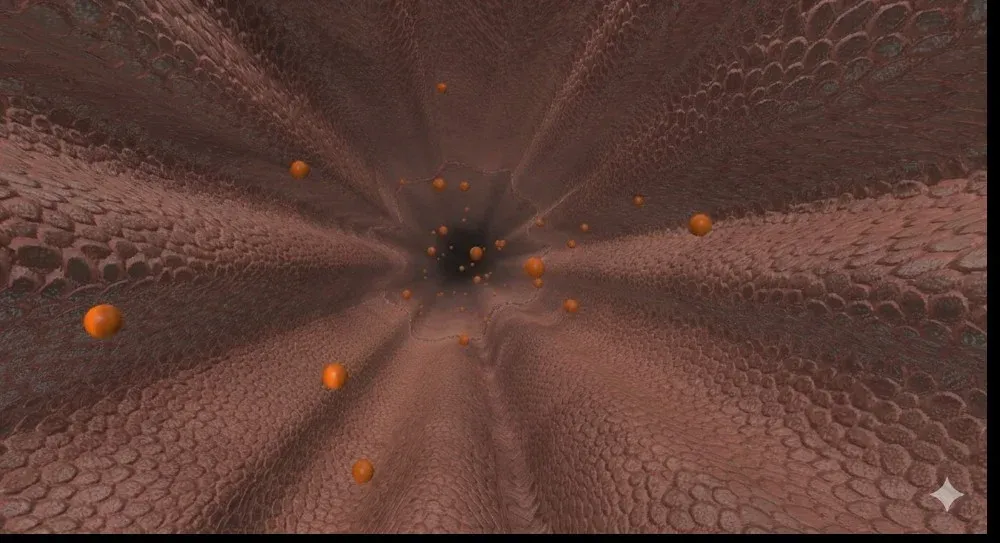
- A bronchus opening into alveolar sacs
- The respiratory membrane between alveolus and capillary
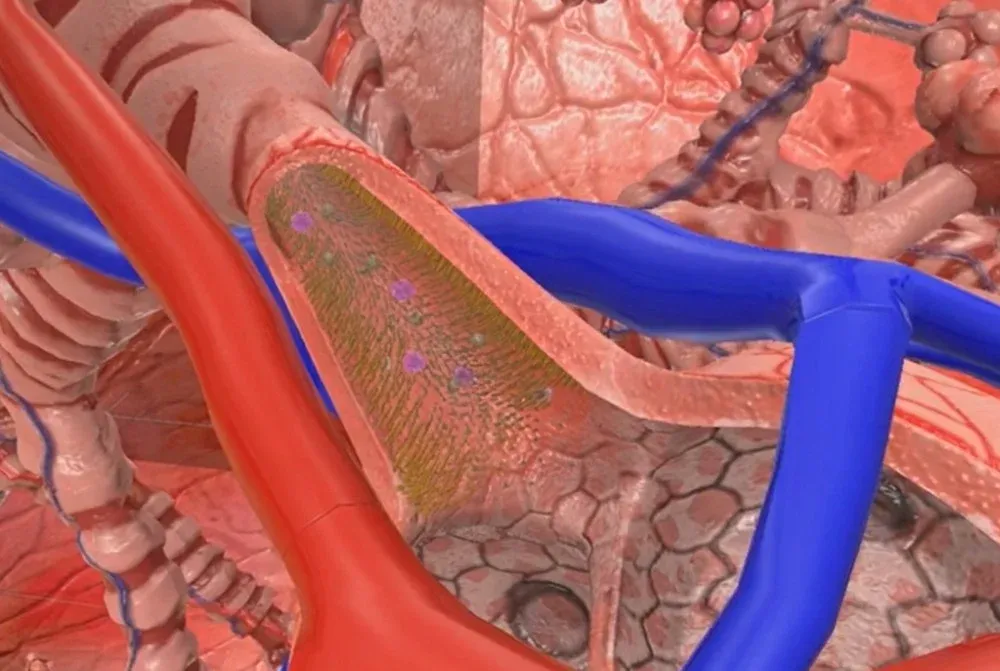
- The pulmonary artery and vein around the alveoli
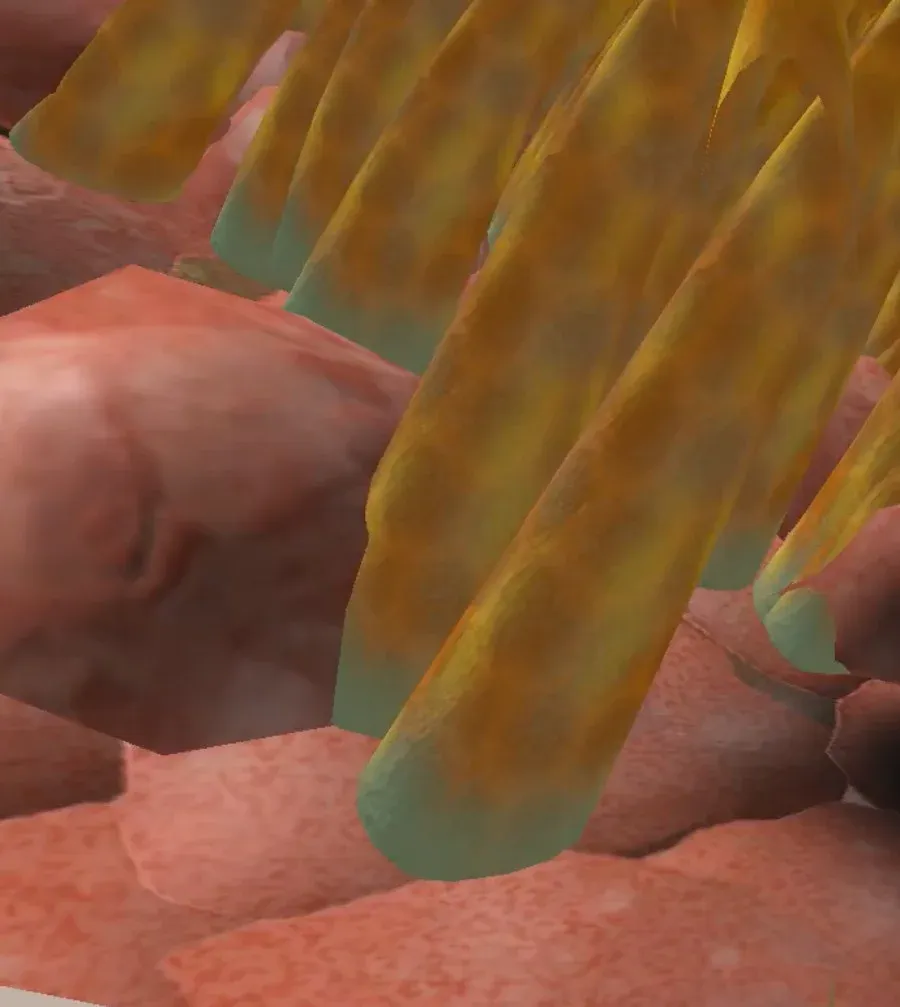
- Ciliated epithelium and goblet cells
Concepts it makes tangible
- The path of air from airway to alveolus
- Gas exchange across the respiratory membrane
- How oxygen and carbon dioxide travel in the blood
- The mucociliary escalator and airway defence
- How airway structure supports ventilation
How the simulation runs
- Travel down the airway toward the gas-exchange surface
- Watch oxygen and carbon dioxide cross the membrane
- Zoom to the ciliated epithelium to see airway clearance
How faculty use it
- Pre-lab or lecture support for respiratory physiology
- Self-paced revision of gas exchange
- Demonstration for large groups
- Assessment of structure and gas exchange
The 7thi AI tutor sits alongside the whole experience, scaffolding the difficult parts and giving subject-aware answers in context. Built-in assessment lets faculty see, per student, who has grasped which concepts - without grading another paper.
How the module works
Students travel through the respiratory system across scales that no diagram can connect. They descend the upper airway and bronchial tree into an alveolar sac, cross the respiratory membrane at the alveolar-capillary interface where oxygen and carbon dioxide are exchanged, and follow those gases into the surrounding pulmonary vessels. Zooming to the airway lining reveals the ciliated epithelium and goblet cells, and the module shows the mucociliary escalator in motion, sweeping the mucus layer and trapped particles up and out. Structure and function are shown together, at life-like scale, throughout.
What students take away
A student can trace the path of air from the upper airway to the alveolus, explain how gas exchange occurs across the respiratory membrane, and describe how the mucociliary escalator defends the airway. They understand how the branching of the bronchial tree, the alveolar surface area and the thinness of the respiratory membrane all support efficient ventilation - respiration understood as an integrated system.
In the classroom
Physiology and biology courses use the module to make gas exchange concrete, before or alongside the lecture that introduces it. Nursing, paramedic and respiratory-therapy programmes use it to build the structural understanding that clinical practice relies on, and it works as revision for a topic students often find abstract. Travelling the airway at scale gives a shared reference for later teaching on ventilation and disease.
Interactive features and modes
Students travel down the airway into an alveolar sac, cross the respiratory membrane at the gas-exchange interface, and follow oxygen and carbon dioxide into the surrounding vessels. Zooming to the airway lining reveals the ciliated epithelium and shows the mucociliary escalator in motion. Throughout, structure and function are shown together at life-like scale, so the journey connects scales that diagrams usually keep apart.
Why it matters
Respiration spans an enormous range of scale, from whole-lung mechanics down to a single molecule crossing a membrane, and conventional teaching breaks that continuous journey into disconnected pictures. The alveolar-capillary interface where exchange actually happens is far too small to observe, and the mucociliary escalator is a moving process that a still image cannot capture. Travelling the airway in VR lets students experience the whole journey as one continuous, correctly scaled system.
The bigger picture
Respiration is genuinely a multi-scale phenomenon, and that is exactly why it resists conventional teaching: the whole-lung mechanics, the alveolar structure and the molecular exchange at the membrane are usually presented as three disconnected pictures at three different scales. Travelling from the airway down to the alveolar-capillary interface and across the respiratory membrane connects those scales into one continuous journey, so students see how the branching airways, the vast alveolar surface area and the thinness of the membrane all serve the single purpose of efficient gas exchange.
Devices, deployment and assessment
Deploying the module is straightforward. It runs on Meta Quest, ClassVR and Pico headsets, on WebXR-compatible browsers, and on the desktop without any headset at all, so a department can start with the hardware it already has and scale as it grows. Faculty can assign the whole module or specific scenes, set it as pre-lab preparation or post-lab revision, and track progress on a dashboard that records concepts mastered, time per scene and assessment scores, with export to the LMS via xAPI. The 7thi AI tutor answers student questions in context throughout, so learners are never left stuck and faculty are not fielding the same question forty times.
Who this module is for
- Medical, nursing and allied health undergraduates studying respiratory physiology
- Biology and physiology students covering gas exchange
- Paramedic, respiratory therapy and health science programmes
- Faculty running revision on a process students find abstract
Syllabus alignment
Where this module fits.
University syllabi
We map this module to your institution's own respiratory physiology syllabus before deployment. Request a custom mapping.
Competency-based curriculum (Global)
Aligned with competency-based medical and nursing education outcomes for respiratory physiology. Detailed mapping available on request.
NMC (India)
Supports National Medical Commission competency outcomes for the respiratory system. Detailed mapping available on request.
Keep exploring
Related modules.
See Respiratory System live in a demo.
Thirty minutes, the full module, your curriculum questions answered.
What do students travel through?
The upper airway and bronchial tree, a bronchus opening into alveolar sacs, the respiratory membrane between alveolus and capillary, the pulmonary vessels around the alveoli, and the ciliated epithelium lining the airway.
How is gas exchange shown?
Students watch oxygen and carbon dioxide cross the respiratory membrane at the alveolar-capillary interface, then follow those gases as they are carried away in the blood.
What is the mucociliary escalator, and is it covered?
It is the coordinated beating of cilia that moves the mucus layer and trapped particles up and out of the airway. The module zooms to the ciliated epithelium and goblet cells so students can see it working.
Does it explain how airway structure supports ventilation?
Yes. The branching of the bronchial tree, the surface area created by the alveoli, and the thinness of the respiratory membrane are all shown as design features rather than described in the abstract.
Is the assessment graded automatically?
Yes. Scores reach the faculty dashboard immediately, pass thresholds are adjustable, and results export to your LMS via xAPI.
Is this mapped to our curriculum?
It is mapped to ABET, NBA and equivalent frameworks, and we map it to your own respiratory system syllabus before deployment. Request a custom mapping.
Can this be used in a flipped classroom?
Yes. Students complete Respiratory System before the lecture, so class time goes on analysis and discussion rather than first exposure to the topic.
Does it integrate with our LMS?
Yes. Moodle, Canvas and Blackboard are supported, with SSO and xAPI export of session data and assessment results.
What do students travel through?
The upper airway and bronchial tree, a bronchus opening into alveolar sacs, the respiratory membrane between alveolus and capillary, the pulmonary vessels around the alveoli, and the ciliated epithelium lining the airway.
How is gas exchange shown?
Students watch oxygen and carbon dioxide cross the respiratory membrane at the alveolar-capillary interface, then follow those gases as they are carried away in the blood.
What is the mucociliary escalator, and is it covered?
It is the coordinated beating of cilia that moves the mucus layer and trapped particles up and out of the airway. The module zooms to the ciliated epithelium and goblet cells so students can see it working.
Does it explain how airway structure supports ventilation?
Yes. The branching of the bronchial tree, the surface area created by the alveoli, and the thinness of the respiratory membrane are all shown as design features rather than described in the abstract.
Is the assessment graded automatically?
Yes. Scores reach the faculty dashboard immediately, pass thresholds are adjustable, and results export to your LMS via xAPI.
Is this mapped to our curriculum?
It is mapped to ABET, NBA and equivalent frameworks, and we map it to your own respiratory system syllabus before deployment. Request a custom mapping.
Can this be used in a flipped classroom?
Yes. Students complete Respiratory System before the lecture, so class time goes on analysis and discussion rather than first exposure to the topic.
Does it integrate with our LMS?
Yes. Moodle, Canvas and Blackboard are supported, with SSO and xAPI export of session data and assessment results.