
See it
Inside the module.
Learning objectives
By the end of this module, students will be able to:
Understand the role of a substation in power transmission and distribution
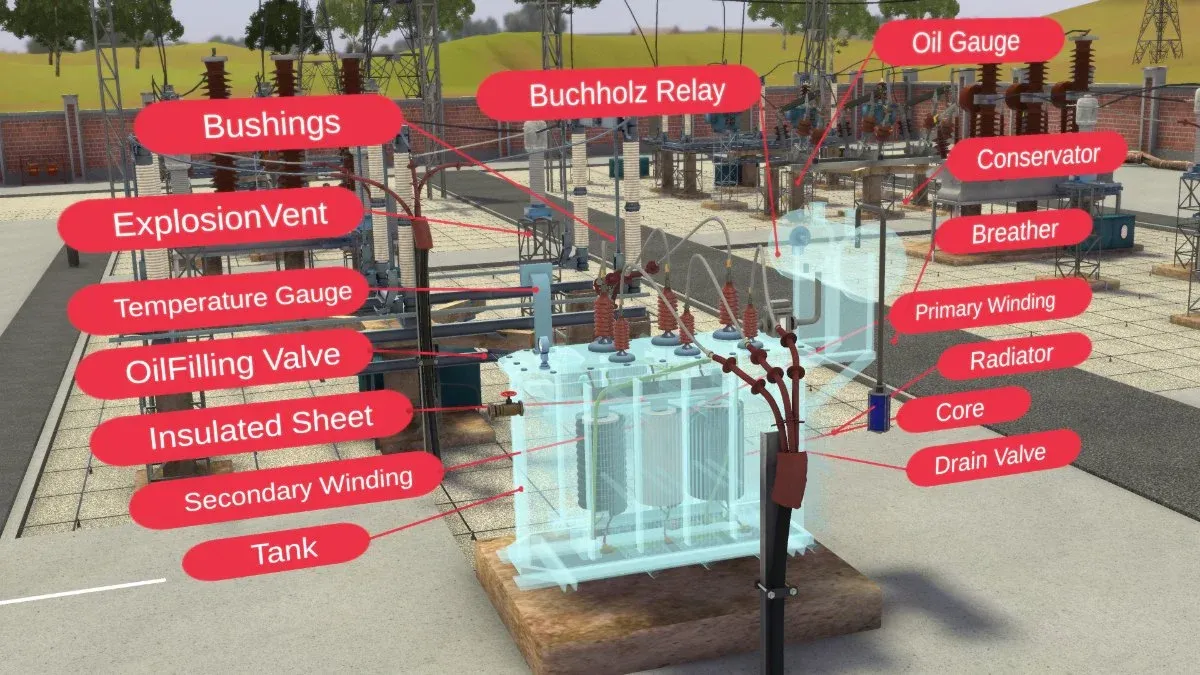
Identify major equipment - transformers, breakers, isolators, CTs, PTs, busbars, relays, and surge arresters
Understand how voltage is stepped up or down for efficient power transfer
Visualise the flow of power from incoming lines to outgoing feeders
Understand protection, switching, metering, isolation, and earthing systems
Relate substation equipment to real grid operation, reliability, and electrical safety
A substation you can walk through, safely.
An electrical substation receives power from generating stations or transmission lines, transforms voltage levels, enables switching and protection, and distributes power to outgoing feeders. It is essential for grid stability, fault isolation, voltage regulation, and reliable supply - and almost impossible to explore safely in real life.
This module is a structured virtual industrial visit, not a simulation experiment. In Guided Tour Mode, learners are taken through the substation section by section with explanations of each major system. In Self-Explore Mode, they move at their own pace through the switchyard, transformer area, control room, protection panels, busbar arrangement, and feeder bays.
The tour explains power transformers, circuit breakers, isolators, busbars, CTs and PTs, lightning arresters, relay panels, the earthing grid, and incoming and outgoing feeders, alongside concepts such as switching operation, fault protection, insulation coordination, metering, grounding, and substation safety zones - bridging classroom theory and real infrastructure.
Why tour a substation virtually?
- A live substation is among the most restricted environments in the power sector. Student access is effectively impossible.
- Where a visit does happen, the class stays behind a fence and sees equipment at a distance.
- Equipment can be examined up close and identified individually, which is the actual learning objective.
- The layout logic - why equipment sits where it does - only becomes clear when you can walk the power flow.
Equipment on the tour
- Power transformers and their bushings
- Circuit breakers and isolators
- Busbars and feeder bays
- Current transformers (CTs) and potential transformers (PTs)
- Lightning arresters and surge protection
- Relay and protection panels
- Earthing grid and safety zones
Concepts it makes tangible
- The substation's role in transmission and distribution
- Stepping voltage up and down for efficient transfer
- Power flow from incoming lines to outgoing feeders
- Switching, protection, isolation, and metering
- Insulation coordination and grounding
- Fault isolation and grid reliability
On the tour
- Guided Tour Mode walks each system section by section
- Self-Explore covers the switchyard, control room, and feeder bays
- Individual equipment can be examined up close
How faculty use it
- Virtual industrial visit to hard-to-access infrastructure
- Pre-visit briefing before a real substation tour
- Safe exploration of high-voltage equipment
- Guided walkthrough and assessment for large cohorts
How the module works
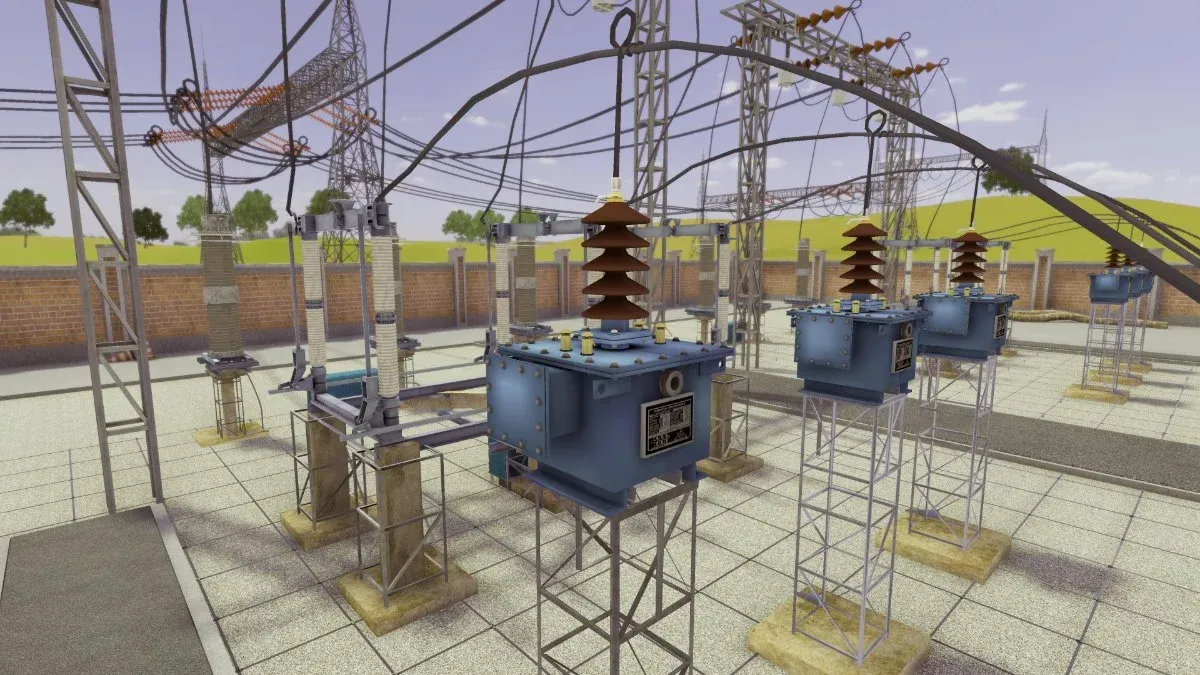
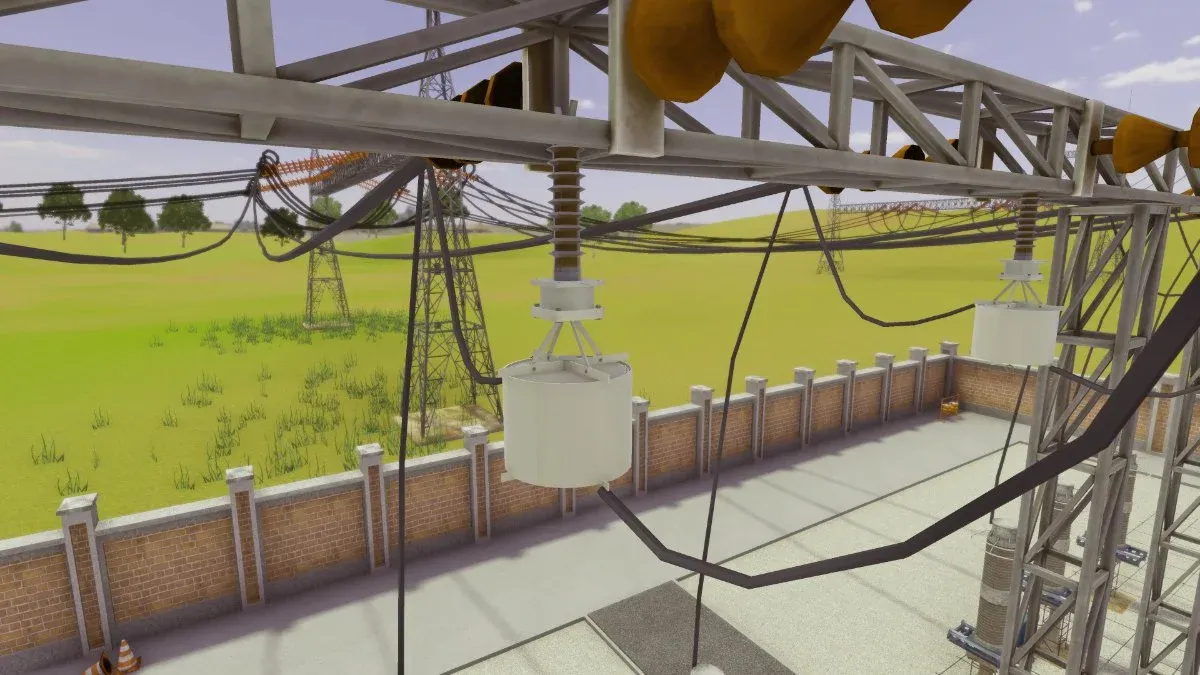
The module is a guided walk through a working substation, taking students into areas a real visit never reaches. They move through the switchyard, the transformer area, the control room, the protection and relay panels and the feeder bays, examining each piece of equipment up close: power transformers and bushings, circuit breakers, isolators, busbars, current and potential transformers, lightning arresters and the earthing grid. Every item is explained by its role - switching, protection, isolation or metering - so students learn why a breaker and an isolator are both present, not merely what each looks like. Walking the power flow from incoming lines to outgoing feeders makes the layout logic clear.
What students take away
Students finish able to identify every major item of substation equipment and state its function, explain how a substation steps voltage and routes power between transmission and distribution, and describe how protection isolates a fault without taking the whole installation out of service. They understand insulation coordination, grounding and the safety clearances that govern the site - which makes them far safer and more capable visitors if they later attend a real substation.
In the classroom
Power-systems and switchgear courses use the tour to teach equipment identification and layout - skills that are genuinely industrial and genuinely impossible to practise on a live installation. It prepares students for a supervised substation visit, so that the visit becomes a confirmation of knowledge rather than a distant look through a fence, and it stands alone where no visit is possible. Utility and industrial training programmes use it for the same familiarisation, giving new staff a safe way to learn a substation before setting foot in one.
Interactive features and modes
The tour moves through the switchyard, transformer area, control room, protection panels and feeder bays, with each piece of equipment examinable up close and explained by its function. Students can walk the power flow from incoming lines to outgoing feeders, so the layout logic becomes clear, and the safety zones are shown explicitly. It is a walkable, self-paced experience rather than a fixed slideshow, which is what lets students learn to read the substation the way an engineer does.
Why it matters
A live substation is one of the most restricted environments in the power sector. Student access is effectively impossible, and on the rare occasions a visit happens the class stays behind a fence and sees the equipment only at a distance. That distance is the whole problem: the learning objective is to identify equipment and understand the layout, and neither is possible from the perimeter. A virtual substation lets students walk right up to energised-looking apparatus in complete safety and study the layout the way an engineer actually needs to.
The bigger picture
A substation is a system whose layout encodes its function: equipment is arranged the way it is because power flows in a particular direction and because protection, isolation and metering each have a job to do at a particular point. Learning to read that layout - to see why a current transformer sits where it does, why a breaker and an isolator are paired, how a fault is cleared without dropping the whole supply - is the foundation of power-systems practice. None of it can be learned from the perimeter of a live site, which is why walking the substation virtually, up close and in safety, teaches what a real visit structurally cannot.
Devices, deployment and assessment
Deploying the module is straightforward. It runs on Meta Quest, ClassVR and Pico headsets, on WebXR-compatible browsers, and on the desktop without any headset at all, so a department can start with the hardware it already has and scale as it grows. Faculty can assign the whole module or specific scenes, set it as pre-lab preparation or post-lab revision, and track progress on a dashboard that records concepts mastered, time per scene and assessment scores, with export to the LMS via xAPI. The 7thi AI tutor answers student questions in context throughout, so learners are never left stuck and faculty are not fielding the same question forty times.
Who this module is for
- Electrical engineering undergraduates from Year 2 in power systems, switchgear and protection
- Diploma and polytechnic electrical programmes
- Utility and industrial training providers covering substation familiarisation
- Faculty briefing students before a supervised substation visit
Syllabus alignment
Where this module fits.
ABET (United States)
Supports Student Outcome 1 through engineering knowledge of power systems, transmission, distribution, and protection equipment, and Student Outcome 7 through applied learning via immersive industrial exposure.
NBA (India)
Maps to Course Outcomes in Power Systems, Protection and Switchgear, and High Voltage Engineering, supporting POs around engineering knowledge, investigation, safety, and modern tool usage (notably PO5).
University syllabi
Maps to unit topics, industrial-visit requirements, lab demonstrations, course outcomes, and assessment rubrics. Request a custom mapping.
AICTE / NEP 2020
Aligns with Electrical Engineering, Power Systems, and Protection and Switchgear outcomes, supporting experiential, visualization-led, and industry-connected learning.
Keep exploring
Related modules.
See Electrical Substation live in a demo.
Thirty minutes, the full module, your curriculum questions answered.
Which substation equipment is covered?
Power transformers and bushings, circuit breakers, isolators, busbars and feeder bays, current and potential transformers, lightning arresters, relay and protection panels, and the earthing grid.
Does it explain what each device is for?
Yes. Each item is explained by its role in switching, protection, isolation or metering, so students learn why a breaker and an isolator are both present rather than just what they look like.
What power systems concepts does the tour build?
The substation's role in transmission and distribution, stepping voltage for efficient transfer, power flow from incoming lines to outgoing feeders, insulation coordination, grounding and fault isolation.
Is it useful before a real site visit?
That is one of its strongest uses. Students who already recognise the equipment and understand the safety zones make far better visitors, and identification work is done before anyone is near live apparatus.
Does it integrate with our LMS?
Yes. Moodle, Canvas and Blackboard are supported, with SSO and xAPI export of session data and assessment results.
What prior knowledge do students need?
Foundation-level power systems. The module suits UG Year 2+ and above, including diploma and polytechnic cohorts.
How long is a typical session?
About 45 minutes for a full run including assessment. Students can pause and resume, and faculty can assign specific parts rather than the whole module.
Which headsets does this module run on?
HTC, Meta Quest, ClassVR, WebXR, plus any WebXR-compatible browser. It also runs on desktop without a headset, which covers faculty preview and remote cohorts. OpenXR and 6DOF headsets are supported.
Which substation equipment is covered?
Power transformers and bushings, circuit breakers, isolators, busbars and feeder bays, current and potential transformers, lightning arresters, relay and protection panels, and the earthing grid.
Does it explain what each device is for?
Yes. Each item is explained by its role in switching, protection, isolation or metering, so students learn why a breaker and an isolator are both present rather than just what they look like.
What power systems concepts does the tour build?
The substation's role in transmission and distribution, stepping voltage for efficient transfer, power flow from incoming lines to outgoing feeders, insulation coordination, grounding and fault isolation.
Is it useful before a real site visit?
That is one of its strongest uses. Students who already recognise the equipment and understand the safety zones make far better visitors, and identification work is done before anyone is near live apparatus.
Does it integrate with our LMS?
Yes. Moodle, Canvas and Blackboard are supported, with SSO and xAPI export of session data and assessment results.
What prior knowledge do students need?
Foundation-level power systems. The module suits UG Year 2+ and above, including diploma and polytechnic cohorts.
How long is a typical session?
About 45 minutes for a full run including assessment. Students can pause and resume, and faculty can assign specific parts rather than the whole module.
Which headsets does this module run on?
HTC, Meta Quest, ClassVR, WebXR, plus any WebXR-compatible browser. It also runs on desktop without a headset, which covers faculty preview and remote cohorts. OpenXR and 6DOF headsets are supported.