
See it
Inside the module.
Learning objectives
By the end of this module, students will be able to:
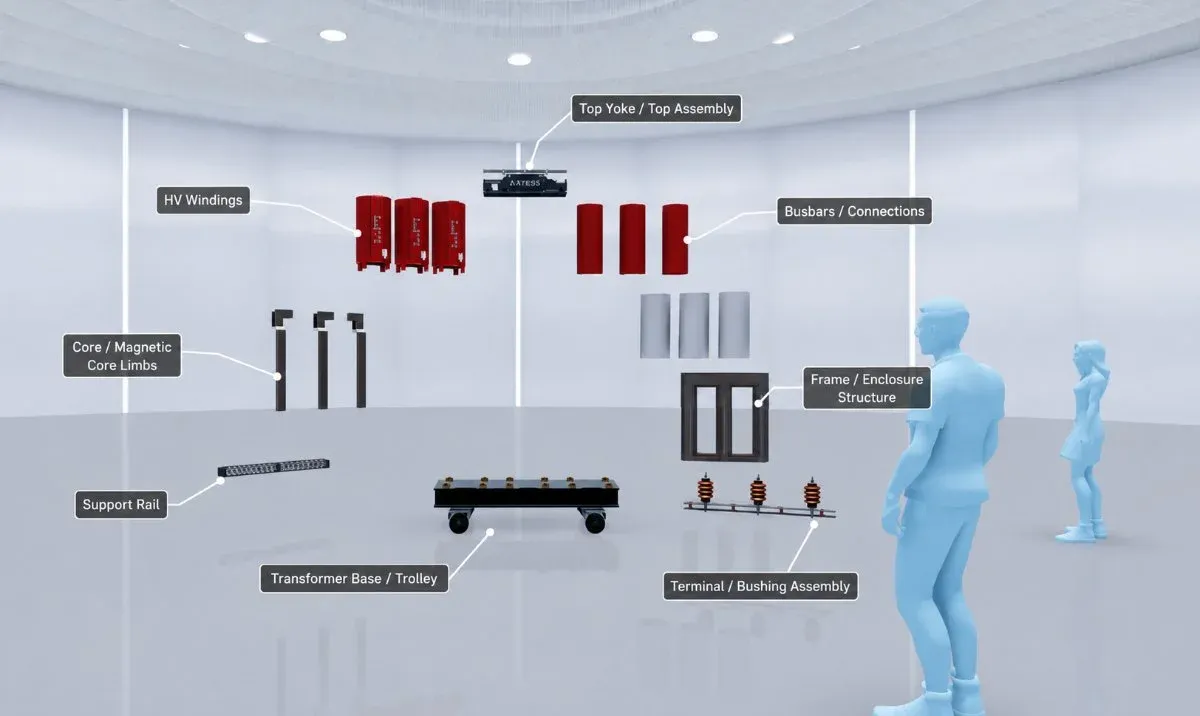
Identify the key parts - core, primary and secondary windings, insulation, terminals, busbars, cooling ducts, enclosure, and temperature sensors
Understand how voltage is stepped up or down using electromagnetic induction
Visualise magnetic flux flowing through the laminated core
Understand the role of insulation, air cooling, resin casting, and ventilation
Relate the winding turns ratio to voltage transformation
Understand basic transformer losses - copper loss, core loss, and heating
A transformer you can take apart and switch on.
A dry type transformer transfers energy between circuits by electromagnetic induction without using liquid oil for cooling or insulation. It is common in indoor substations, commercial buildings, hospitals, data centres, and metro systems - anywhere fire safety and low maintenance matter.
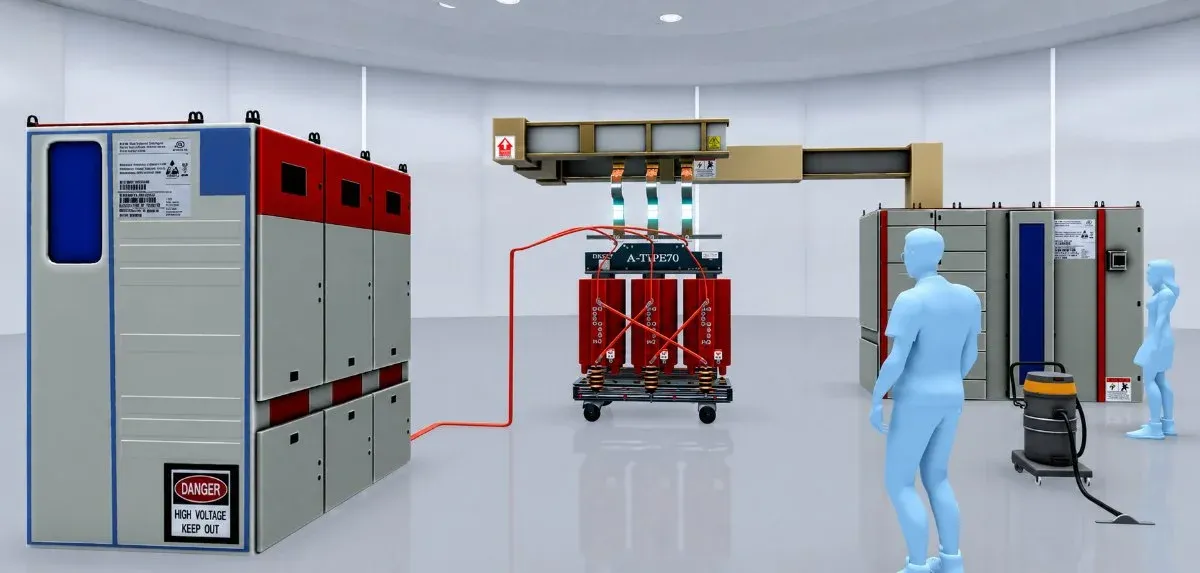
In this module, students explore the transformer as a complete machine: the core, high- and low-voltage windings, insulation system, busbar connections, terminal blocks, enclosure, cooling passages, clamps, and support structure. Learners interact with each part and see how it contributes to safe, efficient operation.
Why explore a transformer in 3D?
- Nobody opens an energised transformer, and a decommissioned one is a rare teaching asset.
- Flux is the entire mechanism and is completely invisible. Animating it is the only way to show it.
- Assembly and disassembly make the relationship between core, windings and insulation obvious in a way a sectional drawing does not.
- Students can compare dry type against oil-filled construction and see why fire safety drives the choice.
Parts you can inspect
- Laminated magnetic core and limbs
- High-voltage and low-voltage windings
- Cast-resin / air insulation system
- Busbar connections and terminal blocks
- Enclosure, cooling ducts, and ventilation
- Clamps, frame, and support structure
- Temperature sensors
Concepts it makes tangible
- Electromagnetic induction and mutual flux linkage
- How the turns ratio sets step-up / step-down voltage
- Flux flow through the laminated core
- No-load and on-load behaviour
- Air cooling, resin casting, and thermal management
- Copper loss, core loss, and heating
Modes of interaction
- Assembly / Disassembly to separate and inspect each part
- Working Mode animates flux and induced voltage
- X-Ray-style views expose the internal core and windings
How faculty use it
- Pre-lab or pre-lecture primer on transformer construction
- Flipped classroom - explore at home, analyse in class
- Safe alternative to opening a live transformer
- Assessment of parts, working, and losses
A working mode shows alternating current in the primary winding creating a changing flux in the laminated core and inducing voltage in the secondary - stepping voltage up or down by the turns ratio, with no direct electrical contact between circuits. It also covers flux linkage, no-load and load behaviour, insulation coordination, thermal management, and core and copper losses. The 7thi AI tutor and built-in assessment run throughout.
How the module works
Students take the machine apart and put it back together. Assembly and disassembly separate the laminated core, the high-voltage and low-voltage windings, the cast-resin insulation, the busbars and the cooling ducts, so the relationship between the parts becomes obvious rather than inferred from a sectional drawing. X-ray views expose the core limbs and winding arrangement without dismantling anything. Then a working mode animates the mechanism: alternating current in the primary sets up a changing magnetic flux in the core, that flux links the secondary and induces a voltage, and the turns ratio between the windings sets whether the output is stepped up or down - all with no electrical connection between the two circuits.
What students take away
A student can explain what distinguishes a dry type transformer from an oil-filled one and why that difference matters for fire safety and siting, identify every major component and its function, and describe how mutual induction transfers energy across the turns ratio. They understand core loss and copper loss, the heating these produce, and how air cooling, ventilation ducts and temperature sensors manage it - a complete picture of both construction and operation.
In the classroom
Transformer and electrical-machines courses use the module as a flipped-classroom primer and as pre-lab preparation. Students explore the construction and operation at their own pace beforehand, so lecture and lab time can go on analysis and measurement rather than on first familiarisation. It also suits building-services and electrical-installation programmes, where the dry type transformer is the unit students will actually meet in hospitals, data centres and commercial buildings, and where its fire-safety advantages are part of the design rationale they need to understand.
Interactive features and modes
Students can assemble and disassemble the machine part by part, use X-ray views to see the core limbs and windings without dismantling anything, and switch to a working mode that animates the flux linking primary and secondary. The turns ratio, the cooling path and the temperature-management features can each be examined in turn, so both the construction and the operating principle are covered in a single, coherent experience.
Why it matters
Dry type transformers are chosen wherever a fire load cannot be tolerated: indoor substations, hospitals, data centres, ships and metro systems. Using solid cast-resin insulation and air cooling instead of oil removes the fire and containment risk that comes with an oil-filled unit. Yet a transformer is sealed and energised in service and opened only during major maintenance, so students almost never see inside one. Taking a virtual machine apart, and then animating the invisible flux that makes it work, teaches in minutes what a photograph of a sealed tank never could.
The bigger picture
The dry type transformer is a clear illustration of how a single design constraint - eliminating the fire and containment risk of insulating oil - shapes an entire machine. Choosing air and cast resin over oil changes the cooling strategy, the insulation system, the physical form and the places the transformer can safely be installed. Understanding that chain of consequences, rather than just memorising a parts list, is what lets an engineer choose the right transformer for a setting and explain why. Seeing the machine in three dimensions, and watching the invisible flux that actually does the work, makes both the construction logic and the operating principle concrete.
Devices, deployment and assessment
Deploying the module is straightforward. It runs on Meta Quest, ClassVR and Pico headsets, on WebXR-compatible browsers, and on the desktop without any headset at all, so a department can start with the hardware it already has and scale as it grows. Faculty can assign the whole module or specific scenes, set it as pre-lab preparation or post-lab revision, and track progress on a dashboard that records concepts mastered, time per scene and assessment scores, with export to the LMS via xAPI. The 7thi AI tutor answers student questions in context throughout, so learners are never left stuck and faculty are not fielding the same question forty times.
Who this module is for
- Electrical engineering undergraduates from Year 2 studying transformers and machines
- Diploma and polytechnic electrical programmes
- Building services and electrical installation courses
- Faculty running flipped-classroom or pre-lab transformer sessions
Syllabus alignment
Where this module fits.
ABET (United States)
Supports Student Outcome 1 through engineering knowledge of electrical machines, electromagnetic induction, and power distribution, and Student Outcome 6 through visualization-led investigation of machine behaviour.
NBA (India)
Maps to Course Outcomes in Electrical Machines and Power Systems, supporting POs around engineering knowledge, problem analysis, investigation, and modern tool usage (notably PO5).
University syllabi
Maps to transformer theory, construction, working principle, lab demonstrations, course outcomes, and assessment rubrics. Request a custom mapping.
AICTE / NEP 2020
Aligns with Electrical Engineering, Electrical Machines, and Electrical Distribution outcomes, supporting experiential, visualization-led, and digital learning.
Keep exploring
Related modules.
See Dry Type Transformer live in a demo.
Thirty minutes, the full module, your curriculum questions answered.
What makes a dry type transformer different from an oil-filled one?
It uses air and solid insulation, typically cast resin, instead of oil for cooling and dielectric strength. That removes the fire load and oil-containment requirement, which is why they suit hospitals, data centres and metro systems.
Can students see inside the windings?
Yes. X-ray style views expose the laminated core limbs and the HV and LV winding arrangement without dismantling the unit, and disassembly mode separates each part for inspection.
Does the module show the transformer working?
Working mode animates alternating current in the primary creating changing flux in the core, and that flux inducing voltage in the secondary - with the turns ratio setting the step, and no electrical contact between circuits.
Which losses and thermal effects are covered?
Core loss and copper loss, the heating that results, and how air cooling, ventilation ducts, resin casting and temperature sensors manage it - alongside no-load and on-load behaviour.
Can this be used in a flipped classroom?
Yes. Students complete Dry Type Transformer before the lecture, so class time goes on analysis and discussion rather than first exposure to the topic.
Does it integrate with our LMS?
Yes. Moodle, Canvas and Blackboard are supported, with SSO and xAPI export of session data and assessment results.
How does this fit alongside lectures?
Most departments use it as a primer before the lecture or as revision after it, so class time is spent on analysis rather than first exposure to the machine.
What prior knowledge do students need?
Foundation-level transformers. The module suits UG Year 2+ and above, including diploma and polytechnic cohorts.