
VR Module · Civil · Engineering
Concrete Placer Boom
Construction Equipment
See it
Inside the module.
Learning objectives
By the end of this module, students will be able to:
Identify the major parts of a concrete placer boom truck
Understand how concrete is pumped, transferred, and placed on site
Explain the role of the hopper, pump, pipeline, boom sections, hydraulic system, outriggers, and end hose
Understand boom movement, reach, positioning, and safe concrete placement
Relate concrete placing equipment to real construction site workflows
Understand site considerations such as stability, pumping pressure, pipe blockage, work-zone safety, and placement sequence
Mechanised concrete placement, as a working system.
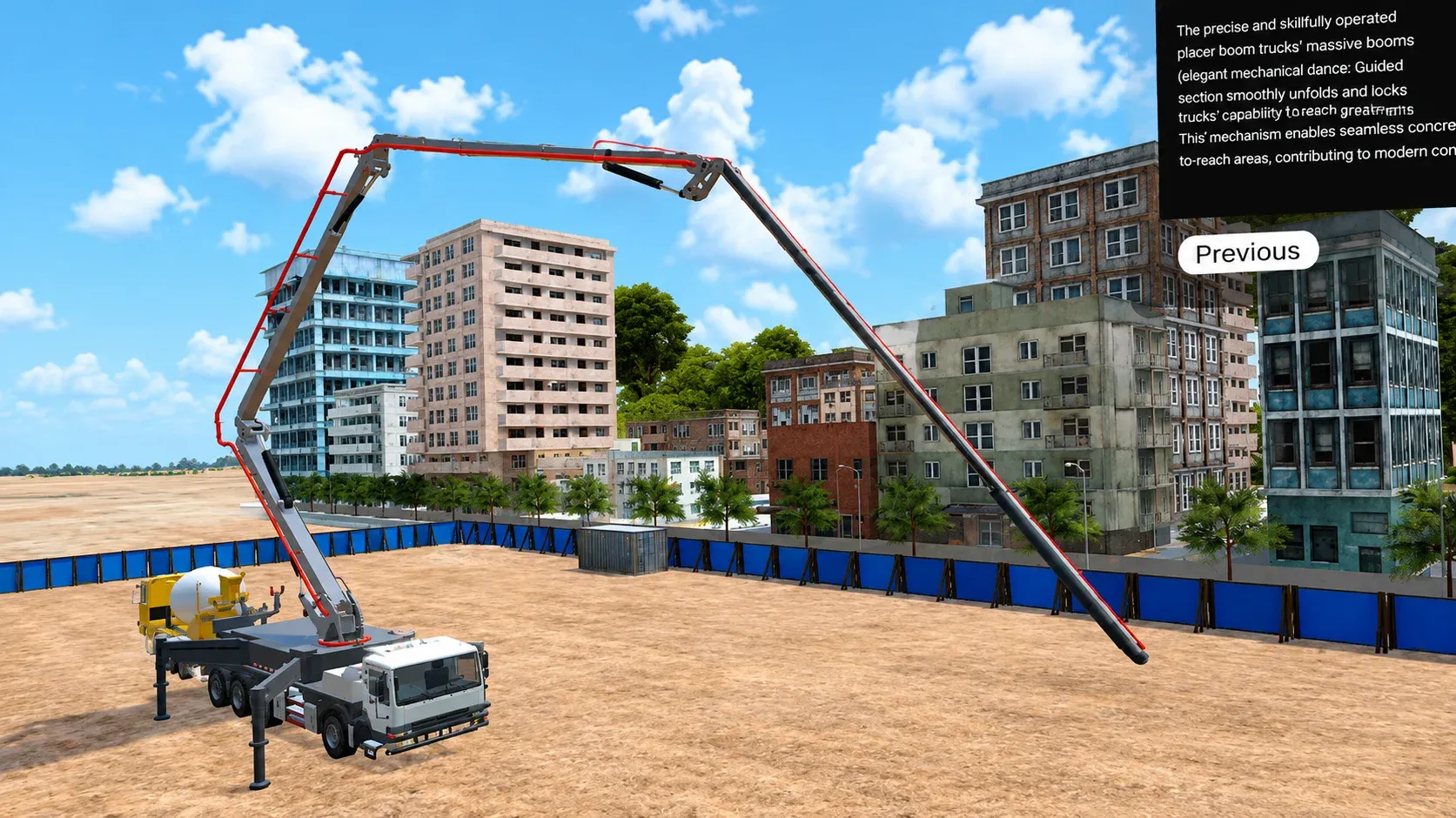
A concrete placer boom truck - also called a truck-mounted concrete boom pump - transports and places concrete efficiently at construction sites. It combines a concrete pump, hydraulic boom, delivery pipeline, and end hose on a mobile truck chassis, allowing concrete to be placed at height, depth, or distance without manual transportation.
In this iXRLabs machine module, learners view the placer boom truck as a complete working system. The module explains the flow of concrete from the mixer truck into the hopper, through the pumping mechanism, along the delivery pipeline, and finally through the boom and end hose to the placement location.
It covers the truck chassis, hopper, agitator, pumping cylinders, S-valve, hydraulic pump, boom sections and joints, delivery pipes, end hose, outriggers, and control panel - and introduces concrete workability, pumpability, boom reach, discharge control, pipeline pressure, placement accuracy, outrigger stability, and safe operating zones. It works well for machine familiarisation, construction-equipment demonstration, and pre-site-visit learning.
Why study a placer boom truck in 3D?
- A working boom pump is one of the most dangerous machines to approach on a live site. The exclusion zone exists for good reason.
- The pumping cylinders and S-valve are sealed inside the machine and never visible in operation.
- Boom articulation, reach and outrigger setup can be studied in isolation, paused and repeated.
- Students see the machine as one continuous concrete path rather than a set of disconnected parts.
Parts you can inspect
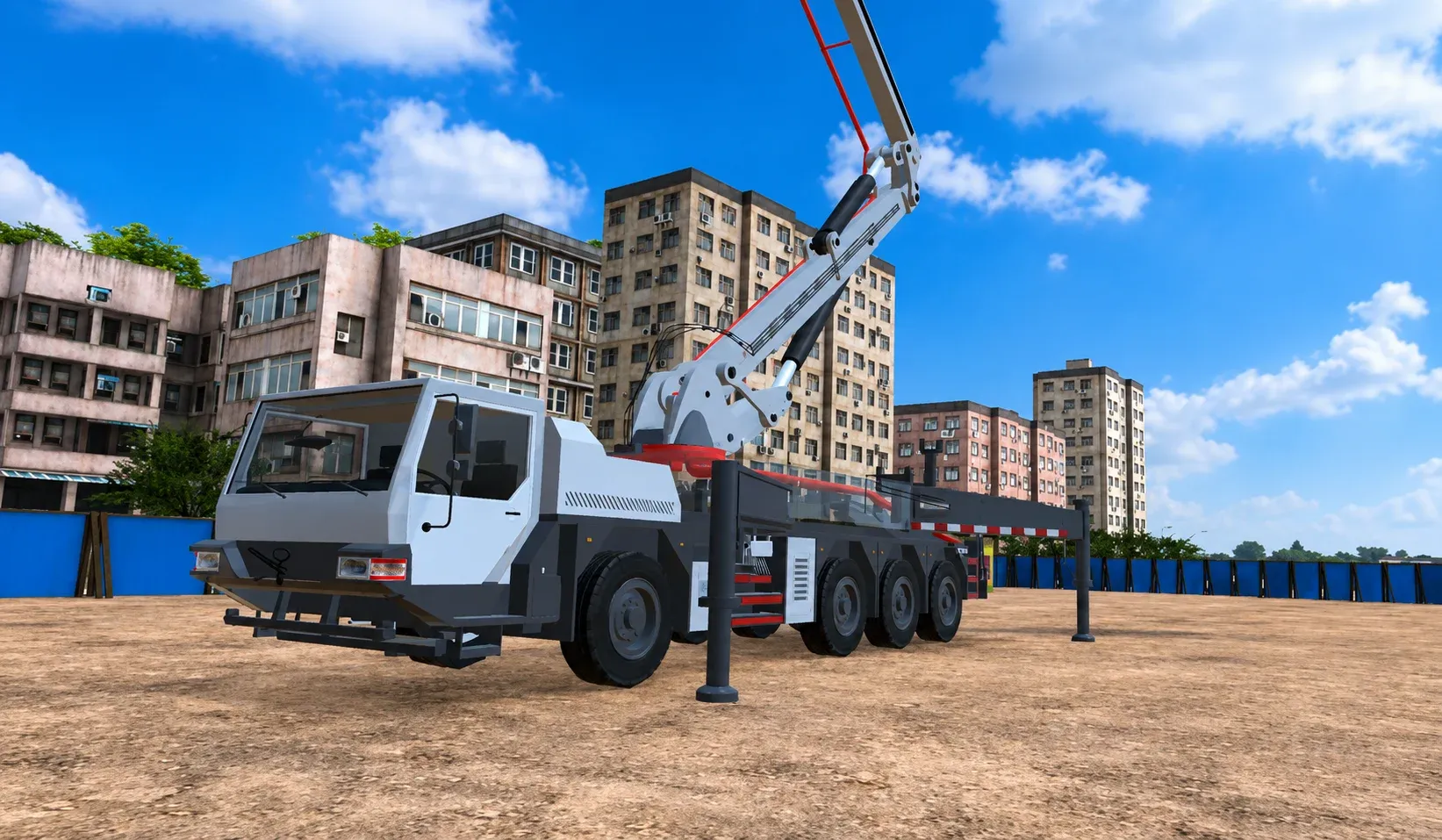
- Truck chassis and cab
- Hopper and agitator that receive ready-mix
- Pumping cylinders and S-valve
- Delivery pipeline running along the boom
- Boom sections and articulating joints
- End hose at the placement point
- Outriggers and stabilising legs
- Hydraulic system and control panel
Concepts it makes tangible
- Concrete workability and pumpability
- Boom reach, folding, and positioning
- Pipeline pressure and the causes of pipe blockage
- Discharge control and placement accuracy
- Outrigger stability and safe operating zones
- The full path of concrete from mixer to slab
How students explore it
- Guided Mode traces concrete from truck to placement
- Self-Explore lets learners walk around and inspect each system
- Boom articulation and outrigger setup can be studied in isolation
How faculty use it
- Machine familiarisation before students meet real equipment
- Pre-site-visit learning ahead of a construction tour
- Safe demonstration of a machine dangerous to approach on site
- Assessment checkpoint on parts, workflow, and site safety
How the module works
Students meet the machine as a complete truck and then take it apart, following the concrete path from end to end. Ready-mix arrives in the mixer truck and discharges into the hopper; the pumping cylinders and S-valve draw it in and force it into the delivery pipeline; the pipeline runs up and along the articulated boom; and the end hose places it exactly where it is needed. Because the pumping mechanism is normally sealed inside the machine, seeing the S-valve alternate and the cylinders reciprocate is the part that makes pumping click. Students also deploy the outriggers, fold and extend the boom, and see how reach and stability trade off against each other.
What students take away
A student who has worked through the module can name every major component of a truck-mounted boom pump and explain what it does, trace concrete as a single continuous path rather than a set of disconnected parts, and reason about the site problems that actually stop a pour: pipeline pressure and blockage, concrete workability and pumpability, discharge control, and outrigger stability. Critically, they understand the safe operating zone around a working boom and why it is enforced, which is knowledge that keeps people alive on real sites.
In the classroom
Within a construction equipment or concrete technology course, the module is most often used as plant familiarisation before students go anywhere near a real pour. A cohort that has already explored the machine in VR arrives on site able to identify components, follow the concrete path and, crucially, respect the exclusion zone - which makes the site visit both safer and more productive. It also supports construction management and site supervision courses, where the goal is not to operate the pump but to understand what it does, what can go wrong and how a pour is controlled and kept safe.
Interactive features and modes
Students can separate the machine into its component parts, follow the concrete path from hopper to end hose as a single continuous flow, and operate the boom and outriggers to see how reach and stability trade off. X-ray views expose the pumping cylinders and S-valve that are sealed inside a real machine, and each site problem - blockage, workability, discharge control, stability - can be explored on its own. The safe operating zone is shown explicitly so that respect for the machine is built in from the start.
Why it matters
A concrete boom pump is among the most productive machines on a modern site and among the most dangerous to be near. Booms strike overhead lines, pipelines burst under pressure, and trucks overturn when outriggers are set badly, so the exclusion zone around a working pump is strict and students are kept well outside it. That safety distance is exactly what prevents close study of the machine. In VR the danger is removed while the learning is not, so students arrive on site already able to read the machine and respect it.
The bigger picture
A boom pump is a good example of a machine whose danger and whose value come from the same source: it moves large volumes of concrete under high pressure, quickly, to places that are otherwise hard to reach. Understanding it means understanding a chain of coupled problems - concrete that must stay pumpable, a pipeline that must not block or burst, a boom that must reach without overturning the truck, and a placement that must be accurate and controlled. Seeing the whole machine as one system, rather than a set of parts, is what lets a future site engineer diagnose a blockage or a stability problem rather than just report it.
Devices, deployment and assessment
Deploying the module is straightforward. It runs on Meta Quest, ClassVR and Pico headsets, on WebXR-compatible browsers, and on the desktop without any headset at all, so a department can start with the hardware it already has and scale as it grows. Faculty can assign the whole module or specific scenes, set it as pre-lab preparation or post-lab revision, and track progress on a dashboard that records concepts mastered, time per scene and assessment scores, with export to the LMS via xAPI. The 7thi AI tutor answers student questions in context throughout, so learners are never left stuck and faculty are not fielding the same question forty times.
Who this module is for
- Civil engineering undergraduates from Year 2 studying construction equipment or concrete technology
- Diploma and polytechnic civil students preparing for site placements
- Construction management and site supervision programmes
- TVET and skills providers covering plant familiarisation and machinery safety
Syllabus alignment
Where this module fits.
ABET (United States)
Supports Student Outcome 1 through engineering knowledge of construction systems, concrete placement, and equipment operation, and Student Outcome 7 through applied, industry-oriented understanding of construction machinery.
NBA (India)
Maps to Course Outcomes in Construction Equipment, Concrete Technology, Building Construction, and Construction Management; supports POs on engineering knowledge, modern tool usage, and safety.
University syllabi
Maps to construction equipment, concrete technology, building construction, site management, and industrial training units. Request a custom mapping.
NSQF / TVET
Maps to competency outcomes in construction equipment awareness, concrete handling, site operations, machinery safety, and quality-conscious concrete placement.
Keep exploring
Related modules.
See Concrete Placer Boom live in a demo.
Thirty minutes, the full module, your curriculum questions answered.
Does the module show how concrete flows through the machine?
Yes. It traces concrete from the mixer truck into the hopper, through the pumping cylinders and S-valve, along the delivery pipeline, and out through the boom and end hose - as one continuous path.
Can students explore boom articulation and outrigger setup?
Yes. Learners see how the boom folds, extends and rotates to cover a placement area, and how the outriggers are deployed to hold the truck stable against the resulting overturning moment.
What site problems does it cover?
Pipeline pressure and the causes of pipe blockage, concrete workability and pumpability, discharge control and placement accuracy, outrigger stability, and safe operating zones around the boom.
Is it useful before a construction site visit?
That is one of its most common uses. Students who can already tell the hopper from the S-valve, and know why nobody stands under a boom, get more from a site tour and are safer on it.
How long is a typical session?
About 15 minutes for a full run including assessment. Students can pause and resume, and faculty can assign specific parts rather than the whole module.
Which headsets does this module run on?
HTC, Meta Quest, WebXR, plus any WebXR-compatible browser. It also runs on desktop without a headset, which covers faculty preview and remote cohorts. OpenXR and 6DOF headsets are supported.
Is the assessment graded automatically?
Yes. Scores reach the faculty dashboard immediately, pass thresholds are adjustable, and results export to your LMS via xAPI.
Is this mapped to our curriculum?
It is mapped to ABET, NBA and equivalent frameworks, and we map it to your own construction equipment syllabus before deployment. Request a custom mapping.