
A VR water-treatment site visit at the University of Leeds.
The University of Leeds ran its first virtual reality site-visit experience with iXRLabs, taking MSc students inside an immersive water treatment plant - bridging the gap between lecture theory and real-world practice.
At a glance
2 programmes
Helix Centre
Majority
The pilot
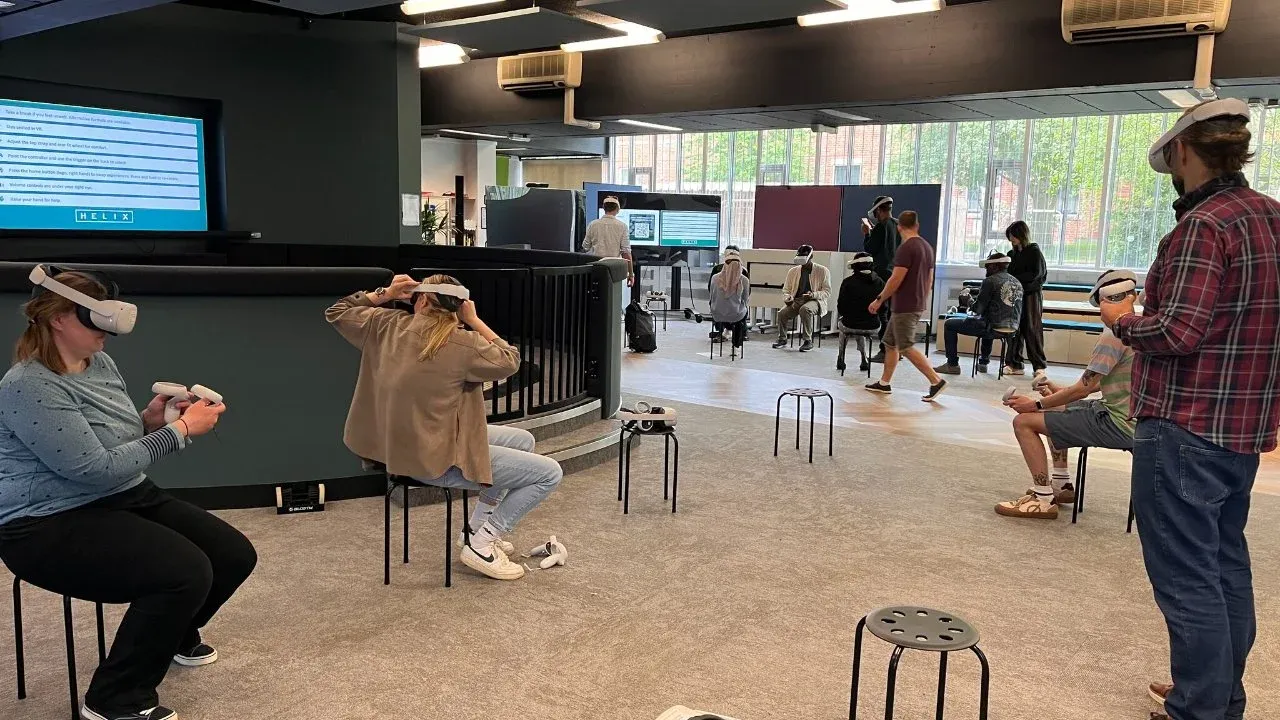
Working with iXRLabs, the University of Leeds launched its first VR site-visit experience, using immersive water treatment plant content as part of a pilot project. MSc students from two flagship programmes - Water, Sanitation and Health (WASH) and Environmental Engineering and Project Management (EEPM) - visited the Helix Centre for an immersive VR tour of the water treatment facility.
The aims
Reinforce concepts from lectures and coursework
Bridge the gap between theory and real-world practice
Provide a safe, accessible alternative to physical site visits
Help students visualise how unit processes are integrated - for use in their design projects
The response
The response was highly positive. Based on post-session surveys, the majority of students described the experience as engaging, innovative, and highly supportive of their learning. The initiative was funded by the Experiential Learning Fund as part of the Curriculum Redefined project, delivered with the University's Digital Education team.
From the session
Inside the Helix Centre during the iXRLabs VR water-treatment site visit, University of Leeds.
A safe, accessible alternative to a physical site visit
The University of Leeds ran its first VR site-visit experience with iXRLabs, taking MSc students inside an immersive water treatment plant. For programmes like Water, Sanitation and Health and Environmental Engineering and Project Management, site visits to real treatment works are enormously valuable and enormously difficult to arrange - constrained by access, safety, travel, capacity and timing.
A VR site visit removes those constraints while preserving much of the value. Every student on the programme can go inside the plant, see how the unit processes are arranged, and connect what they have learned in lectures to a realistic working environment, without the logistics and risk of a physical visit.
Bridging theory and practice
The pilot's explicit aims were to reinforce concepts from lectures and coursework, bridge the gap between theory and real-world practice, provide a safe and accessible alternative to a physical visit, and help students visualise how unit processes integrate - understanding they carry directly into their design projects. That last point is key: an environmental engineering student who has walked a treatment plant, even virtually, designs with a far clearer picture of how the pieces fit together.
The initiative was funded through the Experiential Learning Fund as part of the university's Curriculum Redefined project and delivered with its Digital Education team, which signals institutional backing for immersive site visits as a serious teaching tool.
Why it matters
The Leeds deployment shows how VR can extend one of the most valuable and most logistically difficult elements of engineering education - the site visit - to every student, safely and repeatably. From water treatment to power plants, immersive site visits offer a way to give a whole cohort the experiential understanding that physical visits can only ever provide to a few.
Why virtual site visits are gaining ground
Site visits have always been one of the most valuable elements of an engineering education and one of the most difficult to deliver. A working treatment plant, power station or construction site can host only a small number of visitors at a time, under supervision, at a moment that suits the operator rather than the academic calendar. Health and safety requirements, travel, insurance and sheer capacity mean that for a large postgraduate cohort, a meaningful visit to a live facility is often impossible to arrange for everyone. The result is that the students who most need to connect classroom theory to real infrastructure frequently cannot.
A virtual site visit changes that equation. Every student on the programme can go inside the facility, at the same standard, as many times as they need, with no travel and no risk. The immersive environment preserves the sense of scale and spatial arrangement that makes a real visit valuable, while removing the logistics that make it scarce. That is why institutions like Leeds are treating VR site visits not as a gimmick but as a serious extension of experiential teaching.
From pilot to programme
The Leeds deployment was run as a pilot, which is exactly the right way to introduce a new teaching mode into an established programme. By starting with two flagship MSc programmes and gathering structured feedback through post-session surveys, the university could evaluate the approach against its own students and its own learning objectives before committing more widely. The strongly positive response - with the majority of students describing the experience as engaging, innovative and supportive of their learning - provides the evidence a department needs to expand with confidence.
Backing the initiative through the Experiential Learning Fund and the Curriculum Redefined project, and delivering it with the university's Digital Education team, signals that this was a considered institutional investment rather than an isolated experiment. That combination of a careful pilot, honest evaluation and institutional support is a model other universities can follow when they weigh immersive site visits of their own.
What it means for engineering education
The Leeds pilot points to a broader shift in how practical engineering education can be delivered. Site visits, industrial equipment and real-world context have always been essential and always been scarce, rationed by safety, cost, distance and capacity. Immersive technology offers a way to give every student that experiential understanding, consistently and repeatably, without the constraints that have historically limited it. From water treatment to power generation, a virtual site visit can put a whole cohort inside a working facility, connect classroom theory to real infrastructure, and do so as often as the learning requires - which is why deployments like this one matter well beyond the programmes that ran them.
A foundation to build on
For the University of Leeds, running this pilot establishes a foundation that can grow. Having demonstrated that an immersive water-treatment site visit works for its MSc cohorts, and having captured the evidence to prove it, the university is well placed to extend the approach to other facilities and other programmes - power plants, process sites, laboratories and more. Each additional immersive site visit widens the range of real-world environments students can experience without leaving campus, and each builds on the delivery experience and institutional confidence the first pilot created. That is how a single successful pilot becomes a lasting part of how a university teaches.
About iXRLabs
iXRLabs is an AI-powered VR and XR lab platform for higher education, delivering immersive, hands-on lab modules across Engineering, Medical, Sciences and Nursing. The platform helps universities and colleges teach systems and equipment that are hard, expensive or unsafe to access in reality, with browser-based WebXR delivery, LMS integration, the 7thi AI tutor and built-in assessment - so immersive learning can reach a whole cohort, not just a single lab.
FAQ
Frequently asked questions.
What did the University of Leeds run with iXRLabs?
Which students took part?
What was the pilot trying to achieve?
How did students respond?
Who funded the initiative?
Bring immersive VR to your college.
Start with a focused deployment mapped to your programmes and hardware - the way Coleg Gwent did at HiVE on HTC VIVE - then expand across subjects and facilities.