
An immersive VR session at Murdoch University's DigiLab.
How a single iXRLabs VR workshop let Murdoch University students explore power stations and other complex engineering systems first-hand - in one sitting at the DigiLab in Perth.
At a glance
1
Exploring power stations in VR.
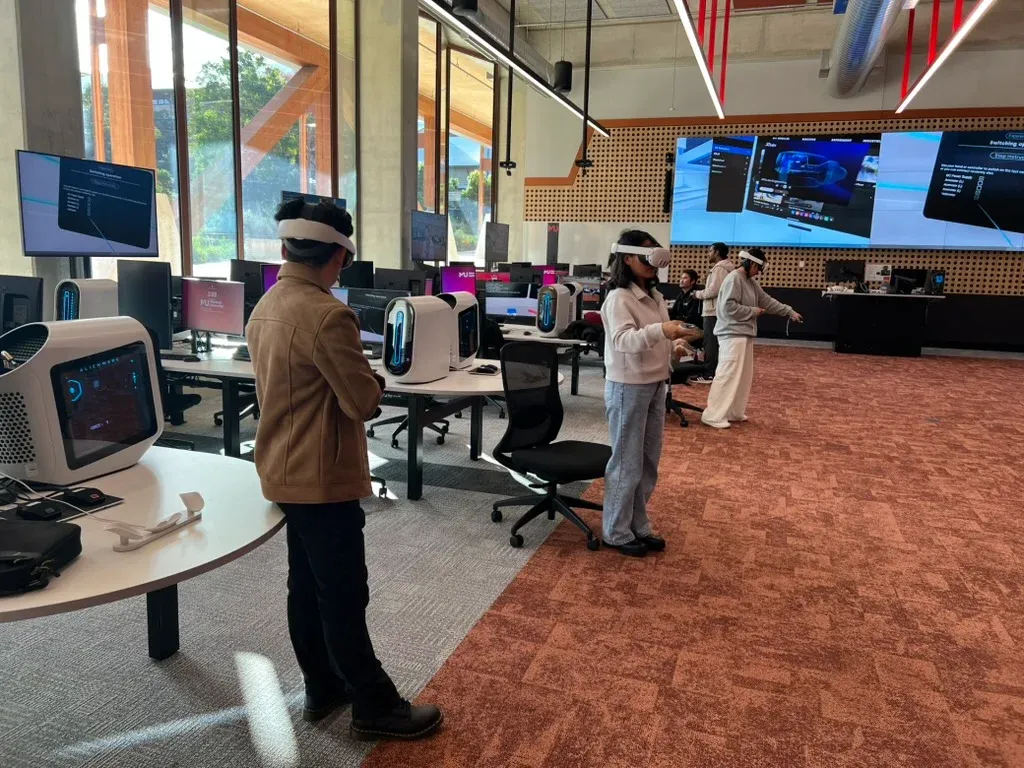
iXRLabs ran a single immersive VR session at Murdoch University's DigiLab, giving students a hands-on way to explore power stations and other engineering use cases in virtual reality. In one sitting, students could step inside and examine complex systems that are difficult to access or visualise in real life - experiencing both the technology and the engineering concepts behind it first-hand.
A self-contained immersive experience.
During the session, students used iXRLabs' VR modules to explore power stations and a range of other use cases - moving through and around equipment and systems that would be hard to see up close in the real world. The format was simple and self-contained: a single, guided immersive workshop at the DigiLab, designed to let students experience both the technology and the engineering concepts behind it. The two recordings above and below capture the session as it unfolded.
In their words
About Murdoch University.
Murdoch University is a public research university in Perth, Western Australia, established in 1973. Home to more than 25,000 students from around the world, Murdoch has a strong track record in immersive learning - including being the first Australian university to adopt mixed-reality teaching. Its DigiLab provides a space for students to engage with digital and immersive technologies such as iXRLabs' VR modules.
What one session delivered.
Students stepped inside power stations and complex equipment they would rarely see up close.
Students said it was a great way to explore and understand power stations and other use cases.
A single sitting was enough to show the value of immersive engineering learning.
Two recordings document the session for others to see the experience first-hand.
Hard-to-see systems made visible Students stepped inside power stations and complex equipment they would rarely see up close.
Positive student response Students said it was a great way to explore and understand power stations and other use cases.
Fast, tangible demonstration A single sitting was enough to show the value of immersive engineering learning.
Captured on video Two recordings document the session for others to see the experience first-hand.
One session, real understanding.
Even a single session can show the value of immersive learning. At Murdoch University's DigiLab, one VR sitting was enough for students to explore power stations and complex systems they would rarely get to see up close - a quick, tangible demonstration of how VR makes hard-to-access engineering understandable.
An immersive XR session at the DigiLab
Murdoch University ran an immersive XR session with iXRLabs at its DigiLab, the university's dedicated space for exploring emerging digital technologies. The session gave students and staff direct, hands-on experience of VR engineering modules in a facilitated setting, letting participants engage with immersive learning content first-hand rather than hearing about it.
Sessions like this play an important role in how immersive technology enters a university. A facilitated, hands-on session lets an institution and its people evaluate what VR engineering content actually feels like to use, which is the most reliable basis for deciding how and where to adopt it more widely.
The value of hands-on evaluation
There is a large difference between watching a video about VR learning and putting on a headset and working through a module. The DigiLab session gave Murdoch that direct experience, in a space purpose-built for exactly this kind of exploration. For students it was a taste of immersive engineering education; for the institution it was a concrete evaluation of the technology in use.
Innovation spaces like the DigiLab exist to bridge the gap between emerging technology and everyday teaching, and an immersive engineering session is a natural fit for that purpose.
Why it matters
The Murdoch session shows how universities can sensibly explore immersive learning: through a focused, facilitated, hands-on experience in a dedicated innovation space, where staff and students can evaluate the technology directly before any wider commitment. It is a low-risk, high-insight way to begin.
What a facilitated XR session offers
A single, facilitated immersive session is a deliberately low-commitment way for a university to engage with new technology, and it delivers value out of proportion to its modest scale. In one session at the DigiLab, students and staff moved from hearing about VR engineering education to actually experiencing it - putting on a headset, working through modules and forming a first-hand judgement of what immersive learning feels like in practice. That direct experience is worth far more than any description when an institution is deciding whether and how to adopt immersive learning.
For students, the session was a hands-on encounter with engineering content presented in a way a lecture cannot match. For the institution, it was a concrete, low-risk evaluation of the technology in a space purpose-built for exactly that kind of exploration.
The role of the innovation lab
Dedicated innovation spaces like Murdoch's DigiLab exist precisely to bridge the gap between emerging technology and everyday teaching. They give an institution a controlled environment in which to try new tools, gather reactions and decide what deserves wider investment, without disrupting core teaching while the evaluation happens. An immersive engineering session is a natural fit for that role: it showcases a concrete application of VR to a real curriculum area, and it lets staff and students assess the technology together.
This is how many successful technology adoptions begin - not with a large, top-down rollout, but with a focused, hands-on experience in a space designed for experimentation, from which a considered decision about scaling can follow.
Why it matters
The Murdoch session illustrates a sensible, evidence-led path into immersive learning. Rather than committing to a large deployment on faith, an institution can run a focused, facilitated session, let its own people evaluate the technology directly, and build any wider adoption on that first-hand understanding. For universities cautious about new technology - which is to say most of them - it is a model worth noting. A hands-on session in a dedicated innovation space turns an abstract proposition into a concrete, evaluated experience, which is the soundest possible basis for any decision that follows.
About iXRLabs
iXRLabs is an AI-powered VR and XR lab platform for higher education, delivering immersive, hands-on lab modules across Engineering, Medical, Sciences and Nursing. The platform helps universities and colleges teach systems and equipment that are hard, expensive or unsafe to access in reality, with browser-based WebXR delivery, LMS integration, the 7thi AI tutor and built-in assessment - so immersive learning can reach a whole cohort, not just a single lab.
FAQ
Frequently asked questions.
What did iXRLabs do at Murdoch University?
What did students explore in the session?
Where was the session held?
Can iXRLabs run full deployments beyond a single session?
More stories
Related case studies.
Bring immersive VR to your college.
Start with a focused deployment mapped to your programmes and hardware - the way Coleg Gwent did at HiVE on HTC VIVE - then expand across subjects and facilities.