
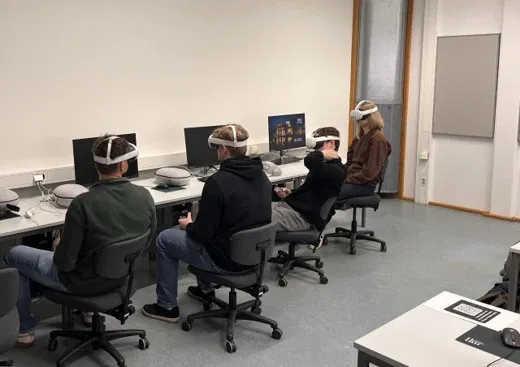
Virtual reality mechanical engineering lab at Mälardalen University.
How iXRLabs deployed its first immersive VR learning lab in Sweden - and how 56 mechanical engineering students rated its impact on visualizing complex systems and classroom engagement.
At a glance
1st
87.5%
89.3%
56
An immersive lab that makes invisible engineering visible.
iXRLabs deployed its first virtual reality (VR) learning lab in Sweden at Mälardalen University (MDU), bringing immersive, hands-on mechanical engineering simulations to students. The rollout was led on the university side by faculty member Avinash Renuke. In post-deployment surveys of 56 students, 87.5% rated the VR lab 4 or 5 out of 5 for helping them visualize complex engineering systems, and 89.3% rated it 4 or 5 for enhancing engagement - with not a single student rating its visualization value below 3.
The deployment demonstrates a repeatable outcome iXRLabs sees across higher-education partners: when students can step inside equipment that a physical campus lab cannot host - and manipulate it at any scale, on demand - abstract concepts become tangible and engagement rises measurably.
Mechanical engineering depends on seeing what can't easily be seen.
Core mechanical engineering competence rests on understanding systems that are difficult to observe directly: internal mechanisms, force and motion relationships, multi-part assemblies, and large, costly, or hazardous equipment that a campus lab can rarely host. Traditional 2D diagrams and static textbook figures leave students to mentally reconstruct three-dimensional behaviour - and that mental reconstruction is exactly where many lose the thread.
Mälardalen University wanted a way for students to explore this equipment and these concepts directly - regardless of whether the physical hardware was available on site - and to do so in a way that fit naturally into existing coursework.
Inaccessible equipment: machinery that is too large, expensive, or unsafe to keep in a teaching lab.
Spatial and conceptual gaps: 2D media that struggle to convey 3D systems, internal flows, and dynamic processes.
Engagement: the need to keep students actively involved rather than passively reading diagrams.
An iXRLabs VR learning lab, built into the curriculum.
iXRLabs deployed a VR learning lab with mechanical engineering modules that students access through immersive headsets. Inside the simulations, students examine equipment at any scale, take assemblies apart and put them back together, observe processes that are invisible or unsafe to watch in real life, and repeat each experiment as many times as they need. Because the lab is designed to sit alongside lectures and practicals rather than replace them, faculty can fold it directly into how they already teach.
Visualize: explore mechanisms, assemblies, and processes spatially - scaling and rotating them freely instead of inferring them from a flat diagram.
Access: interact with machinery that is too large, costly, or hazardous to keep in a physical campus lab.
Engage: learn by doing, with self-paced, repeatable practice that carries no setup cost or risk.
Faculty-led setup and integration.
A key reason the rollout translated into measured classroom outcomes - rather than a one-off demo - was faculty ownership. The setup, coordination, and curriculum integration were driven by Avinash Renuke, faculty at Mälardalen University, who championed immersive learning within the university's teaching environment and ensured the VR lab connected to what students were already studying.
What the students reported.
After using the VR lab, 56 mechanical engineering students across two cohorts - 32 first-year and 24 second-year - were surveyed on a 1-to-5 scale (1 = strongly disagree, 5 = strongly agree). The charts below show how students responded on two dimensions: their ability to visualize complex systems, and how engaged they felt.
87.5% rated the lab 4 or 5, and 69.6% gave the maximum score of 5. No student rated it below 3. First- and second-year cohorts responded almost identically - a mean of roughly 4.6 / 5 each.
89.3% rated the lab 4 or 5 for engagement, rising to 95.8% among second-year students, with the top rating the most frequent choice overall - a mean of roughly 4.5 / 5 .
Visualizing complex systems. Responses clustered firmly at the top of the scale: 87.5% of students rated the lab 4 or 5, and 69.6% gave it the maximum score of 5. Crucially, no student rated it below 3 - every response landed at the midpoint or above - and first- and second-year students responded almost identically (mean of roughly 4.6 / 5). That consistency suggests the visualization benefit holds regardless of how far along a student is in the programme, rather than helping only newcomers or only advanced learners.
Enhancing engagement. Engagement responses were similarly concentrated at the high end: 89.3% rated the lab 4 or 5, rising to 95.8% among second-year students, with the top rating the most frequent choice overall (mean of roughly 4.5 / 5). The pattern indicates that immersive, hands-on interaction does more than aid comprehension - it actively pulls students into the material.
What the deployment showed.
87.5% rated the VR lab 4-5/5 for helping them visualize complex systems, and not a single student rated it below 3.
89.3% rated the lab 4-5/5 for engagement, rising to 95.8% among second-year students.
Both first- and second-year cohorts reported clear benefit, with mean scores near 4.6/5 for visualization and 4.5/5 for engagement.
Embedding the lab into existing coursework - led by faculty - is what turned the technology into measurable classroom outcomes.
Strong visualization gains 87.5% rated the VR lab 4-5/5 for helping them visualize complex systems, and not a single student rated it below 3.
Higher engagement 89.3% rated the lab 4-5/5 for engagement, rising to 95.8% among second-year students.
Consistent across experience levels Both first- and second-year cohorts reported clear benefit, with mean scores near 4.6/5 for visualization and 4.5/5 for engagement.
Faculty ownership matters Embedding the lab into existing coursework - led by faculty - is what turned the technology into measurable classroom outcomes.
About Mälardalen University (MDU).
Mälardalen University (Swedish: Mälardalens universitet, MDU) is a public university founded in 1977, with campuses in Västerås and Eskilstuna, roughly an hour west of Stockholm. With around 18,000-19,000 students, MDU is recognised for its strengths in engineering, embedded systems, and future-energy research, and was the world's first university to be environmentally certified under the ISO 14001 standard. Its strong industry ties make it a natural home for applied, technology-forward teaching like immersive VR.
A model for immersive engineering education.
The Mälardalen University deployment shows that VR is not a novelty layer on top of engineering teaching - it addresses a specific, long-standing gap: the difficulty of seeing, accessing, and practising with complex or unavailable equipment. By turning that equipment into something students can hold, scale, and disassemble, immersive labs convert passive viewing into active understanding.
For universities weighing immersive learning, the takeaway is concrete: with faculty ownership and curriculum integration, a VR learning lab can deliver high student-rated value on both comprehension and engagement - and do so consistently across cohorts. It also points toward more equitable access, since institutions no longer need to own every piece of physical equipment in order to teach with it.
The first iXRLabs VR learning lab in Sweden
Malardalen University hosts the first VR learning lab that iXRLabs deployed in Sweden, bringing immersive mechanical engineering education to a Nordic university with a strong applied and industry-linked tradition. The deployment was led by faculty who connected the VR lab directly to the mechanical engineering curriculum, so it functioned as part of the teaching rather than as a standalone novelty.
That integration is why the deployment produced measured gains rather than passing interest. When immersive modules are folded into existing coursework - used to set up, illustrate or reinforce concepts around lectures and physical practicals - they support learning in a way a one-off demonstration cannot.
Measured student outcomes
The deployment was evaluated across two cohorts, and the survey results were strongly positive: a large majority of students rated the lab highly for helping them visualise complex systems and for enhancing engagement, with no student across those surveyed rating it poorly on the visualisation measure. Letting students see inside machines that are hard to access physically, and repeat each experiment as often as they need, is exactly what makes complex 3D systems intelligible.
Those numbers matter because they come from students using the lab as part of their actual course, not from a controlled showcase. They indicate that the immersive modules delivered real teaching value in a real curriculum.
A reference point for Nordic higher education
As the first deployment of its kind in Sweden, the Malardalen lab is a reference point for immersive engineering education across the Nordic region. It shows that when a VR lab is integrated into the curriculum and evaluated honestly, it can improve both engagement and comprehension in a demanding engineering programme.
About iXRLabs
iXRLabs is an AI-powered VR and XR lab platform for higher education, delivering immersive, hands-on lab modules across Engineering, Medical, Sciences and Nursing. The platform helps universities and colleges teach systems and equipment that are hard, expensive or unsafe to access in reality, with browser-based WebXR delivery, LMS integration, the 7thi AI tutor and built-in assessment - so immersive learning can reach a whole cohort, not just a single lab.
FAQ
Frequently asked questions.
What did iXRLabs deploy at Mälardalen University?
Why does faculty ownership matter for a VR lab rollout?
What can mechanical engineering students actually do inside the VR lab?
How does the VR lab fit alongside existing lectures and lab sessions?
Can iXRLabs VR labs support disciplines beyond mechanical engineering?
How can a university get started with an iXRLabs VR learning lab?
Bring immersive VR to your college.
Start with a focused deployment mapped to your programmes and hardware - the way Coleg Gwent did at HiVE on HTC VIVE - then expand across subjects and facilities.