
See it
Inside the module.
Learning objectives
By the end of this module, students will be able to:
Set up titration apparatus correctly and safely
Carry out an acid-base titration to the end point
Perform a redox titration with potassium permanganate
Record readings and calculate concentration
Complete a scaffolded assessment on titration technique
A titration you can run again and again, with no spills.
Consumables and clean-up limit how often students can practise titration. In VR they set up the burette, pipette, and flask and run the experiment as many times as they need.

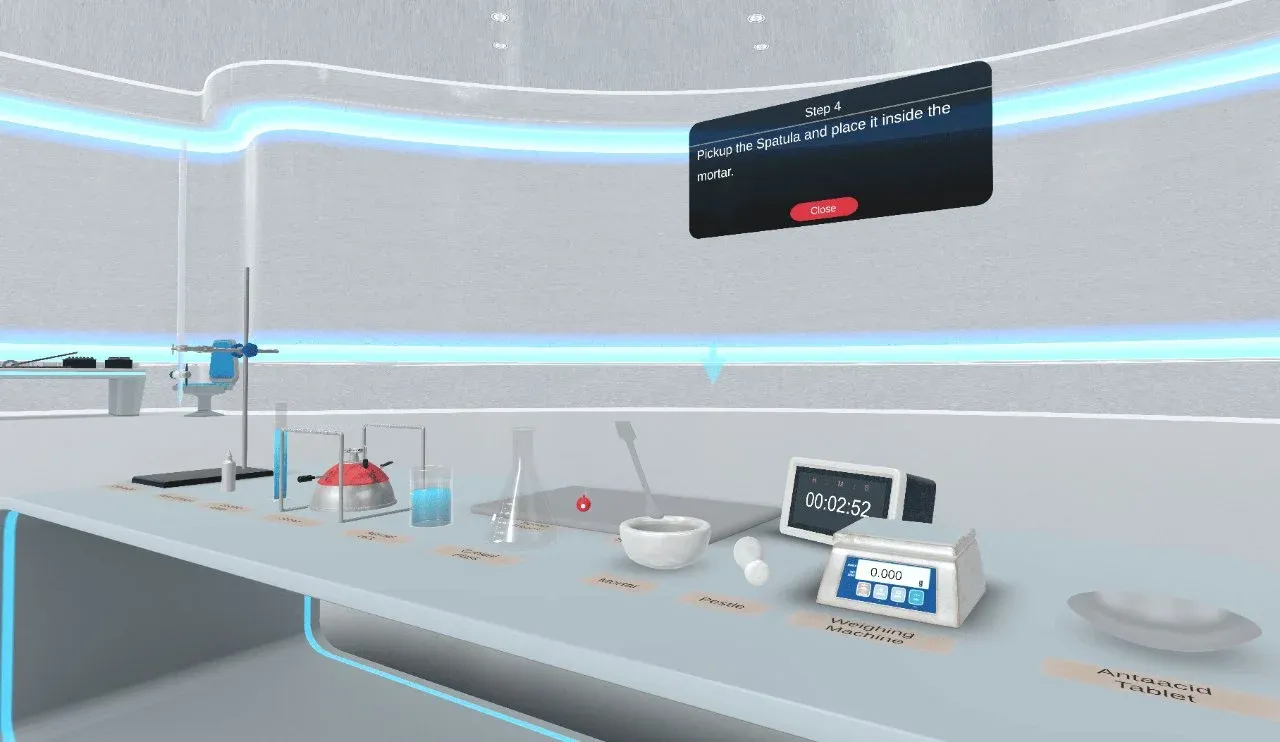
Students determine the alkali content of an antacid tablet using HCl, and find the strength of an unknown oxalic acid solution against standard potassium permanganate - reading the end point and recording results.
Why titrate in VR?
- Reagents, glassware and clean-up limit how often a student can practise, and technique only improves with repetition.
- Reading the end point is a judgement that students need to get wrong a few times before they get it right.
- Rehearsing the setup in VR means less time fumbling with real glassware and more time on the chemistry.
- Students can handle a strong oxidising titrant safely before they meet it on the bench.
The apparatus
- Burette and stand
- Pipette
- Conical flask
- Indicator or self-indicating titrant
- Antacid tablet and unknown solutions
Concepts it makes tangible
- Safe, correct apparatus setup
- Reaching and reading the end point
- Acid-base neutralisation
- Redox titration with potassium permanganate
- Recording readings and calculating concentration
The experiments
- Determine the alkali content of an antacid tablet using HCl
- Find the strength of an unknown oxalic acid solution against standard KMnO4
- Titrate drop by drop to a precise end point
- Record readings and compute the result
How faculty use it
- Pre-lab preparation before the real titration practical
- Unlimited repeats with no reagents or clean-up
- Practise technique before handling real chemicals
- Assessment of technique and calculation
The 7thi AI tutor sits alongside the whole experience, scaffolding the difficult parts and giving subject-aware answers in context. Built-in assessment lets faculty see, per student, who has grasped which concepts - without grading another paper.
How the module works
Students set up and carry out titrations from scratch. They arrange the burette, stand, pipette and conical flask, then titrate drop by drop and judge the end point themselves, recording readings and computing the result. The module covers acid-base neutralisation - determining the alkali content of an antacid tablet with hydrochloric acid - and a redox titration finding the strength of an unknown oxalic acid solution against standard potassium permanganate, which is self-indicating. Because reagents and glassware are virtual, students can overshoot the end point, see the wrong answer it gives, and repeat until their technique is reliable.
What students take away
A student can set up titration apparatus correctly, perform both acid-base and redox titrations, judge an end point and compute concentration from their readings. They understand what a self-indicating titrant is and why potassium permanganate needs no separate indicator, and they have handled a strong oxidising titrant safely before meeting it on the bench.
In the classroom
Analytical and physical chemistry courses use the module to give students the repetition that reagent and glassware budgets normally limit. It works as pre-lab preparation before students handle real chemicals, as a safe first encounter with hazardous titrants, and as a way to practise judging an end point - a skill that improves only by getting it wrong a few times first. Pharmacy and life-sciences programmes use it to establish quantitative technique early.
Interactive features and modes
Students set up the burette, stand, pipette and conical flask, titrate drop by drop, judge the end point and compute the result. The module covers an acid-base neutralisation with hydrochloric acid and a self-indicating redox titration against standard potassium permanganate. Because reagents and glassware are virtual, an overshoot simply gives a wrong answer and a reset, so students can practise the judgement an end point requires until it is reliable.
Why it matters
Titration is a cornerstone of analytical chemistry and one of the first quantitative techniques a student learns, but competence comes only from repetition, and repetition is limited by reagents, glassware and clean-up. Reading the end point is a judgement that students need to get wrong a few times before they get right. Rehearsing the whole procedure in VR means less time fumbling with real glassware and more time on the chemistry, and it lets students handle hazardous titrants safely before the real bench.
The bigger picture
Titration is where many students first meet quantitative analysis, and its lessons run deeper than the arithmetic: reading an end point is a judgement, an overshoot produces a wrong answer, and precision in setup and technique directly determines the reliability of the result. Covering both an acid-base neutralisation and a self-indicating redox titration shows that the same disciplined method applies across different chemistries. Rehearsing all of it virtually means students arrive at the real bench already fluent in the procedure and ready to focus on the chemistry. Because titration is the gateway to all of quantitative analysis, the habits a student forms here - careful setup, honest reading of an end point, and an understanding that precision in technique determines the reliability of the result - carry forward into every analytical method they will later meet. Building those habits through unlimited, low-stakes practice is precisely what a virtual bench allows.
Devices, deployment and assessment
Deploying the module is straightforward. It runs on Meta Quest, ClassVR and Pico headsets, on WebXR-compatible browsers, and on the desktop without any headset at all, so a department can start with the hardware it already has and scale as it grows. Faculty can assign the whole module or specific scenes, set it as pre-lab preparation or post-lab revision, and track progress on a dashboard that records concepts mastered, time per scene and assessment scores, with export to the LMS via xAPI. The 7thi AI tutor answers student questions in context throughout, so learners are never left stuck and faculty are not fielding the same question forty times.
Who this module is for
- Chemistry undergraduates studying analytical or physical chemistry
- Pharmacy, biotechnology and life sciences programmes
- Diploma and polytechnic science students
- Faculty running pre-lab preparation before students handle real chemicals
Syllabus alignment
Where this module fits.
University syllabi
We map this module to your institution's own chemistry practical syllabus before deployment. Request a custom mapping.
QS (Global)
Supports teaching-innovation and learning-experience indicators used in global university rankings. Detailed mapping available on request.
NAAC (India)
Supports outcome-based and experiential-learning criteria. Detailed mapping available on request.
Keep exploring
Related modules.
See Titration live in a demo.
Thirty minutes, the full module, your curriculum questions answered.
Which titrations can students run?
Determining the alkali content of an antacid tablet using HCl, and finding the strength of an unknown oxalic acid solution against standard potassium permanganate.
What is a self-indicating titrant?
One that signals the end point through its own colour change, so no separate indicator is needed. Potassium permanganate is the classic example, and the module uses it to make the idea concrete.
How precise is the end point?
Students titrate drop by drop and judge the end point themselves, then record readings and compute the result - so an overshoot produces a wrong answer, exactly as it would on the bench.
Does it teach apparatus setup as well as calculation?
Yes. Safe and correct setup of burette, stand, pipette and conical flask is part of the exercise, alongside reading the end point, recording results and calculating concentration.
Can this replace our physical lab?
It precedes and extends the lab rather than replacing it. Students arrive knowing the procedure, so scarce bench time goes on technique instead of familiarisation.
What prior knowledge do students need?
Foundation-level chemistry. The module suits Undergraduate and above, including diploma and polytechnic cohorts.
How long is a typical session?
About 30 minutes for a full run including assessment. Students can pause and resume, and faculty can assign specific parts rather than the whole module.
Which headsets does this module run on?
Meta Quest, ClassVR, WebXR, plus any WebXR-compatible browser. It also runs on desktop without a headset, which covers faculty preview and remote cohorts. OpenXR and 6DOF headsets are supported.
Which titrations can students run?
Determining the alkali content of an antacid tablet using HCl, and finding the strength of an unknown oxalic acid solution against standard potassium permanganate.
What is a self-indicating titrant?
One that signals the end point through its own colour change, so no separate indicator is needed. Potassium permanganate is the classic example, and the module uses it to make the idea concrete.
How precise is the end point?
Students titrate drop by drop and judge the end point themselves, then record readings and compute the result - so an overshoot produces a wrong answer, exactly as it would on the bench.
Does it teach apparatus setup as well as calculation?
Yes. Safe and correct setup of burette, stand, pipette and conical flask is part of the exercise, alongside reading the end point, recording results and calculating concentration.
Can this replace our physical lab?
It precedes and extends the lab rather than replacing it. Students arrive knowing the procedure, so scarce bench time goes on technique instead of familiarisation.
What prior knowledge do students need?
Foundation-level chemistry. The module suits Undergraduate and above, including diploma and polytechnic cohorts.
How long is a typical session?
About 30 minutes for a full run including assessment. Students can pause and resume, and faculty can assign specific parts rather than the whole module.
Which headsets does this module run on?
Meta Quest, ClassVR, WebXR, plus any WebXR-compatible browser. It also runs on desktop without a headset, which covers faculty preview and remote cohorts. OpenXR and 6DOF headsets are supported.