
VR Module · Mechanical · Engineering
Thermal Power Plant
Power Plant Engineering - Rankine Cycle
See it
Inside the module.
Learning objectives
By the end of this module, students will be able to:
Identify the major sections of a thermal power plant and trace the flow of energy
Explain the role of the boiler, turbine, condenser, and generator
Describe the Rankine cycle and where heat is added and rejected
Operate each stage and observe the effect on plant performance
Complete a scaffolded assessment on power plant operation
A power plant you can walk through, stage by stage.
Textbooks reduce a thermal power plant to a block diagram. This VR module lets students stand inside a working plant and follow the energy as it moves - from the boiler, through the turbine, to the generator and around the condenser loop.
Students operate each stage and watch how pressure, temperature, and flow change along the Rankine cycle, building an intuition for where energy is added, extracted, and lost.
Why tour a power plant in VR?
- Plant visits need safety clearance, and most departments cannot get a full cohort inside one.
- The high-temperature and high-pressure areas that matter most are exactly the ones visitors never enter.
- A block diagram gives no sense of scale, and scale is half of what makes a plant comprehensible.
- Each stage can be tied to its point on the Rankine cycle as students stand in front of it.
Sections on the tour
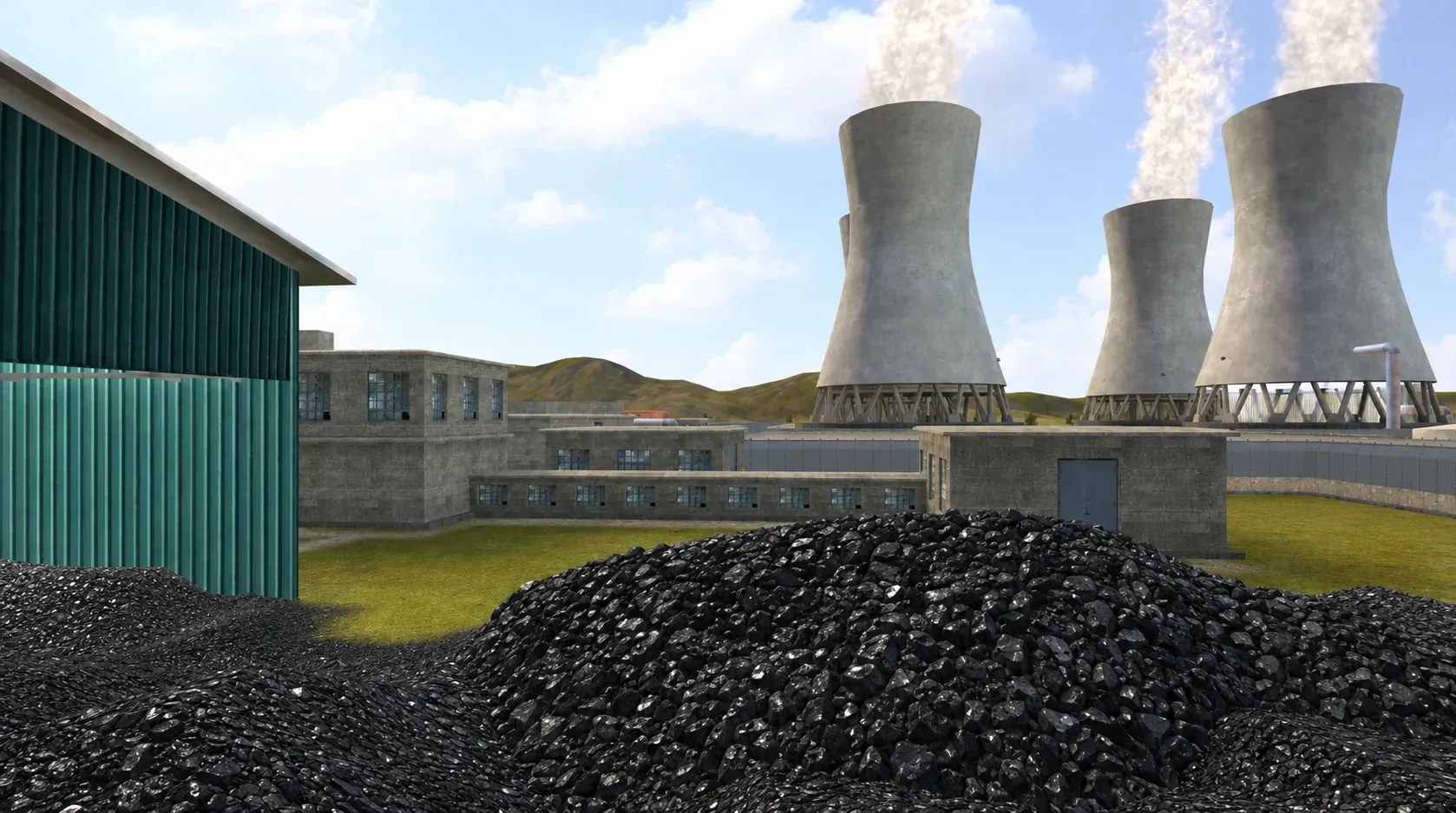
- Coal yard and fuel handling
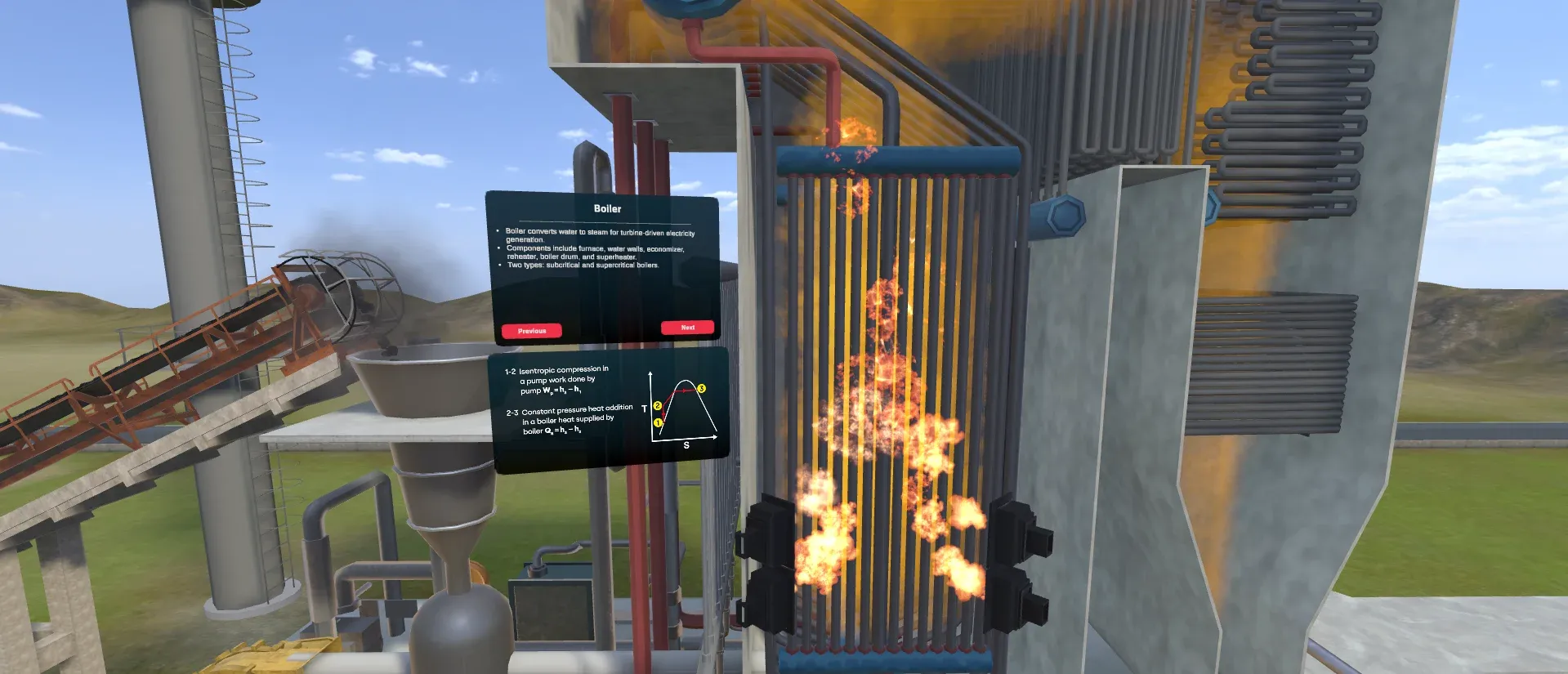
- Boiler, furnace, and water walls
- Economiser, superheater, and reheater
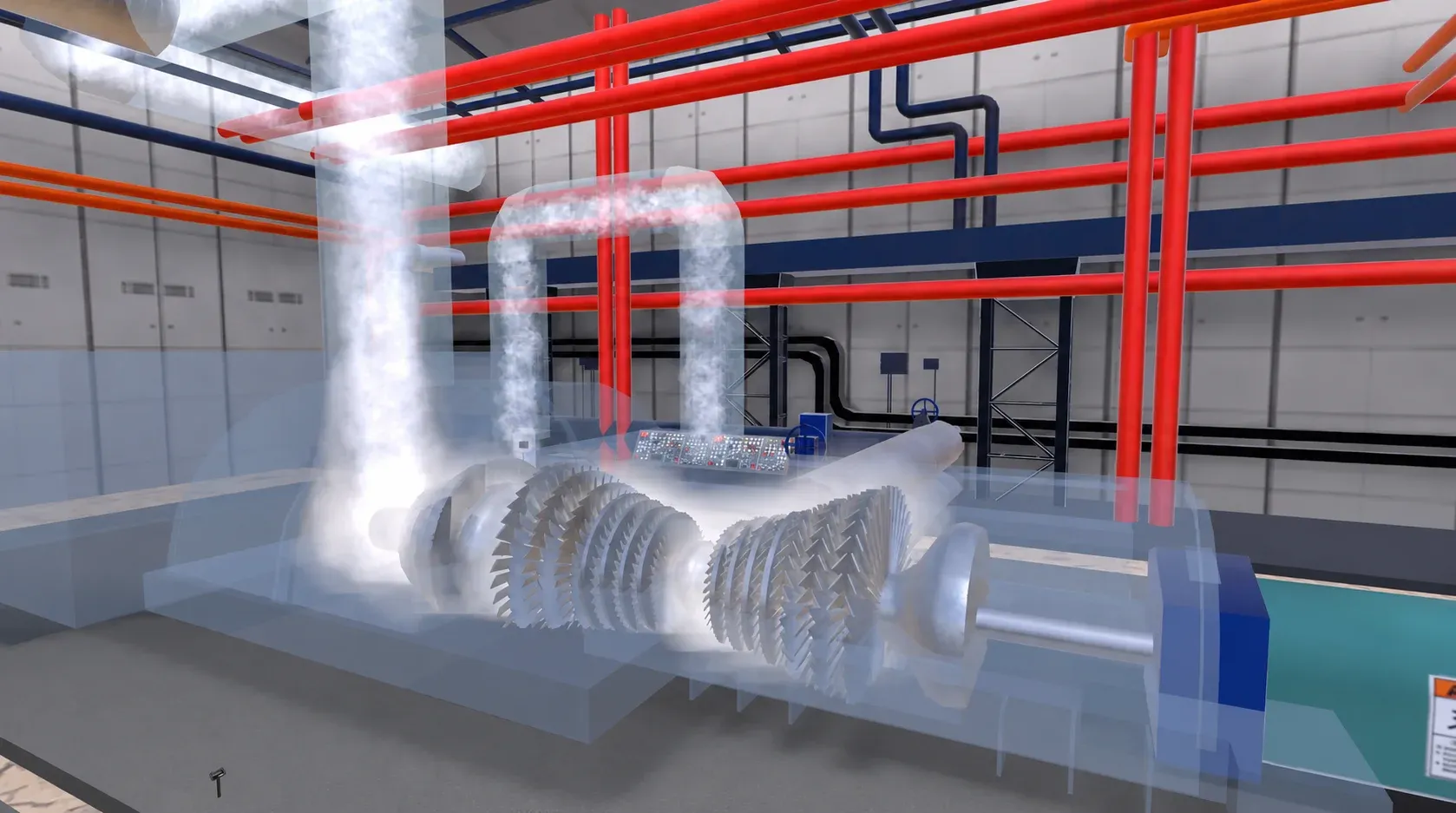
- Steam turbine and turbine hall
- Condenser and cooling towers
- Generator
- Feed pump and the condensate loop
Concepts it makes tangible
- How heat becomes electricity
- The Rankine cycle - where heat is added and rejected
- The roles of boiler, turbine, condenser, and generator
- Pressure and temperature changes around the loop
- Where energy is added, extracted, and lost
- Subcritical versus supercritical operation
On the tour
- Guided Mode follows the energy path stage by stage
- Self-Explore lets students roam the plant
- Each stage is tied to its point on the Rankine cycle
How faculty use it
- Virtual industrial visit when a plant trip is not possible
- Pre-visit briefing for a real power-station tour
- Safe access to high-temperature, high-pressure areas
- Walkthrough and assessment for large cohorts
The 7thi AI tutor sits alongside the whole experience, scaffolding the difficult parts and giving subject-aware answers in context. Built-in assessment lets faculty see, per student, who has grasped which concepts - without grading another paper.
How the module works
The module is a walk through a working coal-fired plant, following energy around the Rankine cycle as a physical journey. Students move from the coal yard and fuel handling to the boiler and furnace, on through the economiser, superheater and reheater, into the turbine hall, then to the condenser and cooling towers, the generator, and the feed pump that returns condensate to pressure. Each stage is tied to its point on the cycle as the student stands in front of it, so heat addition, expansion, rejection and pumping become places rather than abstractions, and the sheer scale of the plant - impossible to convey in a block diagram - becomes part of the understanding.
What students take away
Students finish able to describe every major section of a thermal power plant and its role, map the plant onto the Rankine cycle, and follow pressure and temperature around the loop to see where energy is added, extracted and rejected. They understand why the condenser rejects so much heat, what distinguishes subcritical from supercritical operation, and how the choices a plant makes trace back to the thermodynamics they meet in lectures.
In the classroom
Thermodynamics and power-plant courses use the tour to make the Rankine cycle physical. Students walk the plant as preparation for a real station visit, or in place of one where access is impossible, and they return to it as revision when the cycle needs consolidating before an exam. Electrical and energy-engineering students use it to understand generation as a whole system rather than as an abstract cycle on a T-s diagram.
Interactive features and modes
The tour moves through the coal yard, boiler and furnace, economiser and superheater, turbine hall, condenser, cooling towers and generator, tying each stage to its point on the Rankine cycle as the student stands before it. Steam flow is made visible where it matters, and the sheer scale of the plant - impossible to convey in a diagram - becomes part of the understanding. Students can revisit any section as often as they need.
Why it matters
Thermal power plants still generate a large share of the world's electricity, and they are the canonical application of the Rankine cycle that mechanical and energy students study in depth. But plant visits require safety clearance that a full cohort rarely obtains, and the high-temperature, high-pressure areas that matter most are exactly the ones visitors never enter. A block diagram, meanwhile, conveys nothing of the scale that makes a plant comprehensible. A virtual tour puts every student inside, at every stage, tied to the cycle throughout.
The bigger picture
The great difficulty with the Rankine cycle is that it is taught as a diagram and experienced, if at all, as an inaccessible industrial plant. A block diagram conveys the logic but none of the scale, and a scale that runs to enormous boilers, turbine halls and cooling towers is a large part of what makes a power plant comprehensible. Walking the plant and tying each stage to its point on the cycle turns an abstract loop into a place students can picture, so that heat addition, expansion, condensation and pumping become concrete events with a real footprint rather than corners of a graph.
Devices, deployment and assessment
Deploying the module is straightforward. It runs on Meta Quest, ClassVR and Pico headsets, on WebXR-compatible browsers, and on the desktop without any headset at all, so a department can start with the hardware it already has and scale as it grows. Faculty can assign the whole module or specific scenes, set it as pre-lab preparation or post-lab revision, and track progress on a dashboard that records concepts mastered, time per scene and assessment scores, with export to the LMS via xAPI. The 7thi AI tutor answers student questions in context throughout, so learners are never left stuck and faculty are not fielding the same question forty times.
Who this module is for
- Mechanical engineering undergraduates from Year 2 studying thermodynamics or power plant engineering
- Electrical and energy engineering students covering generation
- Diploma and polytechnic programmes without plant access
- Faculty briefing students before a real power station visit
Syllabus alignment
Where this module fits.
ABET (United States)
Supports ABET Student Outcomes 1 and 6 - applying engineering knowledge and conducting experimentation. Detailed mapping available on request.
IEAC (United Kingdom)
Aligned with Washington Accord graduate attributes for complex engineering problem-solving and investigation. Detailed mapping available on request.
University syllabi
We map this module to your institution's own power plant engineering syllabus before deployment. Request a custom mapping.
NBA (India)
Maps to Course Outcomes in Power Plant Engineering, contributing to POs around problem-solving and modern tool usage.
Keep exploring
Related modules.
See Thermal Power Plant live in a demo.
Thirty minutes, the full module, your curriculum questions answered.
Which sections of the plant does the tour cover?
Coal yard and fuel handling, boiler and furnace, economiser, superheater and reheater, steam turbine and turbine hall, condenser and cooling towers, generator, and the feed pump and condensate loop.
How is the Rankine cycle taught?
Each stage is tied to its point on the cycle as students stand in front of it, so heat addition in the boiler, expansion in the turbine, rejection in the condenser and pumping back to pressure become physical places.
Does it cover where energy is lost?
Yes. Students follow pressure and temperature around the loop and see where energy is added, extracted and rejected - including why the condenser rejects so much heat, which surprises most of them.
Does it explain subcritical and supercritical operation?
It introduces the distinction and why operating above the critical point raises cycle efficiency, linking plant design choices back to the thermodynamics students meet in lectures.
Is this mapped to our curriculum?
It is mapped to ABET, NBA and equivalent frameworks, and we map it to your own power plant engineering syllabus before deployment. Request a custom mapping.
Can this be used in a flipped classroom?
Yes. Students complete Thermal Power Plant before the lecture, so class time goes on analysis and discussion rather than first exposure to the topic.
Does it integrate with our LMS?
Yes. Moodle, Canvas and Blackboard are supported, with SSO and xAPI export of session data and assessment results.
Can this replace a real site visit?
It is built to precede one, or to stand in where a visit is impossible for a full cohort. Students who tour virtually first get considerably more from a real visit.
Which sections of the plant does the tour cover?
Coal yard and fuel handling, boiler and furnace, economiser, superheater and reheater, steam turbine and turbine hall, condenser and cooling towers, generator, and the feed pump and condensate loop.
How is the Rankine cycle taught?
Each stage is tied to its point on the cycle as students stand in front of it, so heat addition in the boiler, expansion in the turbine, rejection in the condenser and pumping back to pressure become physical places.
Does it cover where energy is lost?
Yes. Students follow pressure and temperature around the loop and see where energy is added, extracted and rejected - including why the condenser rejects so much heat, which surprises most of them.
Does it explain subcritical and supercritical operation?
It introduces the distinction and why operating above the critical point raises cycle efficiency, linking plant design choices back to the thermodynamics students meet in lectures.
Is this mapped to our curriculum?
It is mapped to ABET, NBA and equivalent frameworks, and we map it to your own power plant engineering syllabus before deployment. Request a custom mapping.
Can this be used in a flipped classroom?
Yes. Students complete Thermal Power Plant before the lecture, so class time goes on analysis and discussion rather than first exposure to the topic.
Does it integrate with our LMS?
Yes. Moodle, Canvas and Blackboard are supported, with SSO and xAPI export of session data and assessment results.
Can this replace a real site visit?
It is built to precede one, or to stand in where a visit is impossible for a full cohort. Students who tour virtually first get considerably more from a real visit.