
See it
Inside the module.
Learning objectives
By the end of this module, students will be able to:
Identify the main equipment in a distribution substation
Explain how power is stepped down and distributed
Describe the function of breakers, isolators, and busbars
Follow safe switching and protection sequences
Complete a scaffolded assessment on substation operation
A substation you can explore safely, up close.
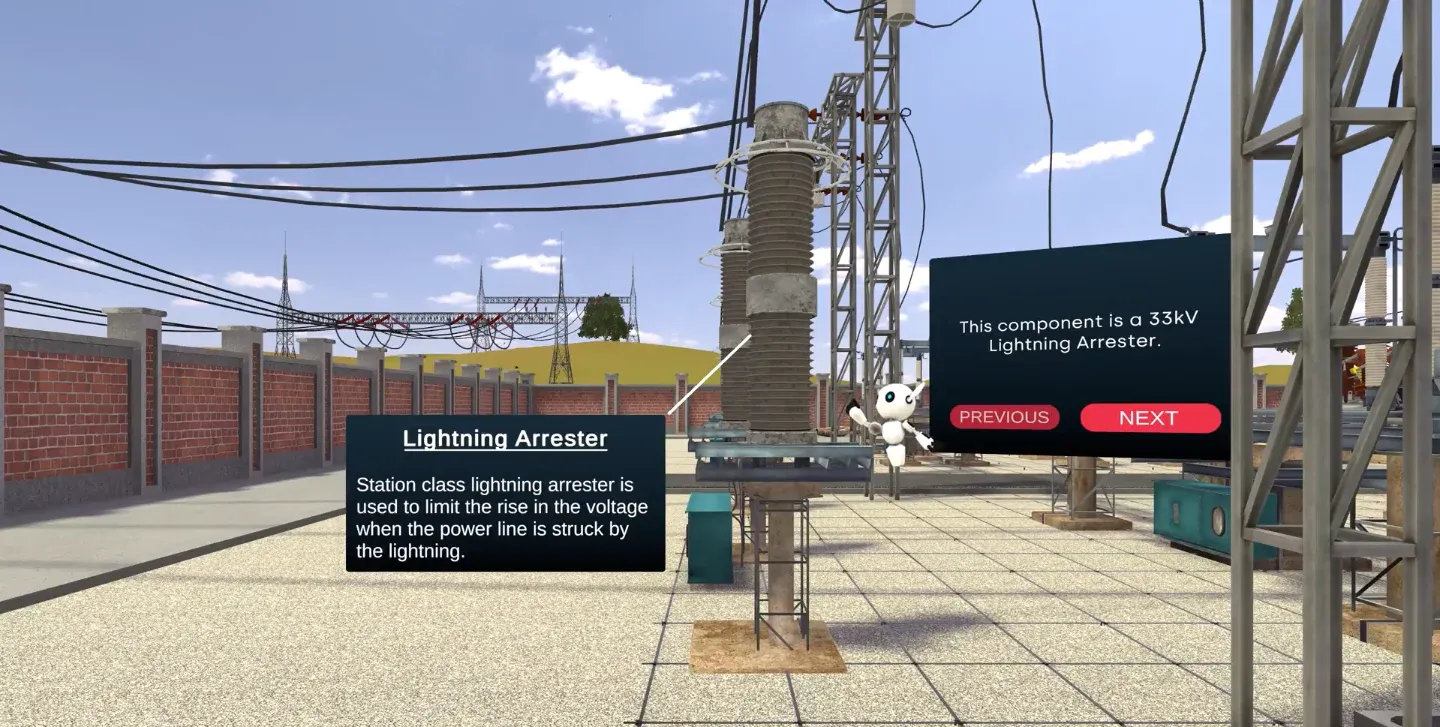
A real substation is dangerous to learn in. In VR, students walk right up to transformers, busbars, circuit breakers, and isolators, and understand the layout without any risk.

The module follows power as it is stepped down and routed through the substation, showing the role of each device in protection and distribution.
Why study a substation in 3D?
- The clearances that make a real substation safe are exactly what stop students examining equipment closely.
- Switching and protection sequences can be stepped through slowly, which is impossible to observe in service.
- Layout familiarisation is a genuine industrial skill and needs walking, not diagramming.
- Fault isolation can be demonstrated without anything actually faulting.
Equipment you can identify
- Distribution transformer
- Busbars and connections
- Circuit breakers and isolators
- Incoming supply and outgoing feeders
- Protection and metering devices
Concepts it makes tangible
- How power is stepped down for distribution
- The role of breakers, isolators, and busbars
- Safe switching and protection sequences
- Fault isolation and supply reliability
- Substation layout and safety
How students explore it
- Walk up to each device and identify it
- Follow power as it is stepped down and routed
- Study switching and protection in sequence
How faculty use it
- Safe alternative to a live substation
- Pre-visit briefing before real infrastructure
- Layout familiarisation for large groups
- Assessment of equipment and power flow
The 7thi AI tutor sits alongside the whole experience, scaffolding the difficult parts and giving subject-aware answers in context. Built-in assessment lets faculty see, per student, who has grasped which concepts - without grading another paper.
How the module works
Students explore a distribution substation as a walkable 3D layout, going right up to the distribution transformer, busbars, circuit breakers, isolators and protection devices that clearances would keep them away from in reality. They follow power from the incoming supply through the transformer and busbars to the outgoing feeders, and step slowly through switching and protection sequences that can never be observed in service. The module makes the breaker-versus-isolator distinction explicit: a breaker interrupts fault current under load, an isolator provides a visible off-load break for safe working, and the two are used together in a specific order.
What students take away
A student can identify the equipment in a distribution substation, explain the difference between a circuit breaker and an isolator and the correct sequence for using them, and describe how a fault on one feeder is detected and isolated without interrupting the rest of the supply. They understand substation layout as a logical consequence of power flow and protection, which is the foundation of distribution engineering.
In the classroom
Power-distribution and switchgear courses use the module for equipment identification and for stepping through switching and protection sequences that a live substation can never show. It suits large groups doing layout familiarisation, and it prepares students and trainees for real distribution equipment by letting them approach and study it safely first. Utility training programmes use it as a low-risk introduction to substation practice.
Interactive features and modes
Students explore the distribution substation as a walkable layout, approaching the transformer, busbars, breakers and isolators that clearances keep them away from in reality. They can follow power from the incoming supply to the outgoing feeders and step slowly through switching and protection sequences, including the correct order for operating a breaker and an isolator together. Fault isolation can be demonstrated without anything actually faulting. Fault isolation can be demonstrated without anything actually faulting, so students see how a protection scheme keeps the wider supply running even as one feeder is taken out - the single most important idea in distribution reliability, made visible and repeatable.
Why it matters
Distribution substations sit between the transmission grid and the streets, stepping voltage down and routing power to feeders. The clearances that keep them safe are exactly what stops students examining the equipment closely, and switching and protection sequences simply cannot be demonstrated on a live installation. Exploring the substation in 3D removes both barriers, letting students walk the layout and step through the protection logic that keeps the lights on.
The bigger picture
Distribution substations are where the grid meets the community, and their reliability depends on protection schemes that isolate faults without collapsing the wider supply. Understanding how a breaker and an isolator differ, and the strict order in which they are operated, is not academic pedantry - it is the difference between safe working and a serious accident. Exploring the substation in three dimensions, and stepping slowly through the protection logic, lets students build that understanding in a way that is impossible around energised apparatus governed by fixed clearances. And because distribution substations are being rebuilt and automated across the world as grids modernise, engineers who can already read a substation layout and reason about its protection scheme enter the workforce with a genuinely valued skill rather than a purely theoretical one.
Devices, deployment and assessment
Deploying the module is straightforward. It runs on Meta Quest, ClassVR and Pico headsets, on WebXR-compatible browsers, and on the desktop without any headset at all, so a department can start with the hardware it already has and scale as it grows. Faculty can assign the whole module or specific scenes, set it as pre-lab preparation or post-lab revision, and track progress on a dashboard that records concepts mastered, time per scene and assessment scores, with export to the LMS via xAPI. The 7thi AI tutor answers student questions in context throughout, so learners are never left stuck and faculty are not fielding the same question forty times.
Who this module is for
- Electrical engineering undergraduates studying power distribution and switchgear
- Diploma and polytechnic electrical students
- Utility and industrial training programmes
- Faculty running layout familiarisation for large groups
Syllabus alignment
Where this module fits.
ABET (United States)
Supports ABET Student Outcomes 1 and 6 - applying engineering knowledge and conducting experimentation. Detailed mapping available on request.
IEAC (United Kingdom)
Aligned with Washington Accord graduate attributes for complex engineering problem-solving and investigation. Detailed mapping available on request.
University syllabi
We map this module to your institution's own power systems syllabus before deployment. Request a custom mapping.
NBA (India)
Maps to Course Outcomes in Power Systems, contributing to POs around problem-solving and modern tool usage.
Keep exploring
Related modules.
See Substation live in a demo.
Thirty minutes, the full module, your curriculum questions answered.
Which equipment can students identify?
The distribution transformer, busbars and connections, circuit breakers and isolators, incoming supply and outgoing feeders, and the protection and metering devices.
What is the difference between a breaker and an isolator?
The module makes it explicit: a circuit breaker interrupts fault current under load, while an isolator gives a visible off-load break for safe working. Students see the correct sequence for using them together.
Does it cover fault isolation?
Yes. Students follow how a fault on one feeder is detected and isolated by protection without taking the rest of the substation out of service - the basis of supply reliability.
How does this differ from the Electrical Substation tour?
This module is a distribution substation as an explorable layout, focused on equipment identification and power flow. The Electrical Substation module is a longer guided tour of a larger installation, including the control room.
How long is a typical session?
About 35 minutes for a full run including assessment. Students can pause and resume, and faculty can assign specific parts rather than the whole module.
Which headsets does this module run on?
Meta Quest, ClassVR, WebXR, plus any WebXR-compatible browser. It also runs on desktop without a headset, which covers faculty preview and remote cohorts. OpenXR and 6DOF headsets are supported.
Is the assessment graded automatically?
Yes. Scores reach the faculty dashboard immediately, pass thresholds are adjustable, and results export to your LMS via xAPI.
Is this mapped to our curriculum?
It is mapped to ABET, NBA and equivalent frameworks, and we map it to your own power systems syllabus before deployment. Request a custom mapping.