
VR Module · Electrical · Engineering
Power Transformers - Core Type
Electrical Machines
See it
Inside the module.
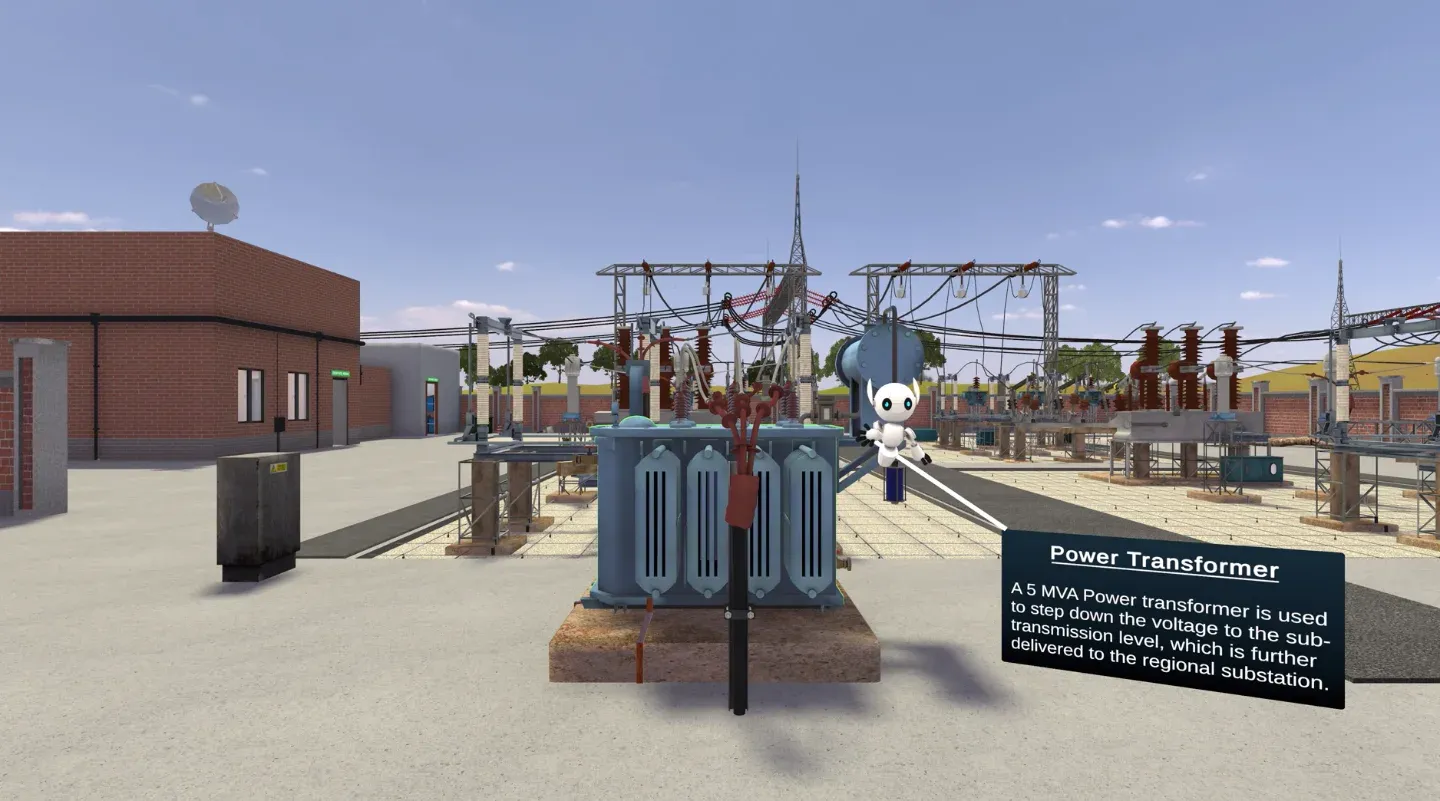
Learning objectives
By the end of this module, students will be able to:
Identify the parts of a core-type power transformer
Explain electromagnetic induction and mutual flux linkage
Relate turns ratio to voltage transformation
Describe core construction and the role of laminations
Complete a scaffolded assessment on transformer principles
A transformer you can take apart to the core.
Students rarely get to open a transformer. This module lets them strip a core-type power transformer down to its laminated core and windings, and build it back up.

By operating the transformer they see how flux links the primary and secondary windings, and how the turns ratio sets the output voltage.
Why take a transformer apart in 3D?
- Students almost never see inside a power transformer. It is sealed, oil-filled and energised.
- Rebuilding the machine tests construction understanding far better than labelling a cutaway drawing.
- Mutual flux linkage between primary and secondary is invisible and needs animating to be understood.
- The purpose of laminations only lands once you can separate the core and see the stack.
Parts you can inspect
- Laminated core and limbs
- Primary and secondary windings
- Insulation system
- Bushings and terminals
- Tank, conservator, and cooling
- Tap connections
Concepts it makes tangible
- Electromagnetic induction and mutual flux linkage
- Turns ratio and voltage transformation
- Core construction and the purpose of laminations
- No-load and on-load behaviour
- Core and copper losses
Modes of interaction
- Assembly / Disassembly down to core and windings
- Working Mode shows flux linking primary and secondary
- Rebuild the machine to reinforce construction
How faculty use it
- Lets students open a machine they would never open in reality
- Pre-lab / pre-lecture primer on transformer principles
- Flipped classroom and revision
- Assessment of parts, working, and losses
The 7thi AI tutor sits alongside the whole experience, scaffolding the difficult parts and giving subject-aware answers in context. Built-in assessment lets faculty see, per student, who has grasped which concepts - without grading another paper.
How the module works
Students strip a core-type power transformer down to its laminated core and windings and then rebuild it, which tests construction understanding far more rigorously than labelling a cutaway ever could. Separating the core reveals the stack of thin insulated laminations, and the module ties that construction directly to eddy-current loss. The working mode traces the flux from the primary winding through the core into the secondary, showing how the ratio of turns between the two windings determines whether voltage is stepped up or down, and how energy crosses from one circuit to the other with no electrical connection between them.
What students take away
A student can dismantle and reassemble a power transformer in the correct order, explain why the core is laminated and how that reduces loss, and describe how the turns ratio governs voltage transformation through mutual induction. They understand core loss and copper loss, how each varies with load, and how they combine to determine efficiency - the complete story of how a transformer is built and how it behaves.
In the classroom
Transformer and power-systems courses use the module as a hands-on primer before the transformer experiments in the machines lab. Dismantling and rebuilding the machine in VR gives students a construction understanding that a cutaway diagram cannot, so lab time can focus on measurement and analysis. It also works as flipped-classroom preparation and as revision before examinations, where the ability to explain lamination, flux linkage and losses is routinely tested.
Interactive features and modes
The module supports full assembly and disassembly down to the laminated core and individual windings, so students rebuild the machine rather than merely label it. A working mode traces the flux from primary to secondary and shows the turns ratio setting the output voltage, while the laminated core can be separated to make the reason for lamination - and its link to eddy-current loss - concrete. Core and copper losses can be explored against load.
Why it matters
Power transformers are the backbone of the electricity grid, stepping voltage up for efficient transmission and back down for distribution and use. They are also sealed, oil-filled and energised, so students essentially never see inside one. That leaves most learners with a diagram and a formula for a machine whose whole behaviour depends on an invisible magnetic flux linking two windings. Taking a virtual transformer apart, rebuilding it and then watching the flux transfer energy makes both the construction and the physics tangible.
The bigger picture
The power transformer is deceptively simple - two windings and an iron core - and yet its behaviour depends entirely on things a student cannot see: the magnetic flux linking the windings, and the currents circulating in the core that make lamination necessary. Rebuilding the machine forces a student to reason about how the parts fit and function together, and watching the flux transfer energy across the turns ratio makes the physics tangible. Since transformers underpin the entire electricity grid, that combined grasp of construction and principle is foundational to power engineering rather than incidental to it. Because the grid depends on transformers at every voltage level, from generation to the domestic supply, a graduate who can reason from the physics of flux linkage to the practical realities of loss, cooling and insulation is far better prepared for power engineering than one who has only memorised a nameplate. This module aims squarely at that deeper, transferable understanding.
Devices, deployment and assessment
Deploying the module is straightforward. It runs on Meta Quest, ClassVR and Pico headsets, on WebXR-compatible browsers, and on the desktop without any headset at all, so a department can start with the hardware it already has and scale as it grows. Faculty can assign the whole module or specific scenes, set it as pre-lab preparation or post-lab revision, and track progress on a dashboard that records concepts mastered, time per scene and assessment scores, with export to the LMS via xAPI. The 7thi AI tutor answers student questions in context throughout, so learners are never left stuck and faculty are not fielding the same question forty times.
Who this module is for
- Electrical engineering undergraduates studying transformers and machines
- Diploma and polytechnic electrical programmes
- Power systems and energy engineering courses
- Faculty needing a pre-lab primer before transformer experiments
Syllabus alignment
Where this module fits.
ABET (United States)
Supports ABET Student Outcomes 1 and 6 - applying engineering knowledge and conducting experimentation. Detailed mapping available on request.
IEAC (United Kingdom)
Aligned with Washington Accord graduate attributes for complex engineering problem-solving and investigation. Detailed mapping available on request.
University syllabi
We map this module to your institution's own electrical machines syllabus before deployment. Request a custom mapping.
NBA (India)
Maps to Course Outcomes in Electrical Machines, contributing to POs around problem-solving and modern tool usage.
Keep exploring
Related modules.
See Power Transformers - Core Type live in a demo.
Thirty minutes, the full module, your curriculum questions answered.
Can students dismantle the transformer completely?
Down to the laminated core and the individual windings, then back up again. Rebuilding is part of the exercise, and a better test of construction understanding than labelling a diagram.
Why is the core laminated, and is that explained?
Yes. Separating the core reveals the stack of thin insulated sheets, and the module links that construction to eddy-current loss and to why a solid core would waste far more energy as heat.
How is the turns ratio demonstrated?
Working mode traces flux from the primary through the core into the secondary, showing how the ratio of turns determines whether voltage is stepped up or down, with no electrical connection between circuits.
Which transformer losses are covered?
Core loss and copper loss, how each varies with load, and how they combine to determine efficiency - alongside no-load and on-load behaviour.
What prior knowledge do students need?
Foundation-level electrical machines. The module suits Undergraduate and above, including diploma and polytechnic cohorts.
How long is a typical session?
About 30 minutes for a full run including assessment. Students can pause and resume, and faculty can assign specific parts rather than the whole module.
Which headsets does this module run on?
Meta Quest, ClassVR, WebXR, plus any WebXR-compatible browser. It also runs on desktop without a headset, which covers faculty preview and remote cohorts. OpenXR and 6DOF headsets are supported.
Is the assessment graded automatically?
Yes. Scores reach the faculty dashboard immediately, pass thresholds are adjustable, and results export to your LMS via xAPI.