
See it
Inside the module.
Learning objectives
By the end of this module, students will be able to:
Explain the principle of micropropagation and totipotency
Prepare explants from shoot tip, axillary bud, and anther
Follow aseptic technique through the workflow
Describe the stages of in-vitro plant propagation
Complete a scaffolded assessment on tissue culture
Plant tissue culture, under sterile conditions - every time.
Micropropagation multiplies plants from small pieces of tissue under sterile, controlled conditions, relying on the totipotency of plant cells to regenerate whole plants. It underpins modern horticulture, forestry, and crop improvement.
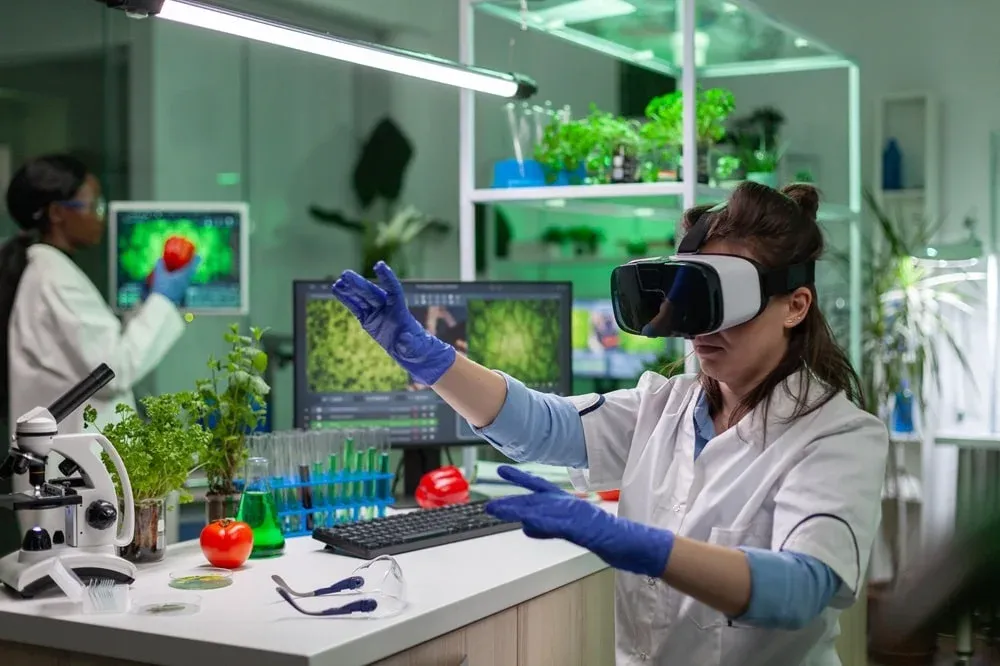
This module recreates the aseptic workflow in VR, letting students prepare explants and work through the stages of in-vitro propagation without a physical tissue-culture lab - so demanding sterile technique can be practised safely and repeatedly.
Why practise tissue culture in VR?
- A tissue-culture lab is expensive to run and tightly controlled, so undergraduate access is usually limited to a demonstration.
- Aseptic technique is unforgiving: one lapse contaminates the culture, and the student finds out days later.
- In VR the consequence of a break in sterile technique can be shown immediately rather than a week later.
- Explant preparation can be repeated until the sequence is automatic, with no plant material consumed.
Explants and workflow
- Shoot-tip explants
- Axillary-bud explants
- Anther explants
- Sterile transfer and culture setup
- The stages of in-vitro propagation
Concepts it makes tangible
- The principle of micropropagation and totipotency
- Why aseptic technique is essential
- How explant choice affects propagation
- The stages from explant to plantlet
- Applications in horticulture and crop improvement
How faculty use it
- Pre-lab preparation before a real tissue-culture practical
- Practise sterile technique with no contamination risk
- Unlimited repeats with no consumables
- Assessment of workflow and principles
The 7thi AI tutor sits alongside the whole experience, scaffolding the difficult parts and giving subject-aware answers in context. Built-in assessment lets faculty see, per student, who has grasped which concepts - without grading another paper.
How the module works
Students rehearse the aseptic plant tissue culture workflow. They prepare shoot-tip, axillary-bud and anther explants, carry out sterile transfer and culture setup, and work through the stages that take an explant toward a plantlet. Because the environment is virtual, the consequence of a break in sterile technique can be shown immediately rather than a week later when a contaminated culture is discovered, so the link between technique and outcome is made obvious. The preparation can be repeated until the sequence is second nature, with no plant material or media consumed.
What students take away
A student can prepare different explant types, describe the stages of in-vitro propagation, and explain why aseptic technique is decisive to the outcome. They understand totipotency as the biological principle the whole technique depends on, and they can place micropropagation in its commercial context in horticulture, forestry and crop improvement.
In the classroom
Biotechnology and botany courses use the module to give students the aseptic-technique experience that a controlled tissue-culture facility usually restricts to a demonstration. It works as pre-lab preparation before a real culture practical, and as a stand-in where no facility is available. Agriculture, horticulture and forestry programmes use it to connect the laboratory technique to the commercial propagation it underpins.
Interactive features and modes
Students prepare shoot-tip, axillary-bud and anther explants, carry out sterile transfer and culture setup, and work through the stages that take an explant toward a plantlet. Because the environment is virtual, the consequence of a break in sterile technique is shown immediately rather than days later, and the whole preparation can be repeated with no plant material or media consumed - so students can build the discipline the technique demands through genuine repetition. Because every stage can be repeated without consuming plant material or media, students can rehearse the entire aseptic workflow as many times as it takes for sterile technique to become second nature, which is exactly the kind of repetition a real culture facility cannot offer.
Why it matters
Micropropagation underpins modern horticulture, forestry and crop improvement, producing large numbers of uniform, disease-free plants far faster than conventional propagation. But a tissue-culture lab is expensive to run and tightly controlled, so undergraduate access is usually limited to a demonstration, and aseptic technique is unforgiving - one lapse contaminates the culture, and the student finds out days later. A virtual lab lets students fail, see the consequence at once, and repeat until the technique is sound.
The bigger picture
Micropropagation depends on totipotency - the remarkable capacity of a plant cell to regenerate an entire plant - and on aseptic technique so unforgiving that a single lapse loses the culture, often discovered only days later. That delayed feedback is what makes the technique so hard to learn on real material. A virtual lab collapses the delay, showing the consequence of a break in sterility at once, so students internalise the discipline the technique demands and understand why the biology - the totipotency that makes it all possible - requires such care to exploit. Because commercial micropropagation now underpins the supply of everything from disease-free banana plants to forestry stock and ornamental crops, a student who has genuinely internalised aseptic discipline and understood the biology behind it is prepared for a real and growing industry. The virtual lab is what makes that depth of preparation possible without a dedicated culture facility. Repetition, not a single demonstration, is what builds the habit, and repetition is exactly what this module provides.
Devices, deployment and assessment
Deploying the module is straightforward. It runs on Meta Quest, ClassVR and Pico headsets, on WebXR-compatible browsers, and on the desktop without any headset at all, so a department can start with the hardware it already has and scale as it grows. Faculty can assign the whole module or specific scenes, set it as pre-lab preparation or post-lab revision, and track progress on a dashboard that records concepts mastered, time per scene and assessment scores, with export to the LMS via xAPI. The 7thi AI tutor answers student questions in context throughout, so learners are never left stuck and faculty are not fielding the same question forty times.
Who this module is for
- Biology, botany and biotechnology undergraduates studying plant tissue culture
- Agriculture, horticulture and forestry programmes
- Departments without a dedicated tissue-culture facility
- Faculty running pre-lab preparation before a real culture practical
Syllabus alignment
Where this module fits.
University syllabi
We map this module to your institution's own botany practical syllabus before deployment. Request a custom mapping.
QS (Global)
Supports teaching-innovation and learning-experience indicators used in global university rankings. Detailed mapping available on request.
NAAC (India)
Supports outcome-based and experiential-learning criteria. Detailed mapping available on request.
Keep exploring
Related modules.
See Micropropagation live in a demo.
Thirty minutes, the full module, your curriculum questions answered.
Which explants can students work with?
Shoot-tip, axillary-bud and anther explants, along with sterile transfer and culture setup, and the stages that take an explant through to a plantlet.
Why does aseptic technique matter so much?
Culture media are as good for bacteria and fungi as they are for plant tissue, so a single lapse loses the culture. The module makes the link between technique and outcome visible immediately.
What is totipotency, and is it explained?
It is the capacity of a plant cell to regenerate a whole plant, and it is the principle micropropagation depends on. The module builds it as the reason the technique works at all.
Where is micropropagation used commercially?
In horticulture, forestry and crop improvement, wherever large numbers of uniform, disease-free plants are needed faster than conventional propagation allows.
Can this be used in a flipped classroom?
Yes. Students complete Micropropagation before the lecture, so class time goes on analysis and discussion rather than first exposure to the topic.
Does it integrate with our LMS?
Yes. Moodle, Canvas and Blackboard are supported, with SSO and xAPI export of session data and assessment results.
Can this replace our physical lab?
It precedes and extends the lab rather than replacing it. Students arrive knowing the procedure, so scarce bench time goes on technique instead of familiarisation.
What prior knowledge do students need?
Foundation-level botany. The module suits Undergraduate and above, including diploma and polytechnic cohorts.
Which explants can students work with?
Shoot-tip, axillary-bud and anther explants, along with sterile transfer and culture setup, and the stages that take an explant through to a plantlet.
Why does aseptic technique matter so much?
Culture media are as good for bacteria and fungi as they are for plant tissue, so a single lapse loses the culture. The module makes the link between technique and outcome visible immediately.
What is totipotency, and is it explained?
It is the capacity of a plant cell to regenerate a whole plant, and it is the principle micropropagation depends on. The module builds it as the reason the technique works at all.
Where is micropropagation used commercially?
In horticulture, forestry and crop improvement, wherever large numbers of uniform, disease-free plants are needed faster than conventional propagation allows.
Can this be used in a flipped classroom?
Yes. Students complete Micropropagation before the lecture, so class time goes on analysis and discussion rather than first exposure to the topic.
Does it integrate with our LMS?
Yes. Moodle, Canvas and Blackboard are supported, with SSO and xAPI export of session data and assessment results.
Can this replace our physical lab?
It precedes and extends the lab rather than replacing it. Students arrive knowing the procedure, so scarce bench time goes on technique instead of familiarisation.
What prior knowledge do students need?
Foundation-level botany. The module suits Undergraduate and above, including diploma and polytechnic cohorts.