
See it
Inside the module.
Learning objectives
By the end of this module, students will be able to:
Describe the phases of the cardiac cycle
Relate atrial and ventricular systole and diastole to valve action
Link pressure and volume changes across one beat
Identify the heart sounds and their causes
Complete a scaffolded assessment on the cardiac cycle
The cardiac cycle, one beat at a time.
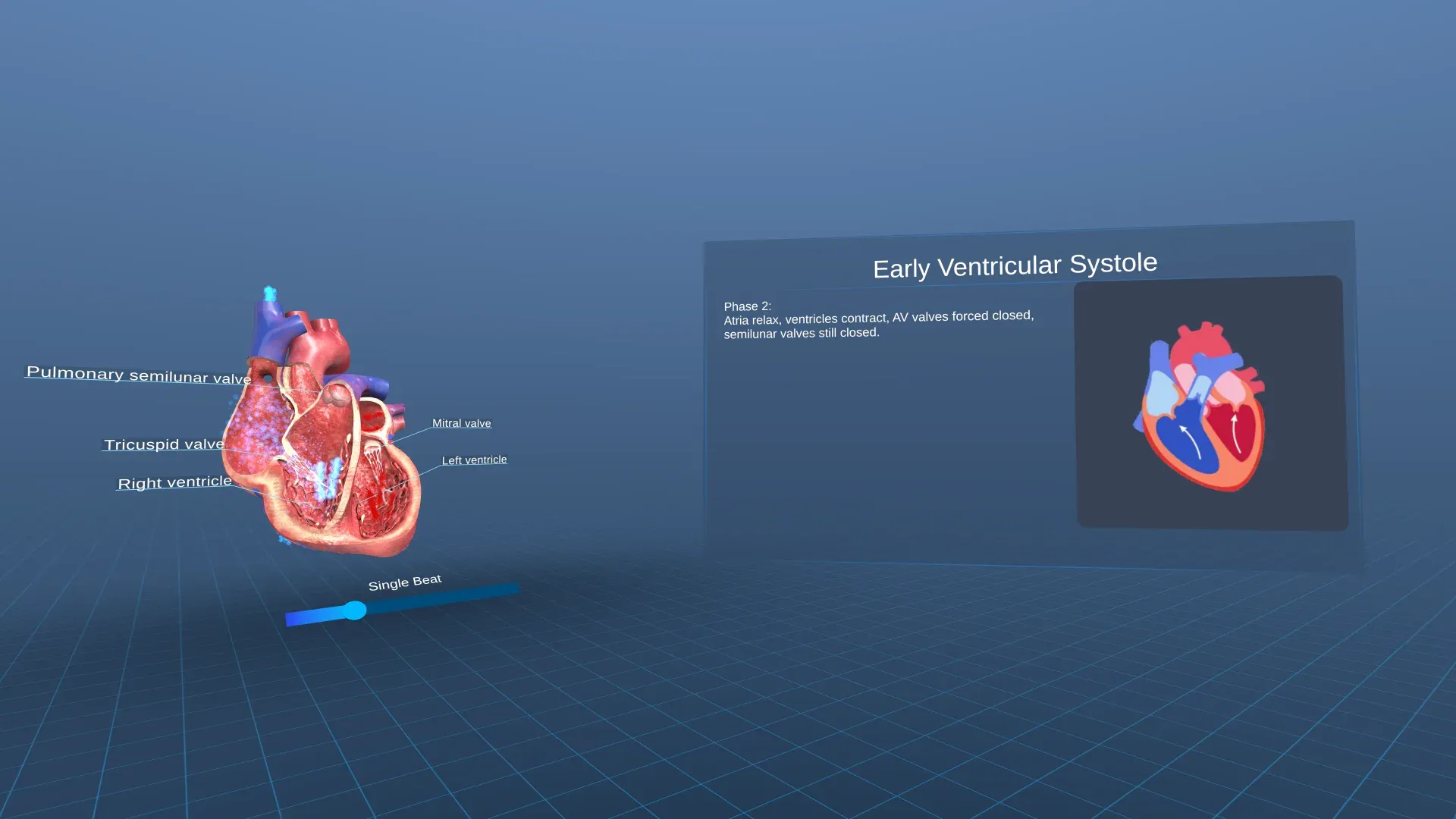
The cardiac cycle is dynamic, and static diagrams struggle to convey it. This module animates a full beat so students can link valve action, pressure, and volume as they happen.

Students step through systole and diastole, see each valve open and close, and relate the events to the pressure-volume story of the heart.
Why animate the cardiac cycle?
- The cycle is defined by timing, and timing is precisely what a static pressure-volume diagram cannot convey.
- Valve action, pressure and volume all change together, so they need to be shown together.
- Stepping one phase at a time lets students pause exactly where their understanding breaks down.
- The heart sounds become obvious once you can see which valves are closing and when.
What the beat shows
- Atrial and ventricular systole and diastole
- Valve opening and closing through the cycle
- Pressure changes in the chambers
- Volume changes and chamber filling
- The heart sounds and their causes
Concepts it makes tangible
- The phases of one full cardiac cycle
- How valve action links to pressure and volume
- The pressure-volume story of a beat
- The timing of systole and diastole
- What produces the first and second heart sounds
How the simulation runs
- Step through the cycle one phase at a time
- A single-beat control links each phase to valve, pressure, and volume
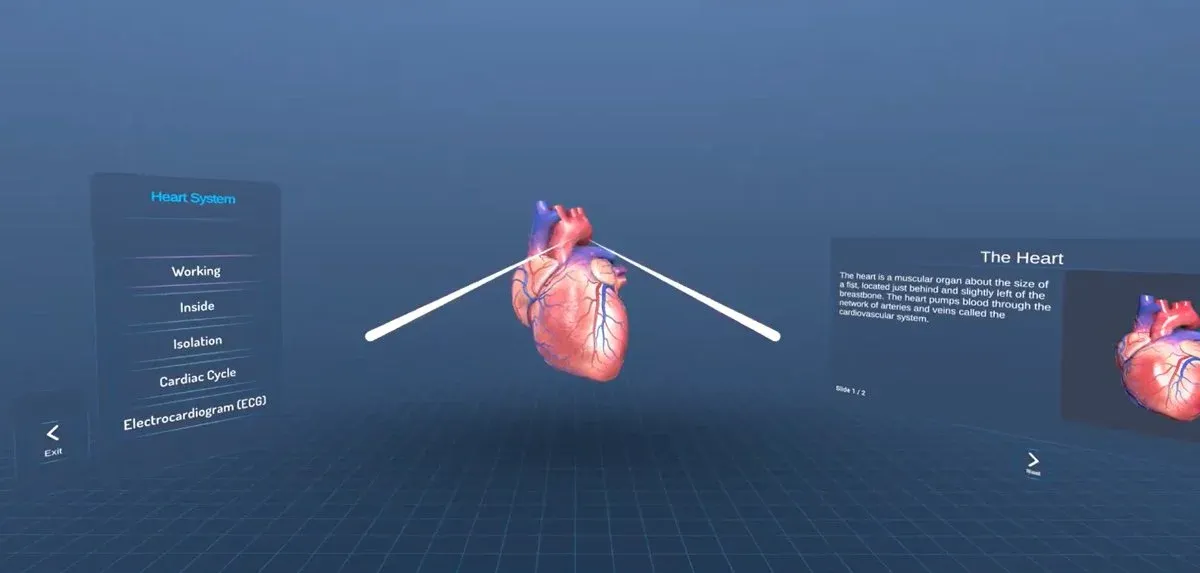
- Move between working, inside, and cardiac-cycle views
How faculty use it
- Pre-lab or lecture support for cardiac physiology
- Self-paced revision of a dynamic process
- Demonstration for large groups
- Assessment of phases and valve timing
The 7thi AI tutor sits alongside the whole experience, scaffolding the difficult parts and giving subject-aware answers in context. Built-in assessment lets faculty see, per student, who has grasped which concepts - without grading another paper.
How the module works
Students step through a single heartbeat one phase at a time. The module animates a full beat and lets the student pause at each phase - atrial and ventricular systole and diastole - linking the valve positions, chamber pressures and volumes at that instant. Because the cycle is defined by timing, being able to stop exactly where understanding breaks down is the whole point. The heart sounds are tied to the specific valve closures that produce them, so an auscultation finding becomes a mechanical event the student can see rather than an association to be memorised.
What students take away
A student can describe the phases of the cardiac cycle in order, explain how valve action, pressure and volume change together through a beat, and account for the origin of the first and second heart sounds. They connect the pressure-volume relationships they meet on paper to a beating heart they can watch, which is the difference between memorising the cycle and understanding it.
In the classroom
Physiology courses use the module to teach a topic students consistently find difficult, either before the lecture as a primer or after it as consolidation. Being able to pause a single beat at any phase lets a lecturer or a student stop exactly where understanding breaks down. It pairs directly with the Human Heart Anatomy module, so learners meet the structures first and then see them in motion.
Interactive features and modes
The module animates a full heartbeat and lets students step through it one phase at a time, linking the valve positions, chamber pressures and volumes at each instant. The heart sounds are tied to the specific valve closures that produce them. A single-beat control gives students precise command over the pace, so they can stop exactly where their understanding needs to catch up.
Why it matters
The cardiac cycle is one of the hardest topics in early physiology because it is defined entirely by timing, and timing is precisely what a static pressure-volume diagram cannot convey. Valve action, chamber pressure and chamber volume all change together, so they need to be shown together and slowly. Animating a single beat that students can step through phase by phase turns an abstract set of curves into an intelligible sequence of events.
The bigger picture
The cardiac cycle ties together pressure, volume, valve action and the heart sounds into a single timed sequence, and it is the timing that makes it hard - a static pressure-volume loop shows the relationships but not the order in which they unfold. Linking each phase to the valve positions, pressures and volumes at that instant, and tying the heart sounds to the specific valve closures that cause them, turns a set of curves and facts into a coherent story. That understanding is what lets a student later interpret a murmur or a pressure trace rather than merely recall a definition.
Devices, deployment and assessment
Deploying the module is straightforward. It runs on Meta Quest, ClassVR and Pico headsets, on WebXR-compatible browsers, and on the desktop without any headset at all, so a department can start with the hardware it already has and scale as it grows. Faculty can assign the whole module or specific scenes, set it as pre-lab preparation or post-lab revision, and track progress on a dashboard that records concepts mastered, time per scene and assessment scores, with export to the LMS via xAPI. It pairs with the Human Heart Anatomy module, which covers the structures this module then sets in motion. The 7thi AI tutor answers student questions in context throughout, so learners are never left stuck and faculty are not fielding the same question forty times.
Who this module is for
- Medical, nursing and allied health undergraduates studying cardiac physiology
- Biology and physiology students covering the circulatory system
- Paramedic and health science programmes
- Faculty demonstrating a dynamic process to large groups
Syllabus alignment
Where this module fits.
University syllabi
We map this module to your institution's own human heart syllabus before deployment. Request a custom mapping.
Competency-based curriculum (Global)
Aligned with competency-based medical and nursing education outcomes. Detailed mapping available on request.
NMC (India)
Supports National Medical Commission competency outcomes. Detailed mapping available on request.
See Cardiac Cycle live in a demo.
Thirty minutes, the full module, your curriculum questions answered.
What does the module show in one beat?
Atrial and ventricular systole and diastole, each valve opening and closing through the cycle, pressure changes in the chambers, volume changes and chamber filling, and the origin of the heart sounds.
Can students control the pace?
Yes. A single-beat control steps through the cycle one phase at a time, linking each phase to the valve positions, pressures and volumes at that instant rather than running continuously.
What produces the first and second heart sounds?
The module ties each sound to the valve closures that cause it, so students connect an auscultation finding to a mechanical event rather than memorising the association.
How does this relate to the Human Heart Anatomy module?
That module covers structure; this one covers the beat. Students usually meet anatomy first, then use this module to see the same structures in motion.
Which headsets does this module run on?
Meta Quest, ClassVR, WebXR, plus any WebXR-compatible browser. It also runs on desktop without a headset, which covers faculty preview and remote cohorts. OpenXR and 6DOF headsets are supported.
Is the assessment graded automatically?
Yes. Scores reach the faculty dashboard immediately, pass thresholds are adjustable, and results export to your LMS via xAPI.
Is this mapped to our curriculum?
It is mapped to ABET, NBA and equivalent frameworks, and we map it to your own human heart syllabus before deployment. Request a custom mapping.
Can this be used in a flipped classroom?
Yes. Students complete Cardiac Cycle before the lecture, so class time goes on analysis and discussion rather than first exposure to the topic.
What does the module show in one beat?
Atrial and ventricular systole and diastole, each valve opening and closing through the cycle, pressure changes in the chambers, volume changes and chamber filling, and the origin of the heart sounds.
Can students control the pace?
Yes. A single-beat control steps through the cycle one phase at a time, linking each phase to the valve positions, pressures and volumes at that instant rather than running continuously.
What produces the first and second heart sounds?
The module ties each sound to the valve closures that cause it, so students connect an auscultation finding to a mechanical event rather than memorising the association.
How does this relate to the Human Heart Anatomy module?
That module covers structure; this one covers the beat. Students usually meet anatomy first, then use this module to see the same structures in motion.
Which headsets does this module run on?
Meta Quest, ClassVR, WebXR, plus any WebXR-compatible browser. It also runs on desktop without a headset, which covers faculty preview and remote cohorts. OpenXR and 6DOF headsets are supported.
Is the assessment graded automatically?
Yes. Scores reach the faculty dashboard immediately, pass thresholds are adjustable, and results export to your LMS via xAPI.
Is this mapped to our curriculum?
It is mapped to ABET, NBA and equivalent frameworks, and we map it to your own human heart syllabus before deployment. Request a custom mapping.
Can this be used in a flipped classroom?
Yes. Students complete Cardiac Cycle before the lecture, so class time goes on analysis and discussion rather than first exposure to the topic.