

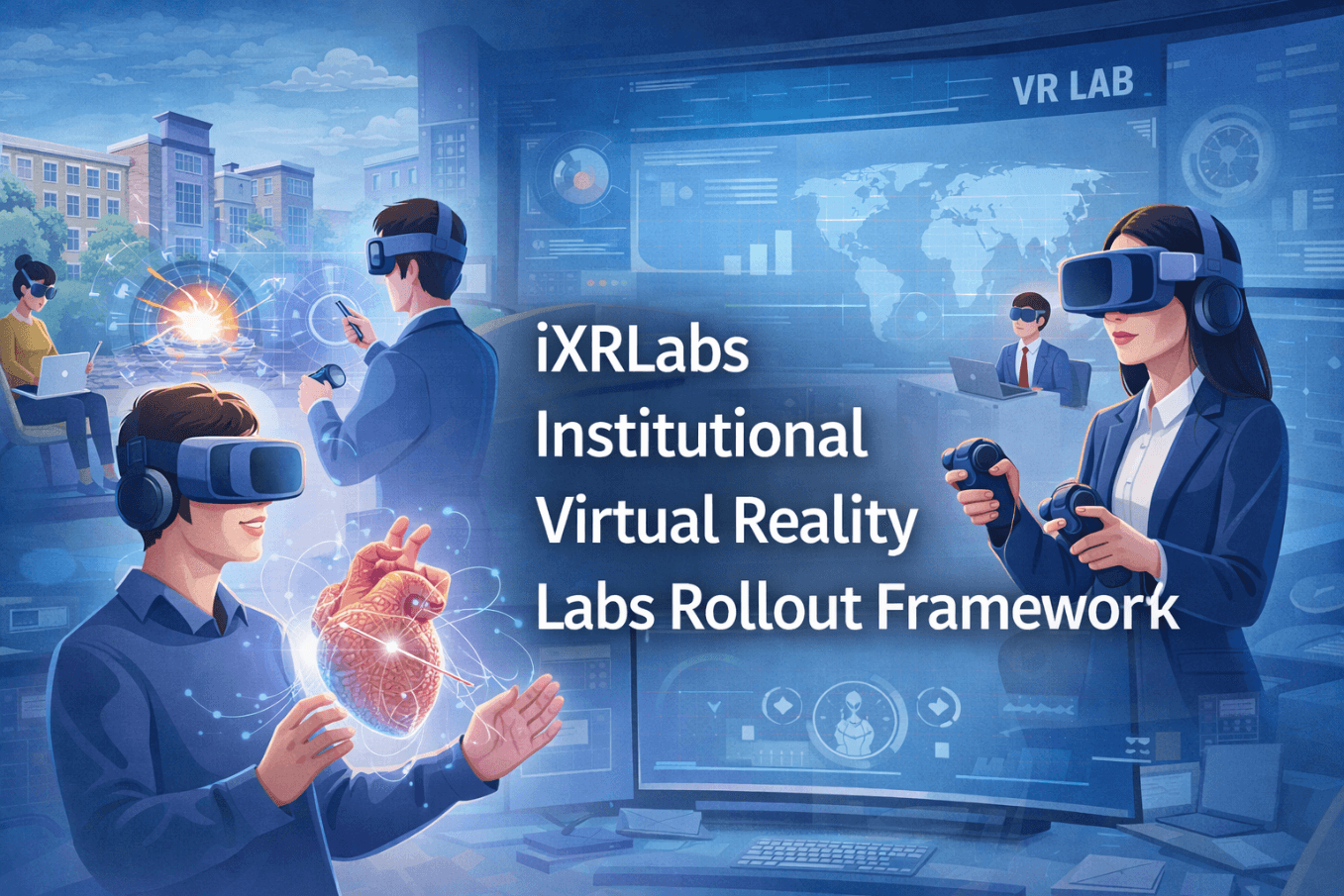
The iXRLabs Institutional Virtual Reality Labs Rollout Framework is a structured, seven-stage virtual reality lab implementation process designed to help colleges deploy immersive learning infrastructure with minimal disruption, measurable outcomes, and accreditation-ready documentation.
It has been refined over 5+ years across 50+ higher education institutions and over 100,000 learners trained through VR-enabled modules in engineering, medical, and applied sciences programs.
This framework emphasizes:
- Clear academic ownership
- Curriculum-linked integration
- Measurable adoption
- Lightweight reporting
- Gradual, evidence-backed expansion
It avoids ad-hoc adoption and instead provides a practical VR lab deployment model aligned with accreditation frameworks such as NAAC, NIRF, and international simulation standards.
Why Structured VR Lab Implementation Matters
The conversation around immersive learning in higher education has matured. Systematic reviews between 2020–2025 show consistent evidence that immersive VR improves engagement, conceptual understanding, and spatial learning when integrated with pedagogy, not when used as a novelty tool.
However, the same research also highlights a recurring problem: institutions struggle not with technology, but with integration.
In our deployments across engineering and medical colleges, we observed that successful institutions treated VR as:
- A pedagogical instrument

- A structured lab extension

- An experiential learning asset

- A measurable teaching-learning intervention
Not as a showroom device.
The iXRLabs Institutional Virtual Reality Labs Rollout Framework was developed precisely to bridge that gap.
The iXRLabs Institutional Virtual Reality Labs Rollout Framework
A Practical 7-Stage VR Lab Deployment Model
Stage 1: Leadership Buy-In and Clear Objective Setting
Every successful VR lab deployment starts with clarity at the top. Without a clearly defined owner and purpose, even the best technology ends up underutilised. This stage establishes accountability and ensures that the implementation begins with measurable intent, not just excitement around new tools.
Principle: One accountable academic champion. Clear, measurable goals.
Avoid setting up large committees. Instead:
- #### Identify one academic lead (HOD / Dean / senior faculty).

- #### Define the primary objective:
Improve engagement?
    - Increase practical exposure?

    - Strengthen accreditation evidence?

    - Reduce lab bottlenecks?
Set 3 measurable goals:
    - Target sessions per month

    - Number of departments covered

    - Student satisfaction threshold (e.g. >80%)
Engineering Example
A Mechanical Engineering department defined:
- 12 VR thermodynamics sessions per semester

- Only for 2nd-year students

- 85% student satisfaction target
Medical Example
An Anatomy department defined:
- Replace 3 cadaver revision sessions with VR-assisted review

- Map the sessions to a structured debrief format aligned to simulation standards such as the INACSL Healthcare Simulation Standards of Best Practice
Evidence Generated
- 1-page implementation note

- Baseline metrics

- Semester-level targets
Success Indicators
- Champion formally designated

- Objectives documented

- Baseline data recorded
This stage ensures that the VR lab rollout begins with clear purpose, not just enthusiasm.
Stage 2: Curriculum Mapping and Use-Case Identification
Before any hardware is installed or sessions are planned, the academic fit must be clearly defined. This stage focuses on embedding VR into the curriculum by identifying where it adds real value. It ensures that the lab is tied directly to courses, outcomes, and accreditation needs rather than remaining a standalone demonstration setup.
Principle: Map before you move hardware.
Before installation:
- Map 5–15 VR modules to specific courses

- Identify semester timing

- Define VR’s role:
Demonstration tool
    - Practice lab

    - Assessment support


Align to NAAC, NIRF, NEP 2020 experiential learning objectives
NEP 2020 emphasizes experiential and technology-enabled learning environments. NAAC manuals explicitly reference ICT-enabled teaching practices. NIRF 2024 Engineering methodology includes “Teaching Learning & Resources” indicators.
Engineering Example
Electrical Engineering mapped:
- Switchgear safety simulation → Power Systems II

- Circuit troubleshooting → Lab component
Medical Example
Nursing faculty mapped:
- IV insertion VR module → Skill lab pre-practice session

- Neonatal emergency simulation → Clinical preparation module
Evidence Generated
- Curriculum mapping sheet (Course → Module → Learning outcome → Assessment method)

- Accreditation evidence folder entry
Success Indicators
- Minimum 5 mapped modules

- Session plan prepared

- Accreditation cross-reference documented
This prevents the lab from becoming a demonstration-only facility.
Stage 3: Infrastructure Setup Based on Usage Model
At this stage, the focus shifts from planning to physical deployment. The key is to design the infrastructure around how the lab will actually be used, not around ideal specifications or over-engineered setups. Practicality, scalability, and ease of operation should drive every decision.
Principle: Design for usage, not specifications.
Key decisions:
- Fixed lab vs mobile kit

- Headset count based on batch size

- Rotation model (e.g. 10 headsets, 40 students → 4 rotations)

- Wi-Fi readiness

- Hygiene SOP and storage workflow
Avoid over-design. Deployment must remain feasible.
Engineering Example
A Civil Engineering department chose a mobile kit (8 headsets) rotated across labs.
Medical Example
An Anatomy department created a 12-headset fixed VR lab aligned with skill lab schedule.
Evidence Generated
- Asset register

- Installation checklist

- SOP for hygiene and safety

- Room documentation
Success Indicators
- Installation completed within 2 weeks

- Session-ready certification

- Network test verified
This stage answers the common search query: how to set up a VR lab in college — practically and proportionately.
Stage 4: Faculty Orientation and First-Use Activation
Research consistently shows faculty readiness determines immersive adoption. This stage is not ceremonial. It is important that faculty are continuously involved, because educators often take an arm’s-length approach to learning about the technology.
We often see that when trainings are conducted, educators have preconceived notions about the technology and assume they will be able to adopt it when the time comes.
Instead, implementation should enforce:
- 2–3 hour operational training

- Ready-made lesson plans

- First session co-delivered

- Troubleshooting checklist
Faculty Training Framework
Aligned loosely with Kirkpatrick Model levels:
- Level 1: Faculty reaction (comfort, clarity)

- Level 2: Operational learning demonstrated
Success Indicators
- At least 70% trained faculty conduct one session independently

- Faculty feedback >4/5
This stage directly supports faculty training for immersive learning.
Stage 5: Structured Classroom Integration
This is the stage where intent translates into actual learning outcomes, and also where most VR deployments tend to break down. The challenge is not access to technology, but how seamlessly it fits into the teaching flow. VR must be integrated into the classroom structure in a way that supports learning, rather than feeling like an add-on activity.
Define:
- When VR is used within the lecture flow

- Pre-session briefing to set context and expectations

- Simulation experience as the core learning activity

- Post-session debrief to reinforce concepts

- Reflection or quiz to assess understanding
Simulation best practice literature emphasizes the brief–simulate–debrief cycle.
Engineering Example
Fluid mechanics class:
- 15-min theory

- 20-min VR simulation

- 15-min debrief
Medical Example
Cardiac emergency simulation:
- Case introduction

- VR scenario

- Guided debrief
Evidence Generated
- Session logs

- Quiz scores

- Debrief notes
Success Indicators
- Minimum 3 sessions/month

- Improvement in formative quiz scores

- 75% student engagement rating
Immersion must integrate, not interrupt.
Stage 6: Monitoring and Usage Review
Once the VR lab is actively being used, the focus shifts to understanding how it is actually performing in a real academic environment. This stage is not about heavy reporting or complex dashboards, but about building a simple, consistent view of usage, adoption, and feedback. The goal is to ensure that the lab continues to deliver value without creating unnecessary administrative overhead.
Keep analytics lightweight.
Track:
- Sessions conducted

- Students covered

- Departments using

- Feedback rating

- Faculty adoption rate
This can be aligned with responsible analytics principles such as data transparency, minimalism, and purpose limitation.
Monthly review: 20 minutes.
Evidence Generated
- 2-page monthly dashboard

- Data use note

- Issue resolution log
Success Indicators
- Monthly reporting consistency

- Progressive increase in session frequency

- Cross-department adoption
This supports measurable immersive learning in higher education outcomes.
Stage 7: Continuous Support and Gradual Expansion
By this stage, the VR lab has moved beyond initial setup and early adoption. The focus now shifts to sustaining momentum, deepening usage, and expanding impact across the institution in a structured and measurable way. Rather than treating the lab as a static installation, it is positioned as a continuously evolving academic resource.
After 3–6 months:
- Add departments to broaden adoption beyond early users

- Expand modules to cover additional subjects and use-cases

- Introduce a showcase day to demonstrate outcomes and build visibility

- Publish a case study capturing implementation and impact

- Review device health to ensure long-term usability and maintenance
Engineering Example
Expanded from Mechanical to Mechatronics after one semester, allowing adjacent disciplines to benefit from the same infrastructure and learning approach.
Medical Example
Anatomy lab expanded to include Pathology simulation, extending the use of VR into more advanced and applied areas of study.
Evidence Generated
- Quarterly impact note documenting progress and outcomes

- Case study detailing implementation and academic value

- Maintenance log tracking device performance and upkeep
Success Indicators
- 25% increase in overall usage over the baseline

- Student testimonial repository capturing qualitative feedback

- Integration into accreditation documentation as supporting evidence
This stage ensures that the VR lab does not plateau after initial deployment, but continues to grow in relevance, usage, and institutional value over time.
Deployment Timeline (Realistic Model)
    Month
    Activity


    0
    Objective setting + curriculum mapping


    1
    Setup + faculty orientation


    2
    Structured classroom integration


    3
    Usage review + optimization


    6
    Expansion decision
Making the Rollout Accreditation-Ready
The key insight: reporting must be a by-product of deployment.
Create one standardized Immersive Lab Evidence Folder with 8 subfolders:
1. Approvals & objectives

2. Curriculum mapping

3. Assets & setup

4. Training

5. Session logs

6. Assessments

7. Feedback

8. Monthly/Quarterly reports
Link outcomes to:
- NAAC experiential learning indicators

- NIRF Teaching Learning & Resources

- NEP 2020 technology-enabled pedagogy

- Simulation best practices (INACSL)

- Evaluation model (Kirkpatrick levels)
This creates a documented trail suitable for audits, inspections, and ranking submissions.
Common Implementation Mistakes
1. Buying hardware before mapping curriculum

2. Training faculty once and expecting independent use

3. No session logs maintained

4. Overcomplicated analytics dashboards

5. Expanding too quickly without first proving usage
Across 50+ deployments, the most successful institutions moved deliberately, not rapidly.
Frequently Asked Questions (FAQs)
1. How many headsets are required to start?
Typically 8–12 headsets are sufficient for rotation-based usage in batches of 40–60 students.
2. Does VR replace traditional labs?
No. It supplements and enhances experiential learning, particularly for visualization and risk-free simulation.
3. How long does the virtual reality lab implementation process take?
A structured rollout can be completed within 8–12 weeks.
4. Is faculty resistance common?
Initial hesitation is common, but structured first-use support significantly reduces resistance.
5. How can impact be measured?
Use session frequency, student coverage, feedback scores, formative assessment deltas, and faculty adoption rates.
Practical Summary: Structured Rollout Over Ad-Hoc Adoption
The difference between a VR lab that becomes central to academic practice and one that becomes dormant lies not in hardware, but in structure.
The iXRLabs Institutional Virtual Reality Labs Rollout Framework demonstrates that successful VR lab deployment models share five traits:
- Clear ownership

- Curriculum integration

- Measurable objectives

- Light but consistent monitoring

- Gradual expansion
Institutions asking how to set up a VR lab in college should not begin with devices. They should begin with deployment structure.
Immersive learning in higher education is no longer experimental. It is viable, measurable, and accreditation-aligned, provided it is implemented deliberately.
A structured rollout transforms VR from a technology purchase into an institutional teaching asset.
And that distinction determines whether a lab becomes a showcase, or a sustained academic resource.
References
- INACSL. Healthcare Simulation Standards of Best Practice. Emphasizes structured simulation design including prebriefing, facilitation, debriefing, and outcomes evaluation to ensure quality and consistency in experiential learning.https://www.inacsl.org/healthcare-simulation-standards-of-best-practice/
- Jisc. Code of Practice for Learning Analytics. Provides guidance on transparent, ethical, and student-centered use of learning analytics data within higher education institutions.https://www.jisc.ac.uk/guides/code-of-practice-for-learning-analytics
- Kirkpatrick Partners. The Kirkpatrick Model. Defines four levels of training evaluation—Reaction, Learning, Behavior, and Results—offering a structured approach to measuring educational impact.https://www.kirkpatrickpartners.com/the-kirkpatrick-model/
- Smidt A, et al. (2009). The Kirkpatrick model: A useful tool for evaluating training outcomes. Medical Education (PMC3070232). Demonstrates the application of the Kirkpatrick framework in healthcare education for evaluating training effectiveness across multiple impactlevels. https://pmc.ncbi.nlm.nih.gov/articles/PMC3070232/
- Ministry of Education, Government of India. (2020). National Education Policy 2020. Advocates experiential, multidisciplinary, and technology-enabled learning to enhance critical thinking and practical exposure in higher education.https://www.education.gov.in/sites/upload_files/mhrd/files/NEP_Final_English_0.pdf
- National Institutional Ranking Framework (NIRF). (2024). Engineering Ranking Framework. Outlines evaluation metrics under Teaching, Learning & Resources (TLR), Graduation Outcomes, Research & Professional Practice, and Perception for institutional ranking.https://www.nirfindia.org/nirfpdfcdn/2024/framework/Engineering.pdf
- National Institutional Ranking Framework (NIRF). Parameters for Ranking. Details the weighted parameters used to assess higher education institutions, including TLR, Research, Graduation Outcomes, Outreach, and Perception. https://www.nirfindia.org/Home/parameter
- National Assessment and Accreditation Council (NAAC). (2021). Manual forAffiliated/Constituent Colleges. Provides accreditation criteria emphasizing ICT-enabled teaching, experiential learning, student engagement, and institutional quality assurance processes. https://naac.gov.in/images/docs/Manuals/manuals_new/Manual-Affiliated-Constituent-Colleges-1.3.2021.pdf
- MDPI (2025). Systematic Review of Virtual Reality Applications in Higher Education. Finds that immersive VR enhances engagement, spatial understanding, and experiential learning outcomes when pedagogically integrated into curricula. https://www.mdpi.com/2075-4698/15/9/251
- Springer (2025). State of the Art Review on Immersive Virtual Reality in Higher Education. Highlights the effectiveness of immersive VR for skill acquisition and conceptual mastery, while emphasizing structured integration and faculty readiness as critical success factors.https://link.springer.com/article/10.1007/s10055-025-01136-x