

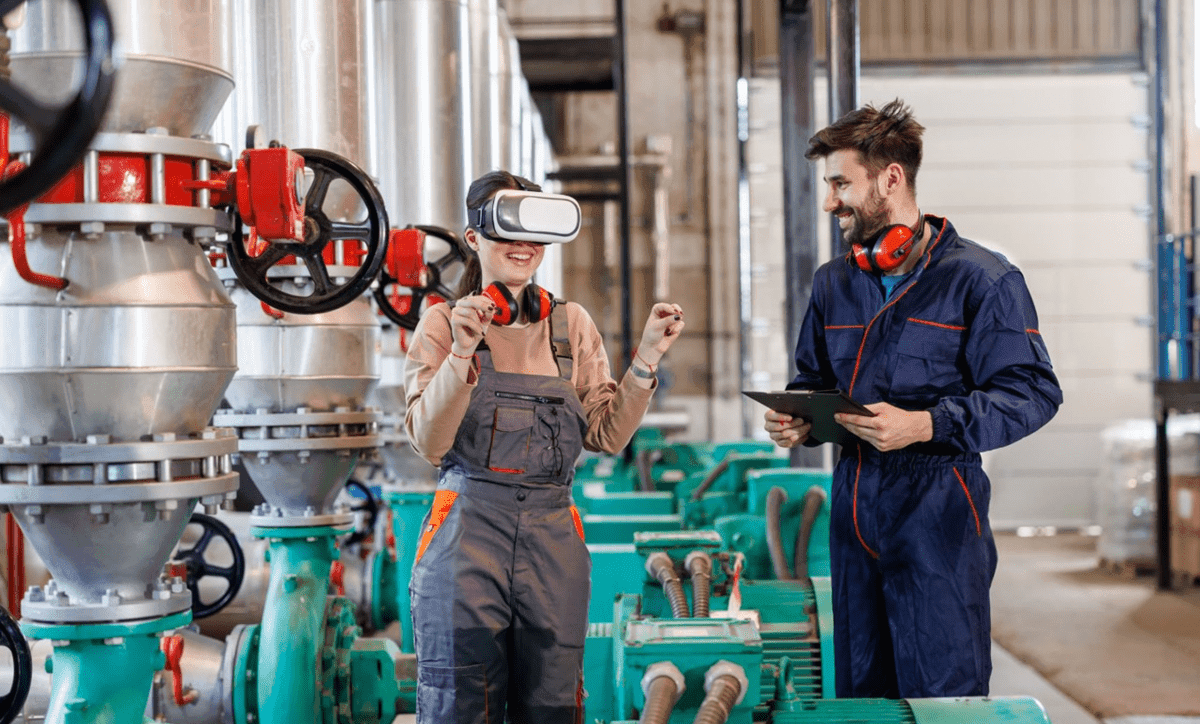
Heat exchangers are essential components in various industries, from HVAC systems to power plants, ensuring efficient energy transfer. Understanding their working principles can be challenging for engineering students, especially when it comes to visualizing complex processes.
Enter Virtual Reality (VR) – a game-changing technology that enables students and engineers to interact with 3D models of heat exchangers, providing immersive learning experiences that transcend traditional methods.
In this article, we’ll explore how VR can enhance the understanding of the heat exchanger working principle, delve into different types of heat exchangers like plate, shell-and-tube, and plate-type, and explain how VR simulations can revolutionize thermal engineering education.
The Heat Exchanger Principle and Working: An Overview
Before diving into the potential of VR, let's revisit the basic concept of heat exchangers. In essence, a heat exchanger is a device designed to transfer heat between two or more fluids, whether they are separated by a solid wall or are in direct contact. The purpose is to regulate temperature and optimize energy efficiency in systems such as HVAC, industrial processes, and power generation.
There are various types of heat exchangers, including plate heat exchangers, shell and tube heat exchangers, and plate-type heat exchangers, each serving specific functions depending on the nature of the fluids involved and the thermal exchange required.
● Heat Exchanger Principle: The basic principle relies on the second law of thermodynamics—heat naturally flows from a higher temperature to a lower temperature. Heat exchangers facilitate this process by maximizing the surface area for heat transfer and minimizing the resistance to fluid flow.
● Working Mechanism: Fluids flow through different channels or tubes in a heat exchanger. The fluids can be either in direct contact (as in air coolers or air conditioners) or separated by a wall (as in shell-and-tube exchangers). The heat from the hot fluid is transferred to the cold fluid, thus cooling the former and heating the latter.
The Role of Virtual Reality in Heat Exchanger Education
Understanding the heat exchanger principle can be challenging, especially when dealing with abstract concepts such as heat transfer, fluid dynamics, and the interaction between different materials. VR provides a solution by creating 3D models and simulations that allow students to interact with the equipment in a highly visual and intuitive way. Here’s how VR transforms heat exchanger learning:
✔️Immersive Learning Environment
With VR, students can experience a heat exchanger working principle simulation in a fully immersive environment. They can explore the structure and function of a heat exchanger, observing how heat flows and is transferred between fluids in real-time. This makes abstract concepts more tangible and easier to grasp.
✔️Interactive 3D Heat Exchanger Models
Traditional textbooks and static diagrams can only do so much. In a VR environment, students can manipulate the 3D model of a heat exchanger to see the flow of fluids through the system. This hands-on interaction helps them visualize how changes in one part of the system can affect the overall performance of the exchanger.
✔️Simulating Complex Scenarios
VR allows for the simulation of complex real-world scenarios that would be difficult or impossible to replicate in a classroom setting. Students can observe how different heat exchanger types (e.g., plate heat exchanger working principle, shell and tube heat exchanger working principle) operate under various conditions, such as high pressures, different flow rates, and temperature gradients.
✔️Real-Time Feedback and Adjustments
One of the key benefits of VR is the ability to receive immediate feedback. If students alter the flow rate or temperature, the simulation adjusts accordingly, providing instant insights into the effects of those changes. This allows students to experiment with different conditions and see firsthand how those adjustments impact the heat transfer efficiency.
✔️Hands-on Training for VR Thermal Engineering Labs
Virtual Reality can simulate thermal engineering labs, enabling students to conduct experiments without the need for expensive equipment or lab space. By exploring VR thermal engineering labs, students can simulate the operations of different heat exchangers, test various parameters, and better understand thermal dynamics in a controlled, virtual setting.
*## Explaining the Heat Exchanger Working Principle with VR
Understanding the working principle of heat exchangers is simplified in VR environments. For instance, immersive VR for thermodynamics provides a 360-degree view of how heat flows between fluids, making it easier to comprehend how thermal gradients affect the system. Here’s how VR can help explain the heat exchange process:
✔️Fluid Flow and Heat Transfer
Students can visualize how the fluid enters and exits the heat exchanger, how it circulates, and how heat is transferred to the other fluid. By moving through the system in VR, students can observe the relationship between fluid velocity, temperature, and heat exchange efficiency.
✔️Understanding Thermal Resistance
One of the challenges of heat exchangers is overcoming thermal resistance, which can impact efficiency. Through virtual reality heat exchanger simulation, students can manipulate the materials of the heat exchanger walls to observe how different materials impact heat transfer. This hands-on experience deepens their understanding of material science and thermodynamics.
✔️Types of Heat Exchangers
VR allows for the exploration of different types of heat exchangers, such as the plate-type heat exchanger working principle and the shell and tube heat exchanger working principle. By virtually disassembling and reassembling the units, students can see the advantages and disadvantages of each type and how their designs affect heat transfer.
✔️Enhancing Heat Exchanger Efficiency
In the VR simulation, students can modify factors like flow direction and the number of plates in a plate heat exchanger. Observing the effects of these changes in real-time can help students understand the importance of design decisions and their impact on overall system efficiency.
Get A Free Quote*
Why VR for Heat Exchanger Learning is the Future of Engineering Education
1. Bridging the Gap Between Theory and Practice
Heat exchanger theory often feels abstract to students, but VR makes these concepts more tangible. By bridging the gap between theoretical knowledge and practical application, VR helps students understand how heat exchangers work and why they’re so crucial in industries such as energy generation, HVAC, and refrigeration.
2. Reducing the Need for Physical Equipment
Setting up physical heat exchanger models for educational purposes can be costly and logistically challenging. With VR, students can interact with a 3D heat exchanger model in VR without the need for expensive or space-consuming hardware, making learning more accessible.
3. Enhancing Engagement and Retention
Studies show that immersive learning experiences increase student engagement and knowledge retention. In engineering education, this means students are more likely to remember how heat exchangers work and be able to apply this knowledge in real-world scenarios.
4. Cost and Time Efficiency
By utilizing VR, educational institutions can save on equipment costs while providing students with a wide range of learning scenarios. Instructors can present multiple types of heat exchangers and working conditions without worrying about the availability of physical equipment.
Conclusion: Transforming Thermal Engineering Education with VR
Virtual Reality offers a powerful tool for enhancing the learning of complex thermal engineering concepts, especially the heat exchanger working principle. By enabling students to interact with realistic 3D models and simulate real-world scenarios, VR creates an immersive, engaging, and effective learning experience that is changing the way engineering is taught. From VR for learning thermodynamics to virtual reality for HVAC training, the applications are vast, and the potential to revolutionize education is clear.
As VR technology continues to evolve, its role in engineering education will only expand, offering students a deeper, more interactive understanding of core concepts. Whether you are teaching heat exchangers, power generation, or thermodynamics, VR will soon become an essential tool in every engineering curriculum.
Are you ready to experience the future of thermal engineering education? Explore iXRlabs, where you can simulate heat exchanger systems and more. Learn more about our engineering simulations and discover how immersive technology is shaping the future of engineering education.