

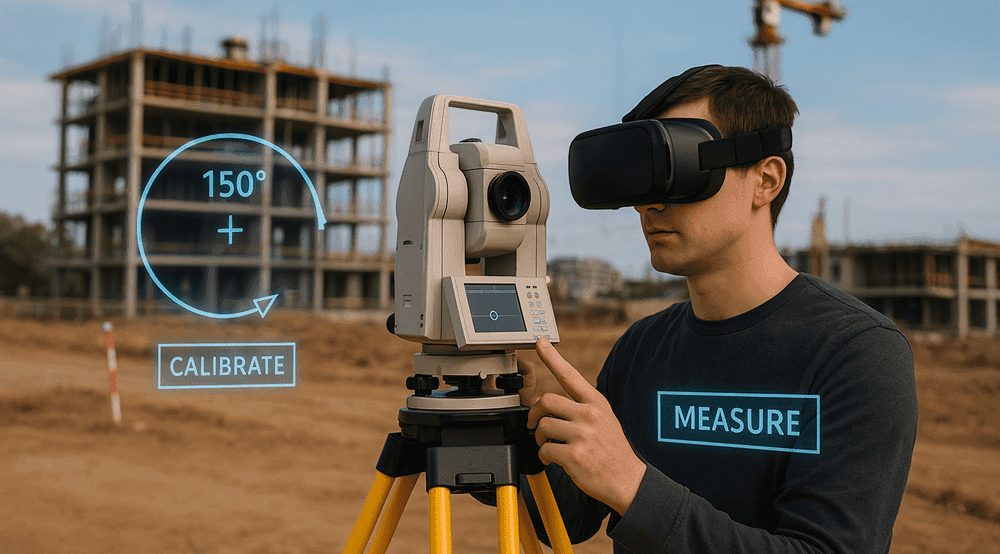
Surveying and construction professionals rely heavily on precision instruments like total stations. These devices combine electronic theodolites, distance meters, and microprocessors to measure angles and distances with high accuracy. However, learning to operate a total station takes time, practice, and a safe environment. Traditional field training often faces challenges such as equipment costs, weather conditions, and safety risks. This is where total station training in VR is proving to be a breakthrough for engineering institutes, training centers, and construction enterprises.
With VR total station operation, learners can gain hands-on experience in a realistic, immersive setting without handling expensive equipment prematurely. Let’s explore how virtual reality is transforming surveying education, the benefits of simulation, and why it is a powerful tool for the future of the construction industry.
Why Teaching Total Station in VR Matters
Total stations are central to modern surveying tasks such as mapping, land measurement, and construction layout. Mistakes during training can lead to costly delays, safety hazards, and damaged equipment. Virtual reality addresses these challenges by creating safe, repeatable, and engaging environments where learners can practice as many times as they need.
Unlike traditional classroom instruction or static demonstrations, virtual reality surveying training allows students to actively engage with instruments in 3D space. They can simulate real-world scenarios, learn measurement techniques, and understand equipment functions through experiential learning.
This approach blends technical knowledge with practical application, helping surveyors build confidence before entering the field.
Features of VR Total Station Training
An effective total station simulation in VR replicates the complete set of actions required to operate the instrument. Key features include:
1. Interactive 3D models of the total station with clickable parts and explanations.
2. Step-by-step training modules covering setup, calibration, and data collection.
3. Realistic construction environments for hands-on practice.
4. Feedback systems that guide learners when they make mistakes.
5. Scenario-based learning where students perform site surveying tasks.
By engaging with these features, trainees not only understand the theory but also master practical skills in a risk-free way.
Benefits of Total Station Training in VR
1. Safe and Risk-Free Learning
Beginners often feel anxious handling expensive surveying equipment. VR provides a safe environment for skill development without the risk of equipment damage or costly mistakes.
2. Cost-Effective Training
Surveying instruments are expensive, and field training requires resources and supervision. A VR construction site training setup can drastically cut down operational costs while offering scalable training opportunities.
3. Standardized Training
Institutions and enterprises can ensure that every trainee receives the same high-quality, simulation-based training for engineers, reducing inconsistencies in learning outcomes.
4. Higher Engagement and Retention
Studies have shown that immersive training leads to better knowledge retention compared to lectures or videos. Immersive surveying training solutions make learning enjoyable and memorable.
5. Anytime, Anywhere Training
Since VR training is not limited by physical location, learners can practice remotely or in classroom labs. This flexibility ensures continuity of learning even when field conditions are not favorable.
How VR Total Station Operation Works
The process of VR total station operation is designed to mirror real-world usage. Trainees wear a VR headset and enter a virtual construction site or surveying environment. Using hand controllers, they interact with a life-like total station model.
Typical learning modules include:
1. Instrument Setup – Positioning the tripod, leveling the instrument, and turning on the device.
2. Calibration – Aligning the total station with reference points to ensure accuracy.
3. Data Collection – Measuring distances, angles, and recording data.
4. Practical Tasks – Performing land boundary measurements, building layouts, or topographic mapping.
5. Error Handling – Identifying mistakes and learning corrective actions.
This structure ensures that students acquire not only operational skills but also the confidence to work independently in the field.
"Unlock the potential of tomorrow's engineers today with VR Labs, where hands-on experience meets digital innovation for unparalleled learning."
Book a Demo **
Use Cases of VR Total Station Training
1. Universities and Technical Institutes– Teaching surveying principles to civil engineering students.
2. Construction Companies – Training employees to perform layout and measurement tasks accurately.
3. Government Training Programs – Preparing technicians for large-scale infrastructure projects.
4. College Training Labs– Using VR labs for higher education for student learning.
By adopting land surveying training in VR, organizations can bridge the gap between classroom learning and field experience.
The Role of VR in Skill Development
Modern industries are moving toward digital transformation, and surveying is no exception. Total station skills development with VR supports workforce upskilling by enabling learners to master both basic and advanced operations.
For example, trainees can simulate:
1. Setting up instruments in rough terrain.
2. Handling real-time project scenarios like construction layout.
3. Collaborating in multi-user VR environments.
This helps professionals practice teamwork and communication while solving technical challenges.
Advantages for Employers and Training Institutes
Employers and educators gain several advantages when adopting VR for teaching total station operation:
1. Reduced downtime in field projects as employees are better prepared.
2. Fewer equipment damages since practice happens virtually first.
3. Increased productivity because trainees reach proficiency faster.
4. Enhanced safety compliance by integrating VR safety training solutions into learning engineering modules.
For technical institutions, it adds modern credibility and makes courses attractive to students who prefer technology-driven learning.
Total Station Training and the Future of Construction
The construction industry faces a talent shortage, especially in roles requiring technical precision. Integrating virtual reality training for construction industry with total station operation can accelerate workforce development.
Moreover, VR technology can integrate with Building Information Modeling (BIM) and other digital construction tools. This ensures that surveyors are not only proficient in field equipment but also understand how their work contributes to digital workflows.
Internal Integration with Broader VR Training Solutions
Total station training is just one part of a much larger ecosystem of immersive learning. Similar approaches are already transforming equipment training, safety education, and construction site preparedness. For example:
1. Immersive equipment operation training prepares workers for cranes, forklifts, and heavy machines.
2. Construction site safety training in VR reduces workplace risks by simulating hazards.
3. Simulation-based training for engineers helps technical learners practice complex tasks in safe environments.
By integrating these modules, organizations can create a comprehensive VR training for heavy machinery operators and surveying professionals under a unified platform.
Real-World Impact: A Case Example
A civil engineering college recently integrated total station simulation in VR into its curriculum. Students who had never handled surveying equipment before were able to practice virtually for weeks before stepping onto the field.
When they eventually worked with real instruments, their confidence levels were significantly higher, and the time required for training reduced by nearly 40%. Employers noticed fewer errors in their first field assignments, validating the effectiveness of immersive training.
Conclusion
Teaching total station operation in VR is not just a trend, but a practical solution for the challenges faced in surveying education. Total station training in VR ensures cost-effective, safe, and repeatable practice opportunities while improving engagement and retention.
By adopting VR total station operation, organizations prepare their workforce for the demands of modern construction and infrastructure projects. Institutions can enhance learning quality, employers can reduce training costs, and learners can gain confidence in handling advanced surveying tools.
The future of surveying education is immersive, accessible, and powered by VR technology.